
*****
God did not make the earthquake happen.
He does not hand out suffering.
He does not answer prayers.
He doesn’t choose individual people to be the recipients of good fortune.
He doesn’t single out or mark groups of people to become victims of prejudice, racism, sexism, genocide, slavery, oppression, murder, poverty, illness, misfortune, personal tragedy, accidents, natural disasters.
God does not test us.
He doesn’t give the strongest people the most difficult challenges.
God does not talk to us.
What is God? Is God real?
*****

*****
Intro to Philosophy. College. Up on the chalkboard:
Words exists. God is a word. God exists.
Teacher to class: “So. After reading this. What do you think? Have I proven the existence of God? Does God exist?”
Classroom entirely silent.
I raised my hand: “Yes. You have proven the existence of God. As a word.”
*****

*****
Nun, years ago, at local Catholic school, in a conversation with me about whether or not I should enroll my young son: “You must ask God. He will give you an answer.”
I didn’t bother to tell her God doesn’t talk to me.
I decided I didn’t want to send my son to a school that might teach him to believe that if you asked God for something, you would get your answer, or your wish, or your great accomplishment, or your magical miracle, or what you’ve always been waiting for.
Life is not wonderful in that kind of way.
*****
The afore-written godstuff is only what I think, for now.
*****
The God I believe in…would never…
The God I believe in…is kind and loving…
The God I believe in…is joyful when we are joyful and suffers when we suffer…
The God I believe in…
*****

*****
On this day in the history of my own life’s sufferings, my husband and I lost our second son. He was stillborn, full term.
The hospital gave me some things to keep. Pictures. A lock of his hair. The little knit cap they put on his head. The blanket he was wrapped in.
They also gave me a piece of paper, made to resemble something official. It was bordered with a stylized, document-type graphic and titled, “Certificate of Birth.” The rest of the paper read, “This is to acknowledge the life of — (Our second son’s name) — Born on 4/27/93 — Time 10:30 AM — Weight 7lbs. 3oz. — Length 21 inches.” At the bottom of the paper: “Unto us a child is born, a special child for a special reason. We don’t pretend to understand, only to accept.” Onto the paper were stamped, in black ink, our son’s footprints and handprints.
We didn’t understand what our son was and neither did our culture. The baby wasn’t really born—there was no birth certificate. And, officially, he didn’t really die, there was no death certificate. A holy person at the hospital blessed him. But the church wouldn’t hold a funeral.
*****
It wasn’t the first tragic thing that ever happened to me. But it was the experience that, as my husband says every year when we visit our son’s grave, “fucked us up.” It used to bother me when my husband would use that word at our baby’s grave.
“This is so fucked up. We were too young. This fucked us up.”
He was right. The suffering did fuck us up.
*****
The instant I understood that our son was dead, a terrifying doom strangled the life out of me. I knew my heart was so broken, it might not ever be healed. In the days, weeks, months, and years to follow, I would find myself balanced over crevasses descending into pits of desired surrender—the caves of Hell that promise to end all pain. When I fell in, sometimes I didn’t care if I ever climbed out.
I never looked at a homeless person the same way again. Many of them were me. Not everyone is able to survive the trials and tribulations of adversity.
I hated war more than ever. Each person killed in a war is someone else’s baby.
I feared the powers of natural disasters. Random, massive sufferings.
I snubbed my nose at people who believed they could entice the favors of the universe through carefully concocted thoughts, behaviors, and choices, or those that believed it was our fate to ride the waves of the universe no matter how they came crashing through our lives.
I had to teach myself to believe in a new kind of God, or accept that perhaps there was no God at all.
*****

*****
I started to read a lot of books. Poetry, fiction, non-fiction, spiritual, self-help.
We had a friend in those days, someone my husband worked with, who gave us a book that helped me. The friend was a small, peaceful gentleman. He dressed impeccably and kept himself cheerful. He was an intellect, had attended Deerfield Academy and Dartmouth, and he appreciated antiques, classical music, history, and the coastlines of New England. My husband was very fond of him and so was I.
He gave us the book, When Bad Things Happen to Good People, with a note that read, “This book helped me at a time of similar need. I hope it will help you.”
The book was a good turning point for me. Though written in simple language about something so complex it will never be understood, I found the writings by Harold S. Kushner to be useful.
I especially liked these ideas from the book: That the primary purpose of religion and belief in God is not so much to put people in touch with a God they can talk to, but to put them in touch with each other. That the purpose of prayer is not to make a request and desperately hope that God will grant what we want, but to become a part of a community of others willing to pray with us, so that we won’t feel isolated or abandoned—“prayer doesn’t help us find God, (because it is easy to find God everywhere); prayer helps us find each other.”
One passage from the book: “That wonderful storyteller Harry Golden makes this point in one of his stories. When he was young, he once asked his father, ‘If you don’t believe in God, why do you go to synagogue so regularly?’ His father answered, ‘Jews go to synagogue for all sorts of reasons. My friend Garfinkle, who is Orthodox, goes to talk to God. I go to talk to Garfinkle.'”
I am like Harry Golden’s father when it comes to showing up at a church.
Kushner’s book emphasizes that it is love, in this life, here and now—genuine, imperfect love—not God’s generosity in answered prayers, which heals human suffering.
He describes a contemporary play, J.B., written by Archibald MacLeish, which re-tells the story of Job—the world’s most classic biblical tale of suffering. At the end of the play, the search for fairness and reasoning and a just God in a world of random heartache is abandoned. The last lines of the play read:
The candles in churches are out,
The stars have gone out in the sky.
Blow on the coal of the heart
And we’ll see by and by…
The main character, whose life has been an unending stream of personal tragedy, stops looking to God to save him and chooses, instead, to look inward and work hard on cultivating the available powers and healing resources of love.
*****

*****
The good friend, and colleague of my husband, who gave us the book, When Bad Things Happen to Good People, did not escape more suffering in his life. In spite of the intentionally kind-hearted life he lived and the hard-work ethics he espoused, an unthinkable tragedy came to pass in the last years of his life. One of his sons, who had served in the Israeli Army, had been trained as a sniper. After his service, he went on to attend medical school. One day, he got into an argument with another man. A few days later, he killed the man.
I won’t ever forget the holiday season when our friend was enduring the anguish of his son’s criminal trial. He called to let us know that we would be unable to reach him for a couple of weeks. He knew his son was guilty and he also knew there was enough evidence to convict him. Our friend believed the law would hand over a just decision, and so, he could not bear to testify against his son whom he knew was already bound, most likely, to spend the rest of his life in jail. When called to the witness stand, our friend stood silent, in contempt of court. He was ordered to jail. His son went on to be punished with life in prison, no parole.
*****

*****
There are so many beautiful people suffering in Nepal because of the random occurrence of a devastating earthquake. They don’t deserve this kind of suffering and for many of them, their lives have already been filled with more than anyone’s fair share of suffering. As soon as the earthquake stopped shifting and shearing the Earth to shreds, rain poured from the sky over the exposed survivors.
Why?
Where is God?
I am praying, not for God to stop the suffering, but for all of humanity to blow on the coals of their hearts.
It is easiest for me to believe that God created the heart and it’s the muscle we have, here and now, with big power.
As imperfect as we are, as imperfect as the world is, the miracle is always that we choose to live in spite of wanting to die. We choose to do the hard work.
We do it because we sense there is love, somewhere, to give and to receive.
I want to believe love is that powerful.
*****

*****
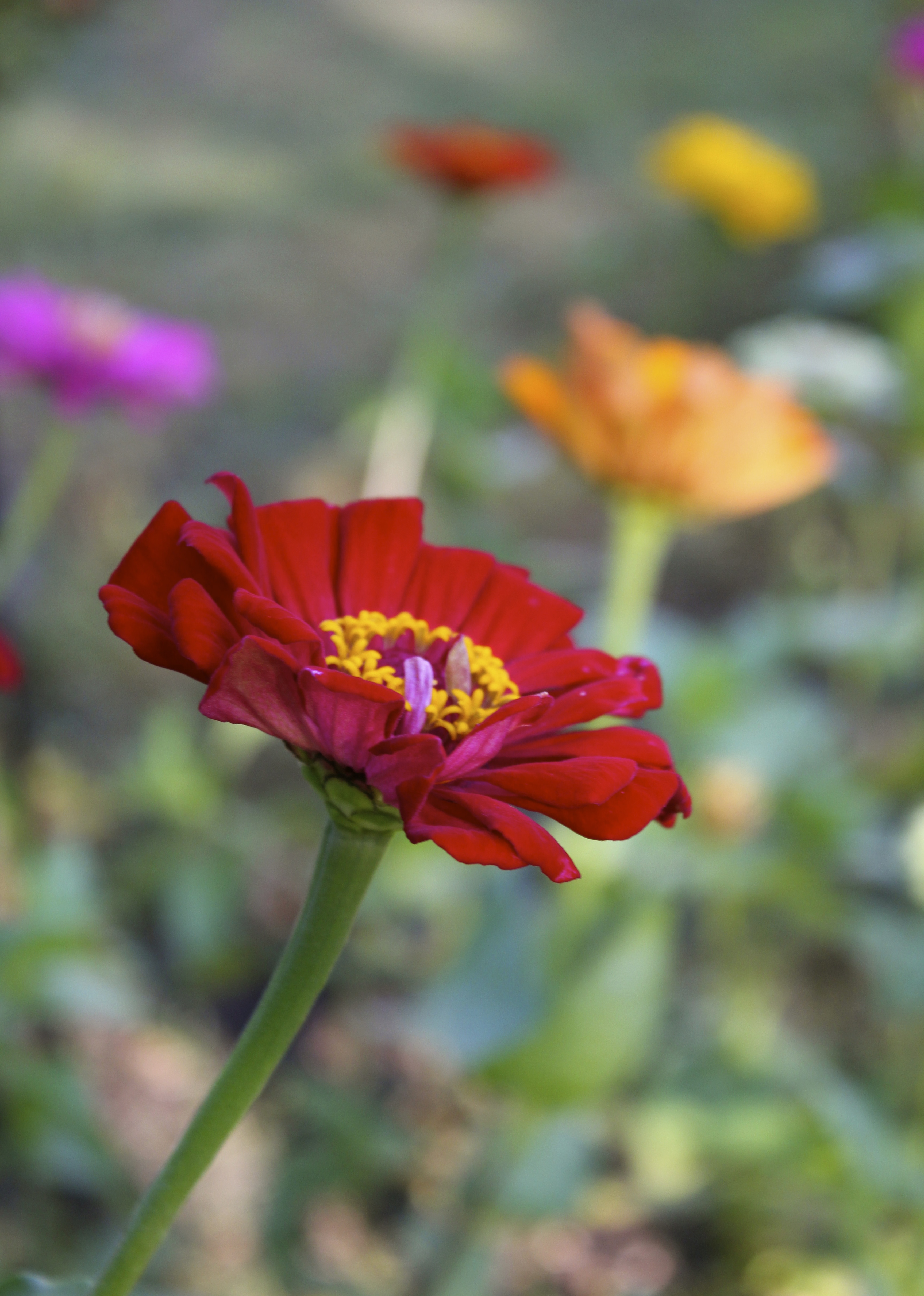
While I was pregnant with our second son, so long ago, I prepared several packages of zinnia seeds to send out as birth announcements. After he died, I planted all of the seeds in a huge bed of soil in front of an old chicken coop on the property where we lived at the time.
I have kept the tradition of planting zinnias every year.
And every year, I photograph them as though I think they are more beautiful than they’ve ever been.
*****
Where is God?
God is everywhere.
Why do earthquakes happen?
Because Earth is an imperfect part of an imperfect universe.
So if God created Earth, God is not perfect?
Maybe He isn’t. Maybe none of us are, nor will any of us ever be, perfect.
God didn’t make everything perfect.
*****
*****
The question becomes, as Harold Kushner leads us to consider:
Do we love God enough to forgive Him for not making everything perfect?
Or, maybe it is more comforting to choose to accept what we can’t understand about creation. Maybe there is no one God. We are on our own.
A sobering thought, but think of it. We have each other.
*****
“The ability to forgive and the ability to love are the weapons God has given us to enable us to live fully, bravely, and meaningfully in this less-than-perfect world.” Harold. S. Kushner
*****
 Excursions
Aum, peace, peace, peace… Thank you for sharing your gift of writing and the gifts that arisen from deep loss… There is a God, it is you and it is me and it is LOVE ❤
LikeLiked by 1 person
Thank you for reading! Your words are a peaceful prayer of kindness.
LikeLike
Thank you for giving me insight with words of compassion.
LikeLiked by 1 person
I pass on to you, through my words, the holy spirits of people who have helped me in my life.
LikeLike