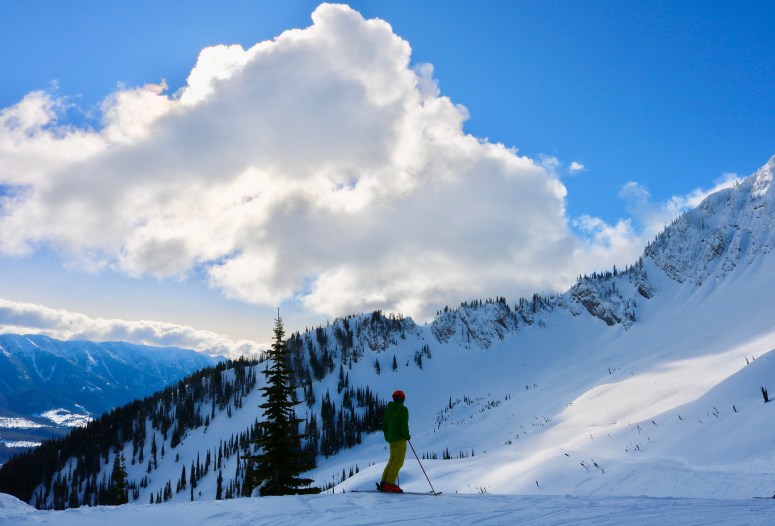
Views from the top of the Polar Peak Chairlift. Fernie Ski Resort.


Early morning. First tracks.
* * * * * * * * * * * *
Beams of pure, late afternoon sunshine are lighting up an expansive supply of fresh air about 7,000 feet above sea level in the Lizard Range of the Canadian Rockies in British Columbia. Heady hits of high altitude sun and oxygen clean out my lungs. My husband and I are gliding through this sparkling airspace aboard the White Pass Chairlift at Fernie Ski Resort. We introduce ourselves to a small man riding the lift with us. He says he’s from Ireland. It’s March 17th, 2018. Who wouldn’t feel a little bit lucky to meet an Irishman on St. Paddy’s Day while riding a chairlift?
Long, wide skis dangle from the ends of our chairlift buddy’s thin legs. He’s older than us, but not so old that we can’t relate when he starts recalling the halcyon days of hardcore skiing. Back then chairlifts were slow and able to ferry, at most, two skiers per swaying seat to blustery mountain summits where experienced adventurers and foolhardy bandits often preferred to venture beyond the limits of a typical chairlift’s range. We did it by removing and then hoisting onto strong, youthful shoulders our skis, before hiking (in ski boots, always straight uphill) through deep snow or across slick, glare ice (routinely through pea-soup fog) to hidden headwalls, steeps, chutes, and virgin stashes of powder snow.
“And if we could’a! We would’a!” our chairlift companion sniggers, “hiked through the deep snow with our legs tied together! Just for the bragging rights!”
We nod and laugh because those classic days of yore were wicked fun and shockingly idiotic. Especially for me, a woman who didn’t grow up near any ski hills and, as far as I know, doesn’t even have skier’s DNA, with all its gutsy goofiness, schussing through my blood. Fortunately, the thrills of skiing don’t discriminate. Its charms will bestow blissful courage upon any knucklehead who, while skiing for the first time amid spectacular scenery, is willing to ingest (directly, from any passing snow cloud’s supply) the seemingly innocuous drug of one pretty snowflake, and feel the love.
I fell (hahaha) in with a group of high-altitude (and attitude) yahoos when I decided, as a lonely, displaced, and curious college coed, that I’d like to learn how to ski. (There is nothing more unsettling to a moody introvert, who has landed in New England from afar, than the thought of spending long winters indoors all alone.) My new ski pals and I were sure we’d never get crushed in an avalanche, suffocated in a tree well, or broken to bits in long, long—so effing long—falls down steep, glacier-carved cirques. We didn’t wear helmets. We didn’t carry cell phones. We didn’t strap transmitters, shovels, whistles, or survival snacks to our bodies. We were members of a ski club based in upstate New York with a link to cheap farmhouse digs in the Mad River Valley of Vermont. I earned money to buy lift tickets for Sugarbush and Mad River Glen by selling my blood to the medical research lab rats at Boston University Medical School every week or so, on Fridays, before work. By the time I was anemic and a really slow bleeder (to this day, I can’t fill a pint pouch with donated blood), I could ski.
We were such a lucky group. Our club promoted ski trips to different mountains throughout the American west every ski season. I needed about six months to save for the trips and to get in shape for them, which meant that every August I became singularly focused on building wealth, building muscle, and building courage. As a wannabe schuss boomer, I had to teach myself to ski. But skiing with so many fearless yahoos (including the hottest skier in the bunch, my future husband) taught me how to get down steeps, chutes, moguls, ice, powder and crud, and in between trees without breaking my neck. If you’ve ever enjoyed the classic ski films of Warren Miller (may the Snow Gods rest his humorous heart and soul!) you know who we were: we were the ones who fell off chairlifts, dropped into chutes, and slammed our stupid asses against mountain boulders without nary a frayed hemline or bent zipper marring the neon-colored ski suits we wore. (It was the 80’s. Maybe our frizzed up and fluffed out, big hair did double duty as de facto helmets.) I remember a deep and glorious powder day in the glades at Northstar, Lake Tahoe. One of our friends, while flying through wisps of snow, snapped one of his brand new Volkl skis into two pieces of useless wood. He continued to sail over the treetops, weave through the tree trunks, and rip the rest of his run on the remaining ski until he zoomed right into the bar at the bottom of the hill.
* * * * * * * * * * * * *
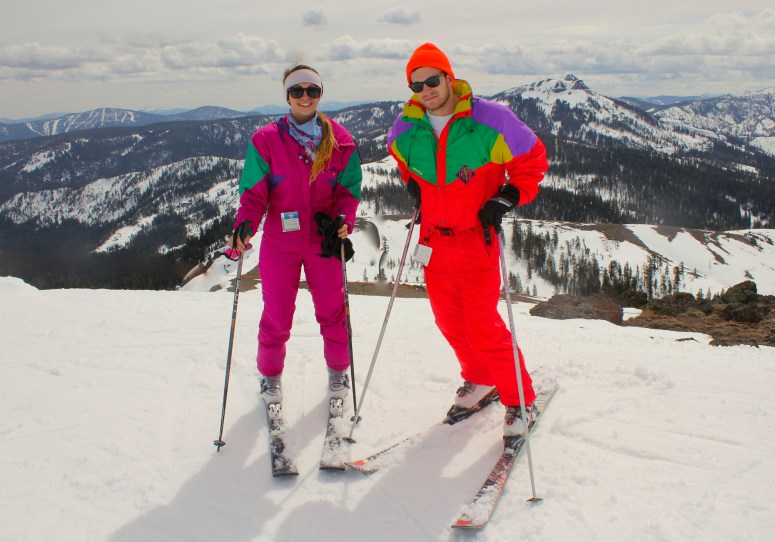
Just for fun (their idea not mine) my daughter and my son wearing my 80’s ski suit and my husband’s 80’s ski suit, respectively. North Lake Tahoe, 2011.
* * * * * * * * * * * *
Way up in Canadian airspace at Fernie, our new Irish friend makes a chairlift confession: He has skied every single day of every single week of every single month, from the first chair to the last chair up, since Fernie opened for the season. Then he says he’s been behaving this way since coming to Canada from Ireland about seven years ago to retire. I say, “that sounds like a fun obsession.” He says, “You can call it an obsession if you want to.” Because to him, it’s not an obsession. It’s how he breathes. Soon, we realize that the powerful little Irishman is probably responsible for some of the impressive ski tracks down distant mountain peaks we’ve been admiring all week—the ones way, way, way up in the sky and out of bounds beneath curlicued, icy cornices where massive layers of snow bear down on steeps studded with rocky outcroppings and smeared with this season’s epic and oh-so-pristine snowpack.
Our chairlift buddy comes clean. Yes, some of those tracks are his. He tells us how he and his pals take the last chairlift up and hide out during final mountain sweeps conducted by the ski patrols. (All part of the local’s “forgiveness friendship club” we presume.) After the ski patrol has herded the rest of us to the bottom, the locals come out of hiding. They climb to dangerous summits and, if all goes well, are home in time for dinner after leaving gracefully arced, ethereal signatures carved into one of nature’s most beautiful and unstable natural substances—snow.
We’re almost at the end of our chairlift ride when our Irish friend notifies us that the Polar Peak Chairlift—easily accessible via a fast ski lane atop a ridge to our right—is up and running. The chairlift leads to cliffs and chutes above the treeline and is rarely open, our friend tells us, so we should go for it. “It’s worth riding up there if only for the views!” He says.
Just my luck! (But maybe not.) An “almost-as-ancient-as-the-mountains” acute nervous system response to the Irishman’s suggestion starts churning the lunch I recently enjoyed into a knotted clump. I know I will want to take that ski lift up to its spooky perch but, after I’m astounded by the views (while balancing on a slippery plot of mountaintop) (no doubt the size of a postage stamp) I know I will then have to find the least terrifying way down from that highest of summits—on my skis—using trails with the kinds of warning signs that used to excite me: Are you an expert? You better be! and STOP! (skull and crossbones) Fatal fall! and Pay attention to the diamonds! The doubles are the genuine article!
The thing is, I really want to see the views up there—all 360 degrees of infinite, snowy Mother Earth extending to the brink of every horizon. From the top of the Polar Peak Chairlift, I know I’ll be able to see the mountains of Alberta, British Columbia, Montana, Idaho…lakes, rivers, valleys…fluffy cloud formations, maybe distant snowstorms. And without the “heads up” from our Irish lucky charm, I might have missed out on making it to the top of Fernie since it’s our last afternoon in Canada.
But, I also know I don’t have youth on my side anymore. My joints and muscles hurt even when I’m doing nothing. Furthermore, I’m too old to be a knucklehead. Furtherfurthermore, after a few days of skiing at Fernie, I’ve noticed that the blue trails are really black trails, the black trails are really double blacks, and the double blacks are really “expert experts” trails. Or…is my head just messing with me? Because nowadays, when I find myself depending on the skinny metal edges of my skis to find harmony with the wobbly muscles of my body in order to keep me clinging to the side of a slippery slope…there’s some good fear, which serves to protect me from harm (I appreciate this fear) and there’s harmful fear, which deprives me of confidence (I hate this fear and it is getting tougher and tougher to manage).
And then—there’s my blasted Bucket List. I still want to ski as many different mountains as I can from top to bottom. I want to enjoy every view, from every summit. I want to identify mountain ranges, name rivers and other waterways, spy distant landmarks, and survey historical territories. I want to experience close encounters of the best kind with the flora and fauna of extreme alpine zones. I want to get high, for as many years as I am able, inside the heart and soul of winter, outside all day, on mountains that make me feel extraordinarily lucky and unbelievably blessed.
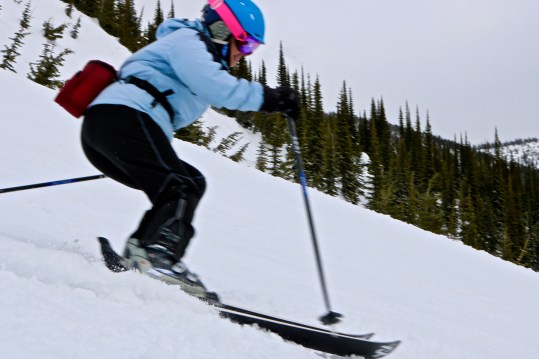
Yet the older I get, the more elusive the mountaintops become. Duh. And instead of my bucket list nearing a stage of completion, it continues to grow. Just last year, we discovered the infamous “Powder Highway” in Canada when we skied Revelstoke (big!) and Kicking Horse which led me to add the mountains of this legendary powder zone to my bucket list. (Fernie this year, now Red Mountain and Whitewater for next year.) My husband (still a wicked fast, beautiful skier) and I discuss this—my bucket list blues—over a well deserved, apres-ski beer after skiing from the summit of Fernie at the Polar Peak Chairlift all the way down 3,550 vertical feet. We compose a list of all the mountains we’ve skied since we started skiing together over 35 years ago. We count 63 mountains skied, in 12 states and two countries. Then we google, “How many ski mountains are there in America?” One answer: 481, give or take a hill. My husband asks me, “How many more do you want to put on your bucket list?”
* * * * * * * * * * * *


* * * * * * * * * * * * *
I have this firm belief that not only should every woman have a room of her own (even if she doesn’t want to write fiction), but she should also have a sporting activity (or activities) of her own.
A sporting activity that takes her into the great outdoors all day where the air is fresh, the views are restorative, and the options for picnicking locations are abundant. A sporting activity that, like a room of one’s own, guarantees long escapes into calm solitude. A sporting activity that rattles the bones, stretches and strengthens the muscles, and encourages useful introspection, refreshing the soul…Every. Time. A sporting activity where the woman athlete makes the rules and where competition falls away. A sporting activity where the woman athlete is challenged and must become fully aware of her own mind and her own body in order to achieve and experience bountiful doses of exhilarating pleasure. (“Abandon learning and there will be no sorrow.” Lao Tzu.) A sporting activity that exhausts the woman athlete, leaving her to marvel at how strong and able her own however-it-is-shaped-and-formed body actually is and how resolute and determined her own however-it-is-wired mind can be. A sporting activity that will rescue the woman athlete in two essential ways: (1) By taking her away, when she needs to get away and, (2) By bringing her back, when she needs to be grounded again. A sporting activity that has faith in the woman athlete, no matter how many set backs, heartbreaks, failures, and distractions she endures, or how many injuries, surgeries, and pregnancies, or how many “losing races against time” hover on her horizon. In other words, a sporting activity without rubrics, awards, rigid expectations, or finish lines. A sporting activity that lands the woman athlete in communities of socially joyful, silly, and heart healthy people who praise Mother Nature (no matter the weather no matter the season) praise love and life, praise good food and drink, praise the merriment of storytelling, praise the spontaneity of making new friends, praise time spent together as a family, and praise, with gratitude, every little moment of exhilarating glee.
I am grateful for three sporting activities of my own:
- Alpine skiing/Cross country skiing/Snowshoeing
- Hiking/Walking
- Road biking/Mountain biking
And, I have found that over a lifetime of devoting myself (and my weekends) to these sporting activities of my own, I continue to find uncommon happiness even as my bucket list grows to include more trails to hike, more routes to ride, and more mountains to ski.
Yes, I am getting older. But after we skied Fernie, we drove back to America and spent a week skiing Whitefish Mountain near Glacier National Park in Montana. What do you think I saw on the beginner’s bunny trail at Whitefish? I saw a woman, older than me, snowplowing down the slope—focused, tense, and determined. When I see something like that, it’s like finding a lucky charm. So encouraging! It’s never too late to find a sporting activity (or activities) of one’s own.
I wonder what’s on that newbie skier’s bucket lists!
* * * * * * * * * * * *
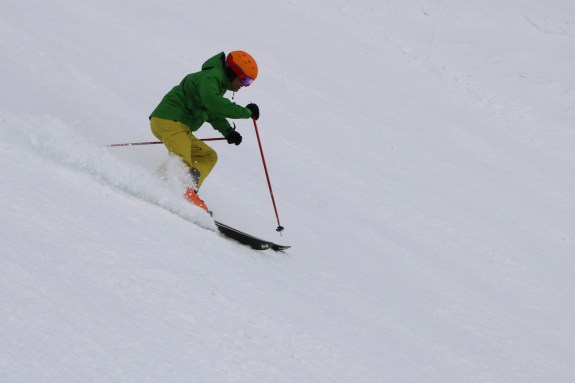
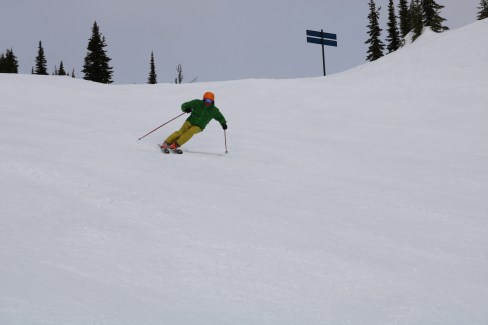
My husband, coach, and best friend on the slopes.
❤ ❤ ❤
 Excursions