One mother’s adventure travel narrative and photographic essay.

PROLOGUE
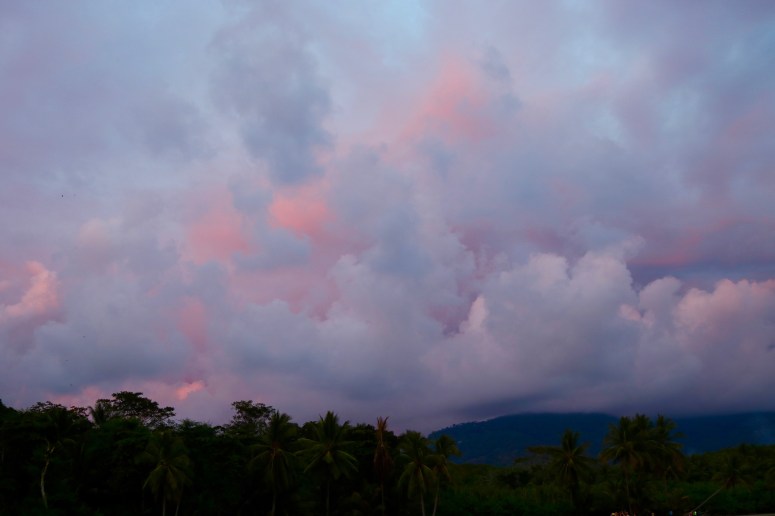
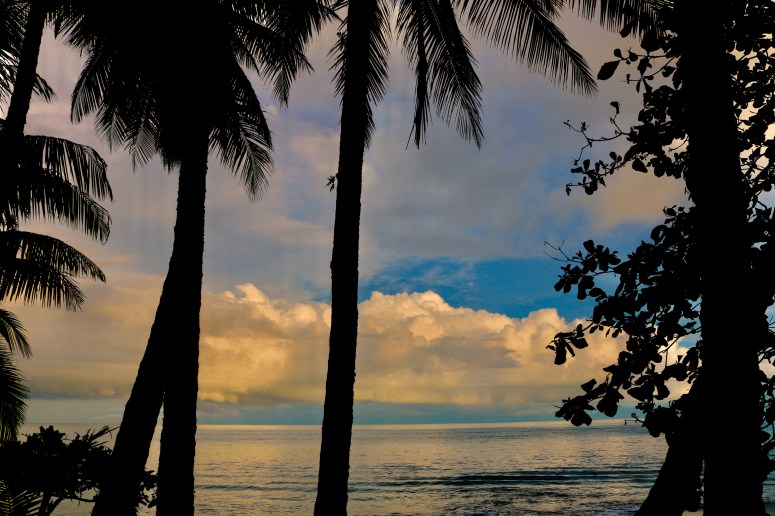
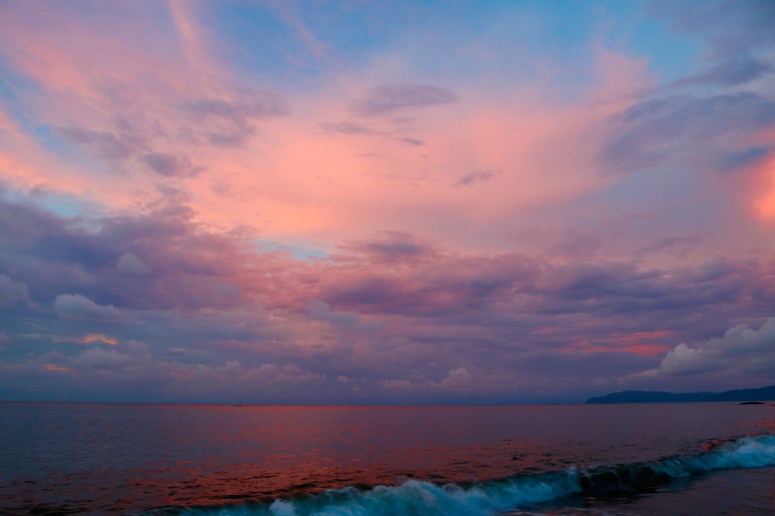
Close to the equator in the phantasmagorically green jungles of Costa Rica’s Peninsula de Osa, a traveler is blessed with about twelve hours of light and twelve hours of darkness every day. The sun rises bright, glows brilliant by midday, and then—after the traveler enjoys a late afternoon snooze in the sand, a pleasant happy hour drink before dinner, and one more swim—the sun flings a heavenly radiance over everything before slipping away. You might describe the sunsets as riots of color, except they don’t make a sound. From my vantage point, in a year dated 2018 by humans on Planet Earth, I’ve been taught that the sun (if we could hear it) would sound terrifying. This is because most of us believe the sun is an explosive, fiery thing.
And I think that’s probably true.
But I love the sun more than I fear it and have only felt anger for its power once in my life when it continued to shine on me (a whit of short-lived, organic matter in its boundless universe) at a time when I wished to die rather than endure the despair and physical pain of grief. Indeed, that phenomenal Superstar—aged more than 4-and-a-half-billion years old—has become my go-to guiding, wishing, and good luck star.
After the sun sets on the Osa Peninsula, the jungle goes dark. One stands in the dense tangle of it and notices how the darkness settles in, first through the eyes, then down the throat, and finally into the soul where it dominates the imagination. Osa Jungle Black neither fades nor intensifies, but is resolute and vast. It feels fresh, smells lush, and pulsates with loud alive-liness. If a traveler turns on her headlamp, and aims its beam of light in every direction, she won’t believe how many eyes are watching. There are big eyes, little eyes, and tiny eyes. There are watery eyes, too, staring through the murk of swamps and calm streams and dangerous rivers.
Embraced by the purity of Osa Jungle Black with my family, after 12 days at peace alongside extraordinary nature, solitude, and the restorative wonders of the Pacific Ocean, I felt a haunting—not from hidden creatures waiting to bite me, sting me, or enjoy my entire family for a midnight snack. Nor from a ghostly sensation—or romantic fantasy—that tribes of the restless dead were guarding a wild paradise at risk.
What haunted me was my own good luck.
What if it had failed me?

CHAPTER ONE
When I first began planning a trip for my family to see Costa Rica, I thought it best to avoid a futile chase for some kind of utopia. After all, Costa Rica’s ecotourist destinations have been on the travel industry’s radar for a long time. I knew I was late to the party.
My husband thought he’d reduce my anguish by giving me a copy of a customized travel itinerary through Costa Rica, prepared by an elite travel consultant for friends taking a getaway trip for two. Their tour included must-see sites, luxury accommodations, and fun activities organized in a stress-free (and appealing) style with chauffeur-driven car rides and plane rides from Palm Tree A to Palm Tree B to Volcano to Cloud Forest to Coffee Plantation to Eco Resort with meals included and personal needs fulfilled.
All I had to do, according to my husband, was study the blueprint for the luxury tour and design something for twice the number of travelers at half the number of colones. Extra credit: Pull it off last minute during the busiest tourist season. Honors: Take our family where all those tourists are not going to be. Cum laude: Include culinary and cultural enrichment. Magna cum laude: Could we go ziplining. Summa cum laude: No shared bedrooms except, of course, for the mom and the dad.
After several fitful starts and stops (Costa Rica really is on every tourist’s radar) and some tense marital discussions, I summoned the goddesses of utopian escapes for help.
Soon, I found an enchanting place for rent in the wild jungles of the Osa Peninsula. The dreamy dwelling, named Casa Nirvanita, was portrayed by its gracious owners as a luxurious shelter, open to nature (“a biological jewel”) set in both secondary and primary rainforest with fruit trees and flowers growing amid rivers that flowed to the Pacific Ocean. Jungle creatures and critters lived all around (and often in) the dwelling, which had three bedrooms, four bathrooms, and several hammocks. We’d need to purchase food and drink for our entire stay, box and load it into a small boat, then take a voyage down the Sierpe River and into the (often turbulent) Pacific Ocean for a run across Drake Bay and over to a beach where we’d rock and roll in the surf while bringing our provisions ashore. Once arrived, we’d have no car, no take-out deliveries, no grocery stores. Not even a neighboring home from whence to borrow an egg.

On approach to the Pacific Ocean and Bahia Drake from the Sierpe River.
CHAPTER TWO
Before setting off for the Osa Peninsula, though, we needed a place to stay for the first four nights of our vacation. The dates fell during the New Year’s weekend holiday and, of course, not much showed up as available. But I did find one curious option made all the more intriguing due to the fact that it didn’t have a collection of 5-star reviews. In fact, it didn’t have any reviews at. It was a new-to-the-market, up-and-coming ecolodge. The name, Eden’s Nest, sounded fun, the price was right, and the digs were neat. They were called jungalows (bungalows built into the jungle canopy) and the property was located in Ojochal, a tranquil village on the way to Sierpe, the port town where we’d be storing our car for several days near the boat launch for travel to the Osa Peninsula. Each newly-renovated jungalow had a kitchenette, a balcony, and a bathroom and they were so well priced (less than $100/night!) that everyone could have their own hideaway. Our potential host, Carlo, offered to custom design a tour for us through the mountains, cloud forests, farms, and markets of a Costa Rica he had grown to love, beyond the beaten tourist paths.
We sent a lot money to Carlo and hoped we wouldn’t be adding a dumb luck story to our family’s tales of travel. After all, the jungalows had no reviews and the village of Ojochal wasn’t on the tourist radar.
CHAPTER THREE
As soon as you come bounding into the jungles of Costa Rica, it seems like everyone you meet is saying everything you want to believe:
There is nothing here that will harm you!
Enjoy yourself!
Pura Vida!
When it first happened to us, we had already managed the airport hustle, retrieved our rental car, and conquered one of Costa Rica’s legendary steep, narrow, rutted, muddy, slick, twisty, and unmarked roads (two attempts) in the dark after a long drive from San Jose and upon final approach to Eden’s Nest. (Like this: Drive up a dark road in a little bit of rain, the road gets surprisingly steep, car wheels start spinning in some slurp, shift into reverse for a long, long ride backwards perhaps a quarter of a mile in the dark to where you started, then switch to first gear and gun the engine never letting your foot off the gas and never loosening your grip on the steering wheel no matter how many ruts throw you off course or how many cliff sides get too close.) And hopefully no other cars are coming at you from the opposite direction.
Welcome to the jungle!

A fairy tale jungalow-of-one’s-own at Eden’s Nest in Ojochal.


Writing, reading, working, drinking Costa Rican coffee, smoothies, and finding local swimming holes (thanks to Carlo’s tips) with waterfalls.

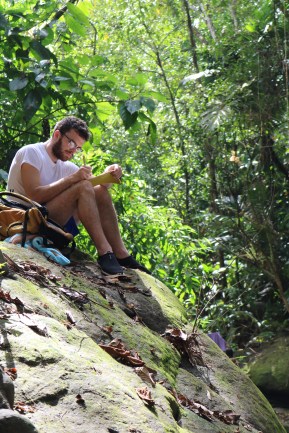
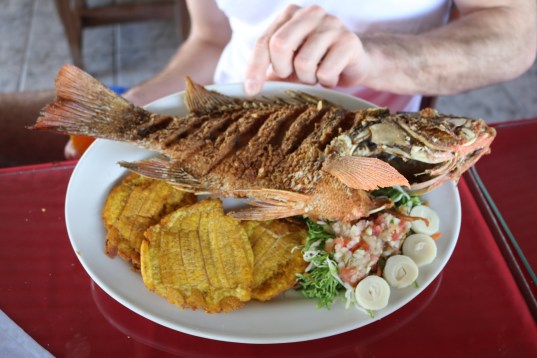
Lunch after swimming. The lemons looked like oranges and that’s what we thought they were until we bit into them! Whole cooked fish with fried plantains.


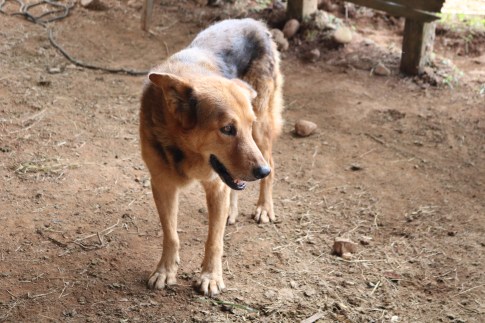
Belly rubs for Jessica at Eden’s Nest—the most lovable dog in Costa Rica!
CHAPTER FOUR
Talk about lucky.
The jungalows at Eden’s Nest were clean, comfortable, charming, and eco friendly. Sure, there were a few quirks…like Carlo’s recommendation that if our family wanted to go on tour with him, and see as much as we could in one day, his truck would be heading for the mountains before 6AM.
So we set the alarms on our phones and woke up laughing out loud
because early-morning-wake-up calls in a rowdy jungle don’t need one iota of technology!
CHAPTER FIVE
The most common question I’m asked about my family’s trip to Costa Rica is this one: Your kids travel with you? It’s a good question. My “kids” are adults—my son is 26, my daughter is 23—and they haven’t lived at home since they graduated high school and left for college. My son lives in Brooklyn, his favorite city, and my daughter lives in Somerville, MA wrapped up with her favorite city, Boston.
They’ve got it going on.
So whenever (3x so far) I’ve decided to hire a private guide for an entire day during our travels, I hope for good luck and good fun because I want my kids to enjoy traveling with us. (One of the most outstanding all-day tours our family took was with Alvin Starkman’s Mezcal Educational Tours in Oaxaca, Mexico. At the end of that long day, my daughter gave the tour an A+ grade.)
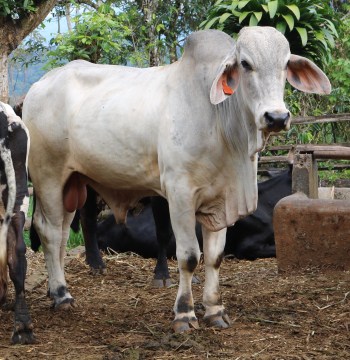
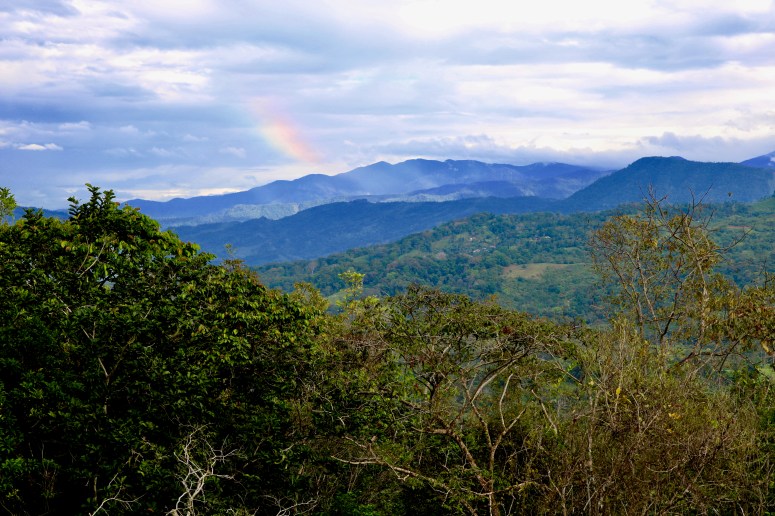
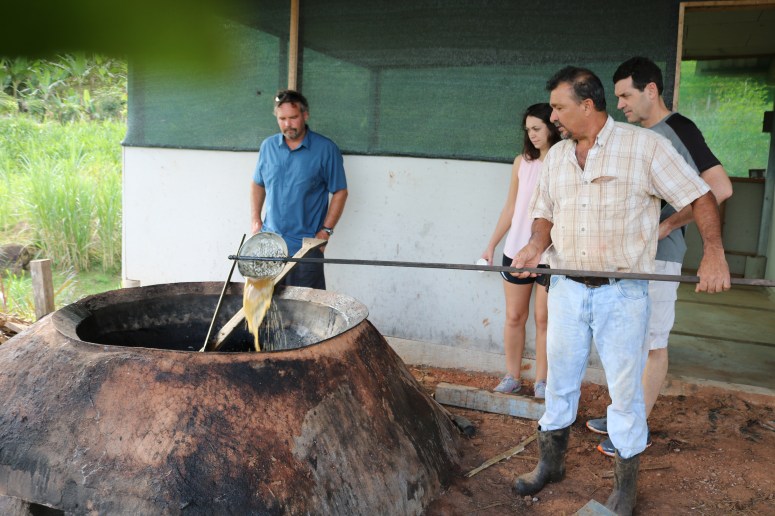
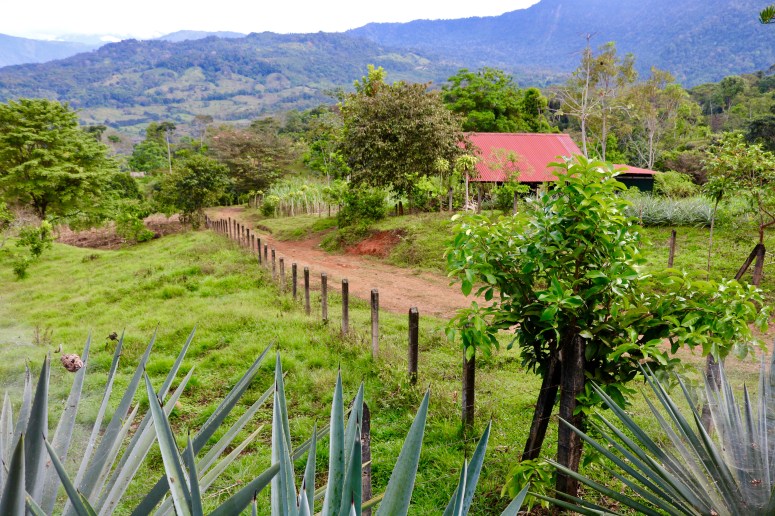
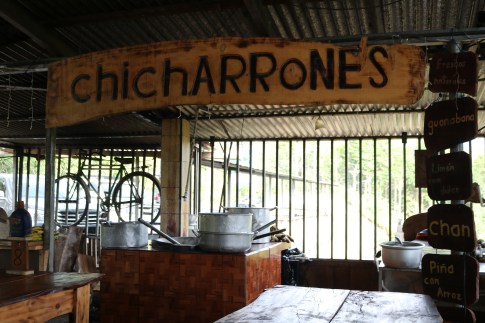
Carlo had it going on for a Costa Rica we hoped to find. He drove us into the Talamanca mountains, past waterfalls, through cloud forests, and onto a farm where a family welcomed us, proudly showed us their lands, crops, and livestock; how they make sugar and grow coffee, and then they bestowed generous gifts of organic fruits upon us after sharing wholesome cups of Costa Rican coffee on their porch. We visited San Isidro and ate in the market. We hiked at Cloudbridge Nature Reserve. We stopped for a typical Costa Rican afternoon snack at a roadside restaurant. All along the winding, scenic, narrow routes, we passed farmers on horseback sharing the roads with people out walking and people out riding motorcycles. Carlo’s tour included unexpected surprises about the culture, customs, cuisines, and beauty of Costa Rica.
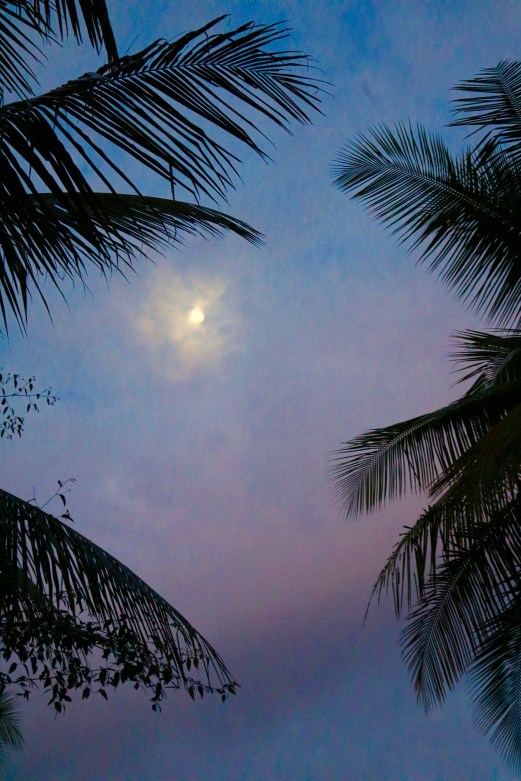
At the end of the day, Carlo took us to the seaside in Dominical. He backed his truck up to the beach, opened the tailgate, and offered all of us a cold beer as local families were gathering on the beach to build campfires and watch the moon rise, almost full, before the start of a new year.




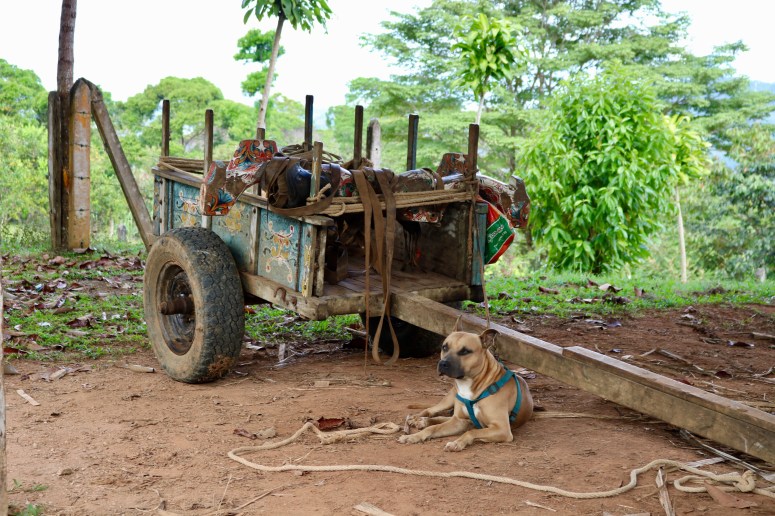
Beautiful pineapples hand picked for us.


A necessary tool, the machete, completely and quickly whittles sugar cane into sticks of true sweetness.


Making sugar.
Taking home sugar and coffee.


The family’s twin grandsons picked shirt-fuls of oranges and grapefruits for us.


Organic fruit for making smoothies back in our jungalows at Eden’s Nest.


A PLEASANT HIKE TO PACIFICA FALLS AT CLOUDBRIDGE NATURE RESERVE
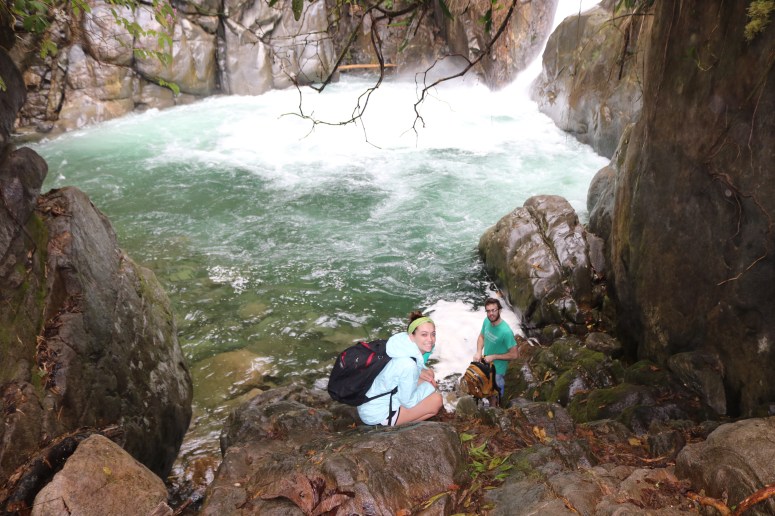
My son playing his Brazilian pandeiro—a hand frame drum—with the falls.

STOPPING TO ENJOY A TYPICAL COSTA RICAN AFTERNOON SNACK


CHAPTER SIX
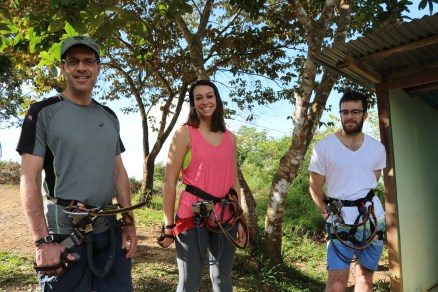
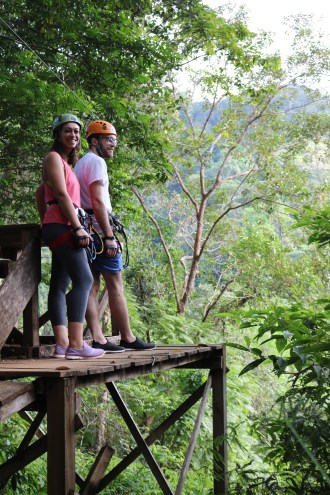
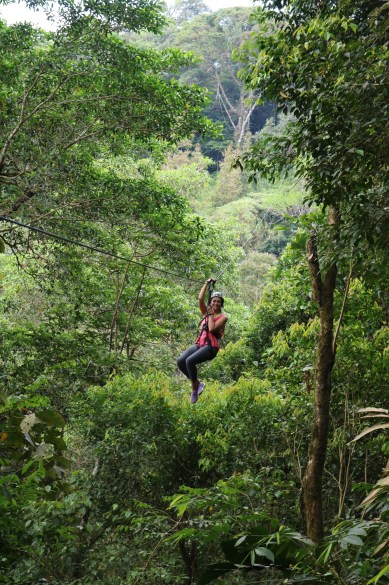
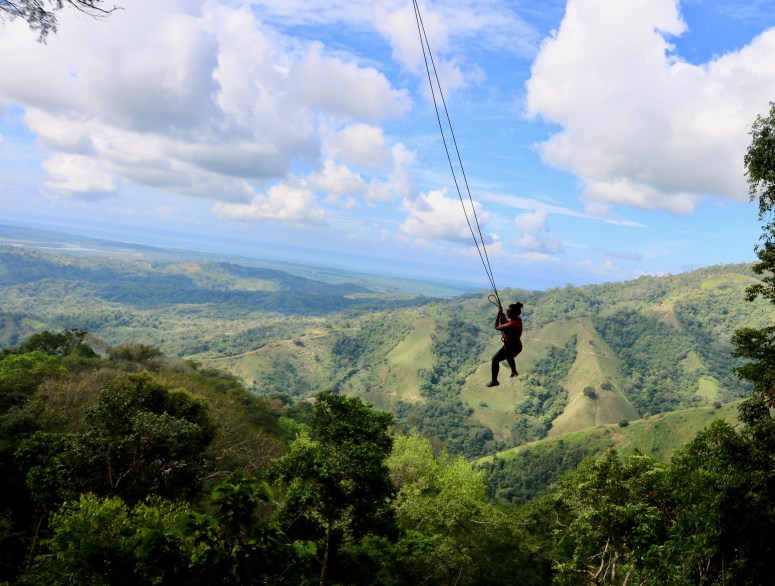
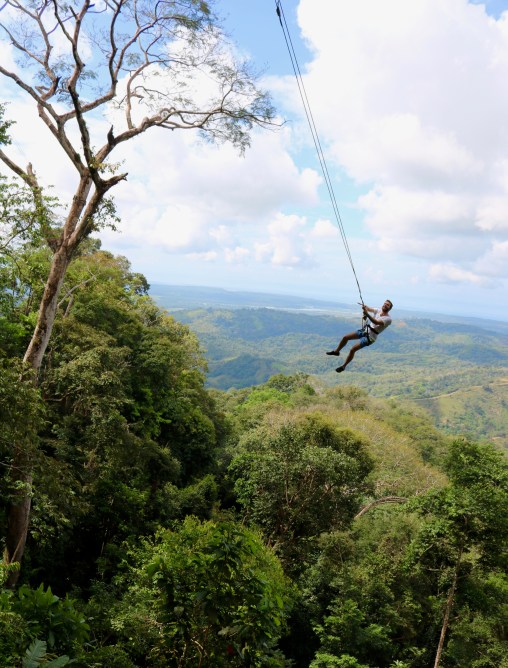
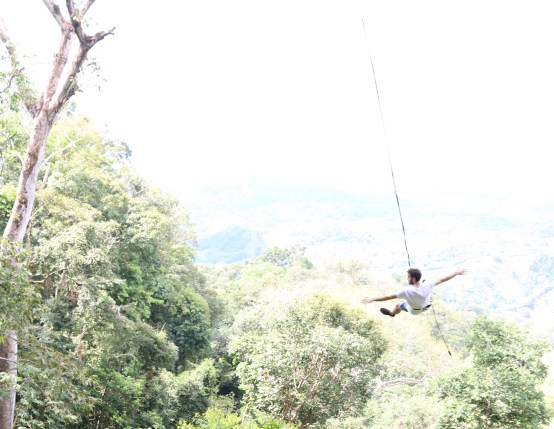
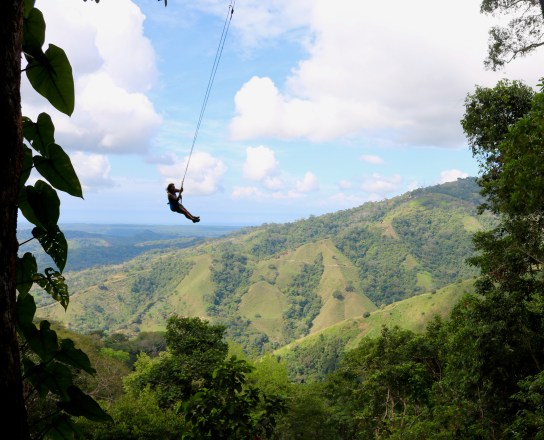
You can’t go to Costa Rica and pass up a chance to zip-line way up high and fast through the canopies of tropical rainforests and jungles. Lucky for us, Osa Canopy Tour was close to Eden’s Nest offering 9 zips, 11 platforms, 2 wobbly bridges, 2 scary drops, and one woohoo Tarzan swing to send you soaring over views of the Pacific Ocean. The adrenaline rush was a good one—it didn’t stop my heart, but it did take my breath away.
I will always remember zip-lining in Costa Rica as one of the most joyful and thrilling excursions I’ve ever shared with my family.



CHAPTER SEVEN
Our time at Eden’s Nest ended on January 1st, 2018 and our boat for the Osa Peninsula was scheduled to depart Sierpe for Bahia Drake and Casa Nirvanita at 3:00 the same day. We said goodbye to Carlo, gave Jessica (the most adorable pooch) some belly rubs, and promised to visit again. Carlo and his wife Tineka have exciting dreams for developing Eden’s Nest and they are ready to offer any services that might make a trip to Costa Rica more appealing. Carlo gave us useful advice consistently, including where to find ATM’s and where to grocery shop. It’s fun to check in on their website to watch Eden’s Nest become more and more of a destination ecolodge. One memory I won’t forget: Watching luminous Blue Morpho Butterflies, from a perch on our balcony, taking magical flights through the vibrant greens of Ojochal’s forests.
After grocery shopping (8 days provisions/four foodies), we crammed eight boxes of food/drink/one cooler into our rental car and set off for the outpost town of Sierpe. I immediately worried about how we would fit our suitcases, plus eight boxes of food and drink and one cooler, plus every member of our family onto a 28′ boat hired to help us find utopia.
Pura Vida! My husband, my son, and my daughter said. And they were right. The boat handled everything just fine. By the time the sun set on the first day of a new year,
the real world had fallen off our radar.
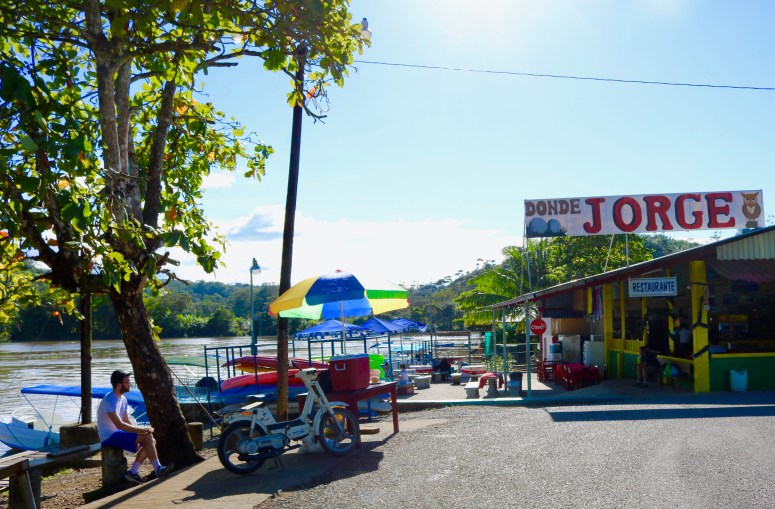
Last supper before departure from the port of Sierpe, Costa Rica.
Our cruise ship.
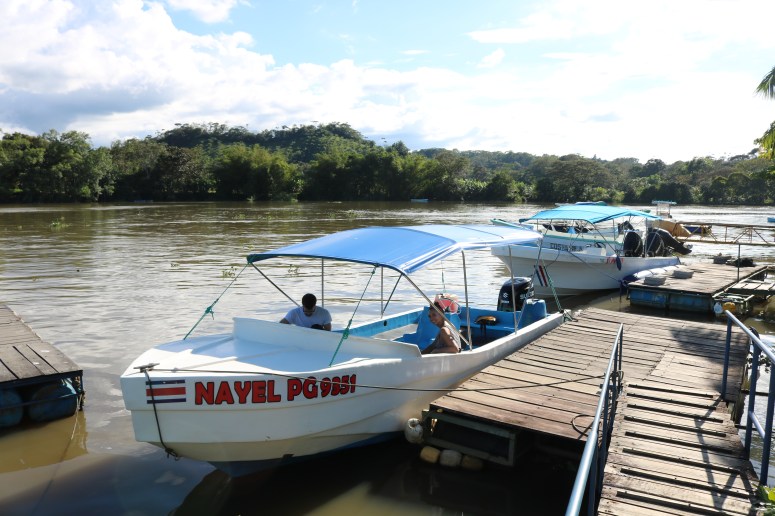
Landing somewhere near the equator in Central America.
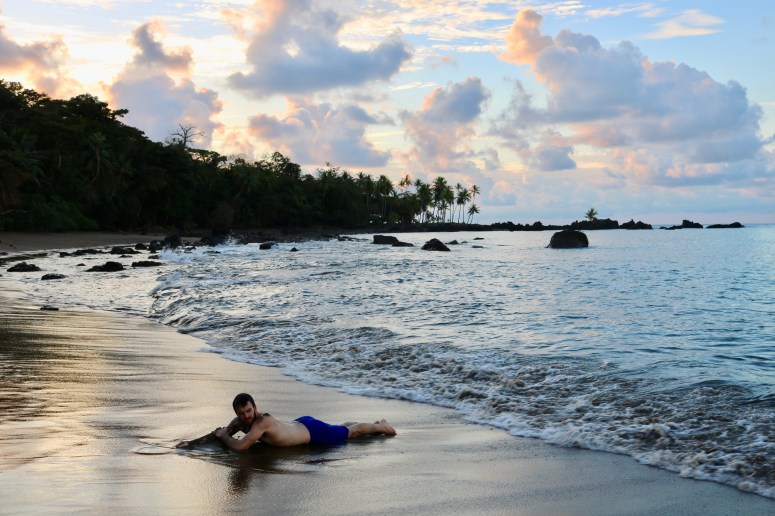
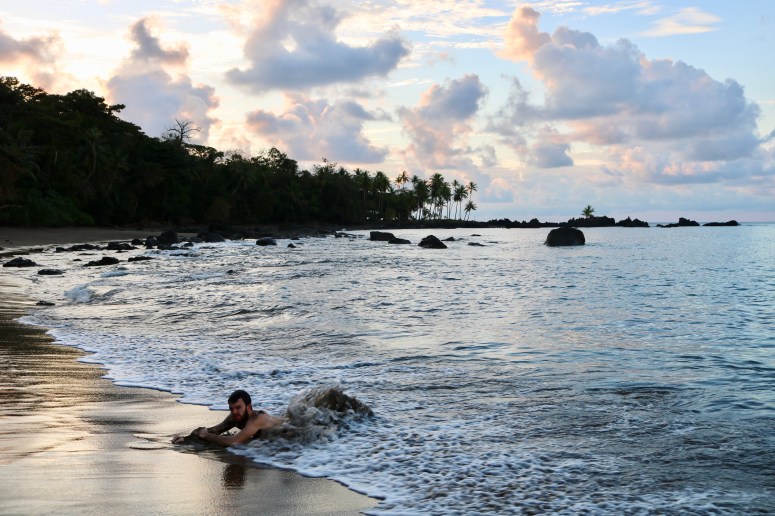
CHAPTER EIGHT
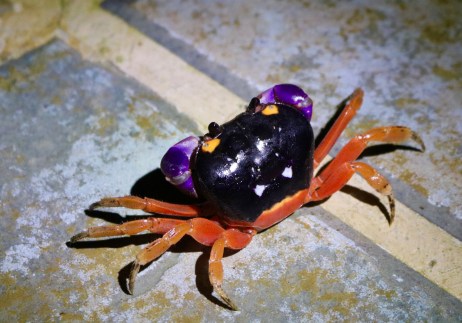
The first of many wild friends in our newfound utopia on the Osa Peninsula greeted us by moving into our shoes while we ate dinner after arriving. Halloween Moon Crabs. We didn’t know what they were when my husband noticed shadows moving on the porch. But our hosts had ensured us, “there is nothing here that will harm you!” so we shook the colorful crustaceans out of the shoes and found them to be somewhat likable.
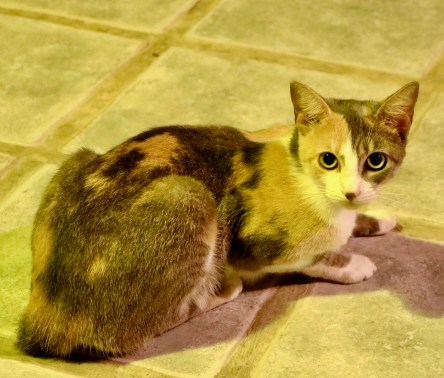
The house came with a cute cat, even so, Cute Cat didn’t seem interested in the crabs or giant Smoky Jungle Frogs (one of Costa Rica’s largest amphibians) that shared our living spaces and environs. The Smoky Jungle Frog we met could have been a prince. It was first spotted by my daughter on a night hike several pitch-black trails away from our house. “O.M.F.G.” She whispered. “Don’t anyone move. There is something BIG looking right at me.” Here is an example of another reason why I travel with my children. My daughter, though she isn’t loopy over strange things that stare at you in the night, is a champion huntress. She’ll never miss a creature feature party, especially one promising unexpected guests in unusual settings. Later that evening, she spied an even bigger amphibian watching her from the comfort of damp, leafy jungle brush close to the house after she had settled in to enjoy a glass of wine. Surely, we joked, Smoky Jungle Frog had followed her and was hoping for a kiss that might change its life forever.
Trying to kiss a Smoky Jungle Frog in Costa Rica probably wouldn’t end well, according to a random Internet fun search: “In addition to inflating its body to appear larger, the Smoky Jungle Frog protects itself by secreting a toxin known as leptodactylin. This poison is released from its skin when it is handled, and it can cause rashes or a stinging sensation in humans, especially on any open cuts. The frog is capable of vaporizing this toxin into the air, potentially affecting people who are nearby without touching it.”
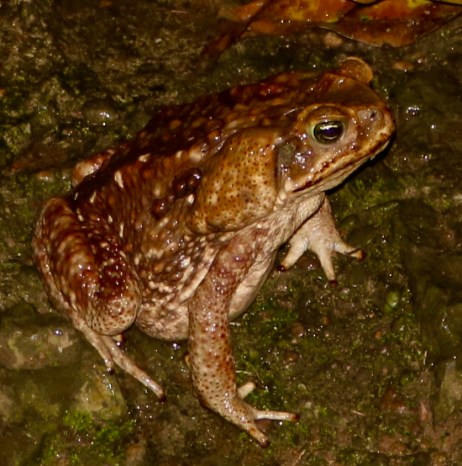
As it turns out, it wasn’t a Smoky Jungle Frog disturbing the peace of my daughter’s evening. It looked more like the largest toad in the world, the Cane Toad, and although there are those who promote the licking of these toads to bring on hallucinogenic visions, that probably wouldn’t end well either. The Cane Toad’s glands are packed with enough poison to kill large animals. Science is studying the toad’s medicinal healing possibilities, but human reaction to recreational experimentation with the toxin can be unpredictable and potentially lethal.
As the days and nights passed in our Jungle Palace (we lit the house with candles at night and it felt like we were living in a wonderful, mystical, lost-world palace) it became evident that Cute Cat had no desire whatsoever to patrol our living and sleeping quarters for creepy crawlies, creepy hoppers, creepy flying things, and/or super creepy slitherers. Perhaps it was because the Osa Peninsula jungles remain, for now, a stronghold for one of the greatest cats on Earth—the elusive Jaguar—and our palace cat shared some of that coolest-of-cats attitude.
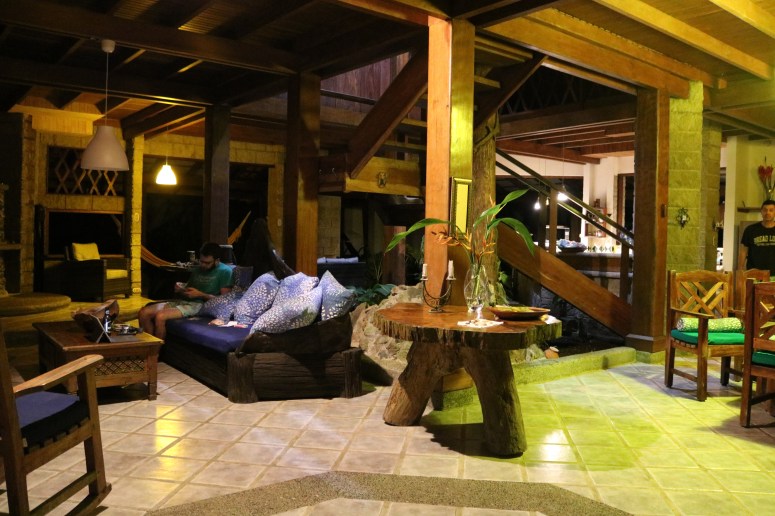
View from the porch into Casa Nirvanita, a luxurious Jungle Palace.
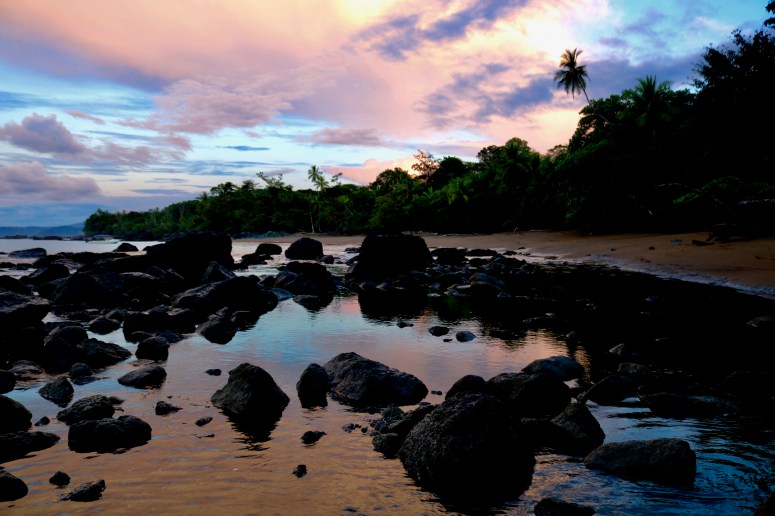
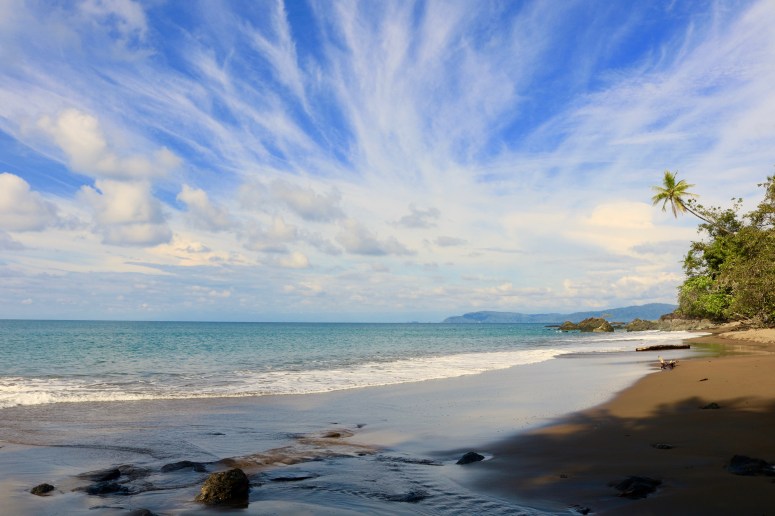
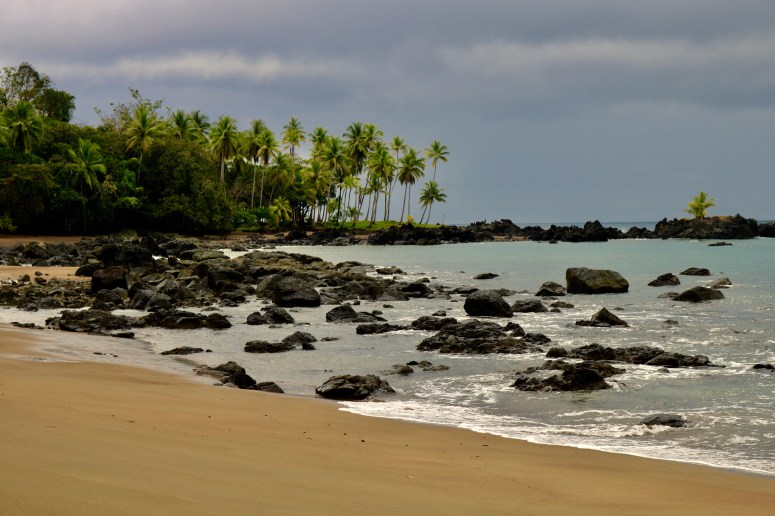
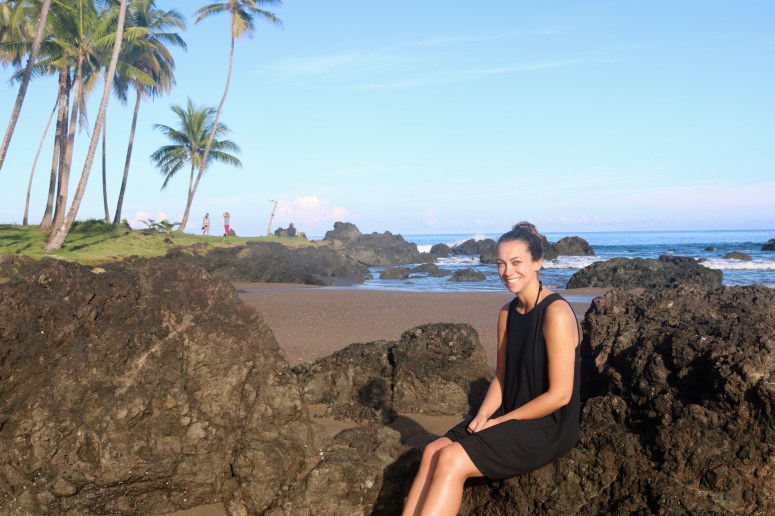
Perfect sand, surf, and tidal pools.
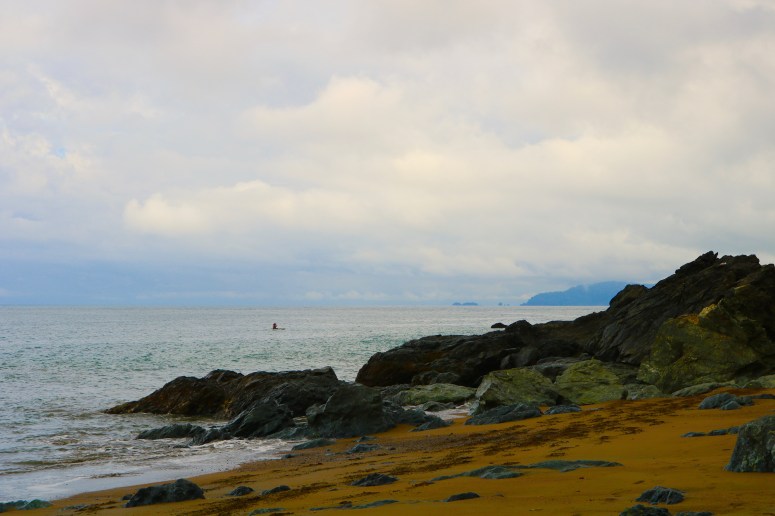
Paddleboarding.

Early morning kayaking.


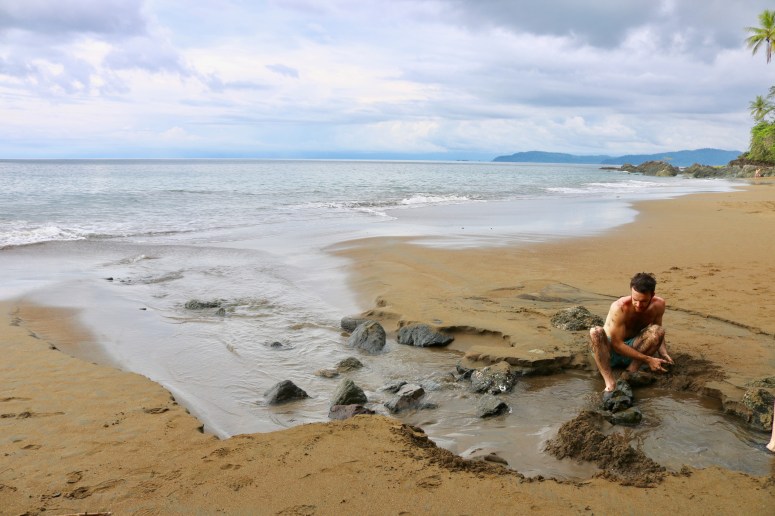
Tide in.

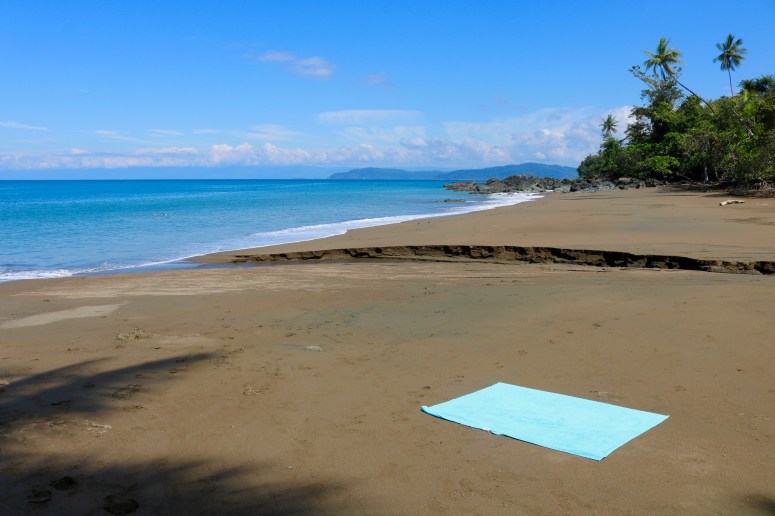
Tide out.
CHAPTER NINE
Ecotourism: Responsible travel to natural areas that conserve the environment, sustain the well-being of local people, and support interpretation and education. (TIES. The International Ecotourism Society.)
The Sixth Extinction: “Though it might be nice to imagine there once was a time when man lived in harmony with nature, it’s not clear that he ever really did.” Elizabeth Kolbert
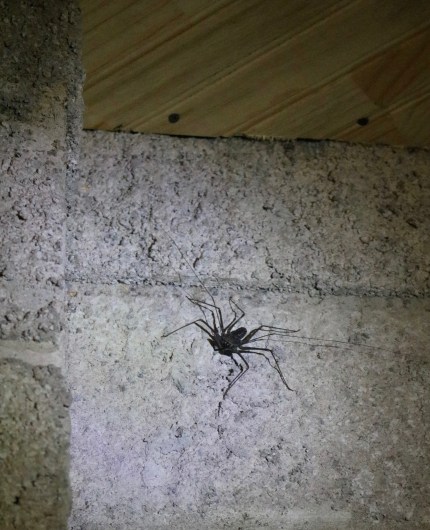
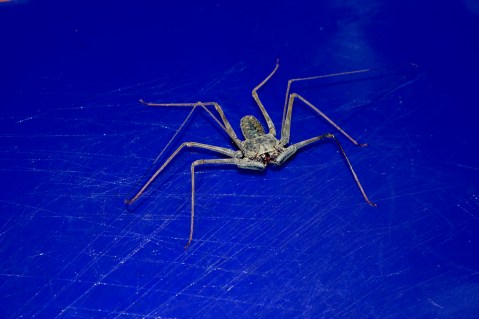
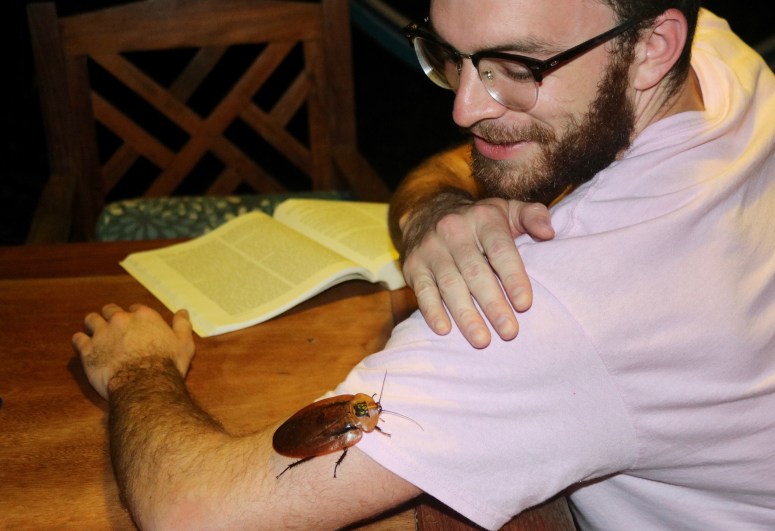
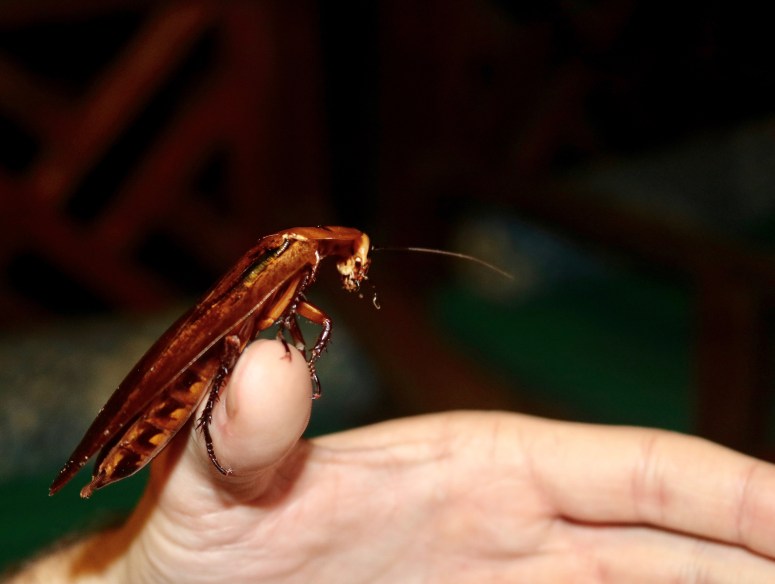
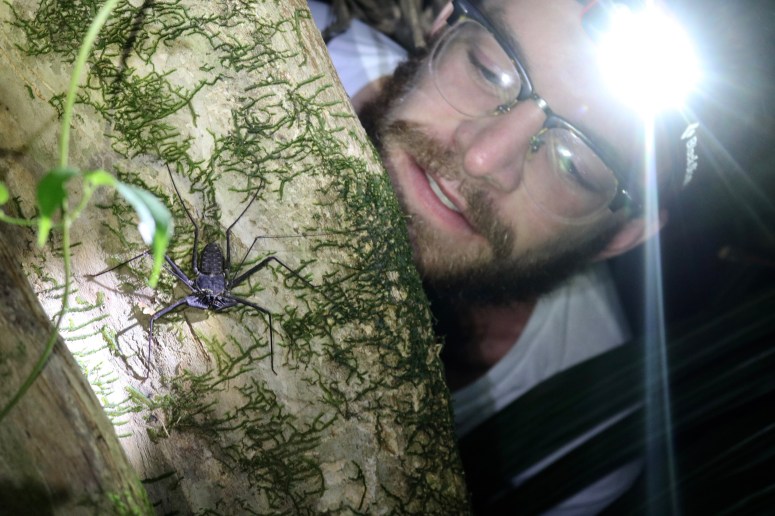
One evening a deluge of rain poured from the night sky, keeping us inside our palace shelter. Refugees from the storm soon appeared on the kitchen shelves (Common Tink Frog), on the walls (Giant Cockroach, Tailless Whip Scorpion), in the ceilings (bats), and in the corners (more amphibians of the toad variety). It became a night of great excitement and adventurous education. Fortunately for us, my son had devoted one summer during college to the pastime of happily skipping through the woods and fields of the Hudson River Valley collecting insects. Through his guidance, we developed a bit of a crush on Blaberus giganteus, a giant cockroach, and Amblypygi, a Tailless Whip Scorpion. The relief that calmed me when my son could immediately identify the astonishing bugs made the trials and tribulations of raising my kids feel even more triumphant. I didn’t question his authority—I could tell by the levels of admiration and rapture percolating through the humid atmosphere of a wet night in a rainforesty jungle, that my son had waited a long time to meet these impressive creatures on their own turf.
As for the frogs and toads coming in from the rain, what a story they can’t tell about their evolution and survival since long before the dinosaurs walked the Earth and long before flowers bloomed on plants, up until these days of present history when research begun in the 1980’s in Costa Rica reported a somber decline in, and vanishing numbers of, frogs.
But it’s a story we can try to understand through science, research, and the deliberate choice to free our minds from the confines of chosen ignorance while opening them to the possibilities of genuine truths about Planet Earth and Life. If all of this sounds like an exhausting and boring way to spend a vacation in paradise, it isn’t. Brain massages administered through the art of thinking can stimulate long periods of obsessed excitement over novel discoveries and wonders of the world. These massages have been proven to ward off the evils of ignorance, apathy, and cynicism while stimulating brilliance, courage, awareness, and—best of all—activism.


Tailless Whip Scorpion. Harmless.
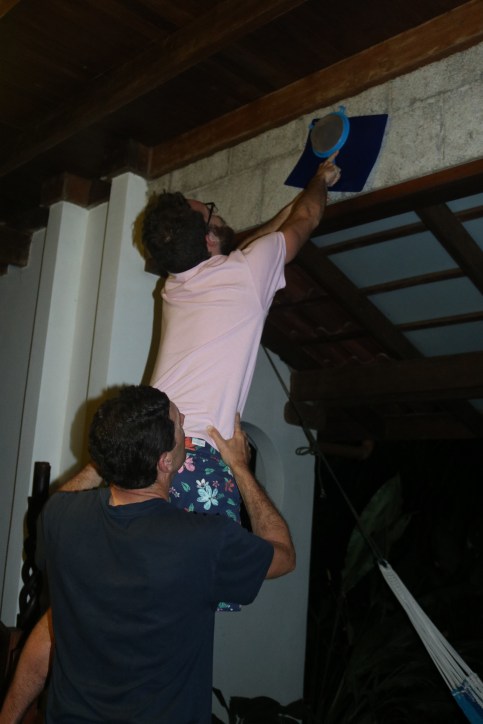
Few adventures are as exciting as spending a rainy night in paradise catching bugs in one of Earth’s most biologically intense jungles. Note the improvisational use of common kitchen utensils and containers as hunting and observation devices.

Blaberus giganteus. Our host, German, names this jungle bug his favorite.
In the night jungle: Tiny frogs. Blue dragonflies. Blue crayfish. Opossum in a tree. Smoky Jungle Frog. Spiders. A lot of the handsome Tailless Whip Scorpions.


The Tailless Whip Scorpion on a tree in the jungle at night. This bug, in spite of having what appears to be an awkward, cumbersome collection of legs, can actually scamper rapidly up and down trees.
CHAPTER TEN
A short walk from Casa Nirvanita, one of the transportation “hubs” for the Osa Peninsula has been set up. It’s marked by a spare, wooden shelter where backpackers, day hikers, eco-lodge tourists, and other travelers wade through the water to hop on small boats for guided (required) tours to the Sirena contact station at Parque Nacional Corcovado and/or guided (also required) snorkeling tours to Isla del Caño. Our Casa Nirvanita hosts arranged a wildlife tour of Corcovado National Park and a snorkeling tour of Caño Island for us.
A public transport hub in Drake Bay and one of the many community pooches. In Costa Rica, we noticed stray dogs were friendly and well fed.

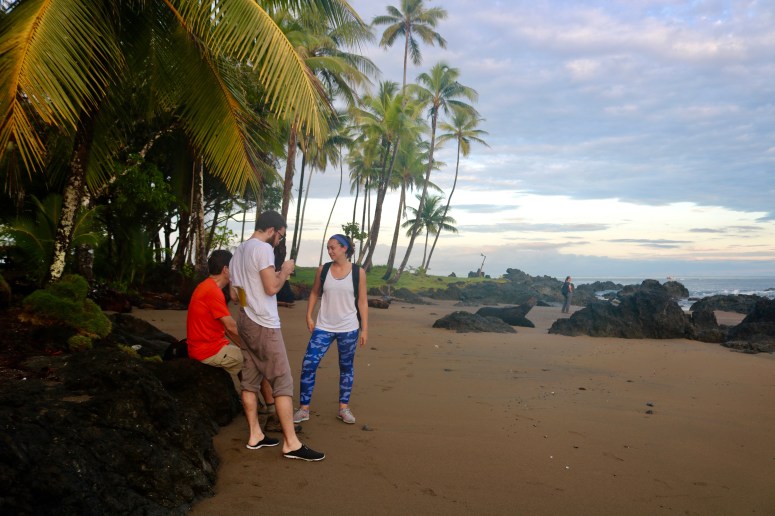
Corcovado National Park is a vibrant habitat for wildlife on the Osa Peninsula. Everything Exciting and Everything Scary and Everything Endangered exists somewhere in Corcovado National Park. (There’s gold in them ‘thar hills too.) For me, a guide added a layer of possible protection from the Everything Scary category of wild animals. I carried a first aid kit everywhere we went (because everywhere we went required walking through a jungle) but after researching the feared Terciopelo (aka: the highly venomous Fer-de-Lance Pit Viper) and noting its aggressive nature, the first aid kit had come to feel like dead weight in my backpack.
A typical day tour through Corcovado takes a group of 10-12 people quietly into the park with a competent guide carrying a powerful scope. Everyone gets a turn peeking at whatever the guide finds and if the animal behaves and sits still long enough, cell phone cameras can be pressed against the scope’s lens for pics. After a few hours of stalking wild beasts, lunch is served at the park headquarters before another round of quiet walks in search of magical creatures.
It was hot and muggy and since I didn’t get to see a three-toed sloth, I wasn’t sure if the tour satisfied me. I asked my kids what they thought of it. We did see a lot of animals! But there is something about sloths, and we were in Costa Rica…and I knew I might not pass that way again for a long time, if ever. My son’s review of the day rescued me. “Mom,” he said, “it was a Pokemon day. I mean everywhere we went, some animal came popping up out of nowhere.”
It’s true, the animals we saw weren’t like any we’d ever seen. And there they were, hiding out in their own habitats. There are no guarantees in Corcovado National Park that you will see wildlife. The animals are free range.
Short hike to the boat-stop for a one-hour ride to Corcovado National Park.


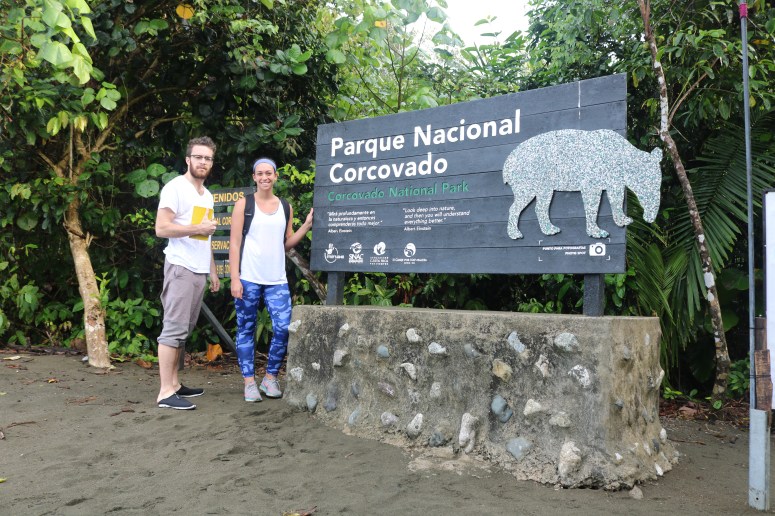
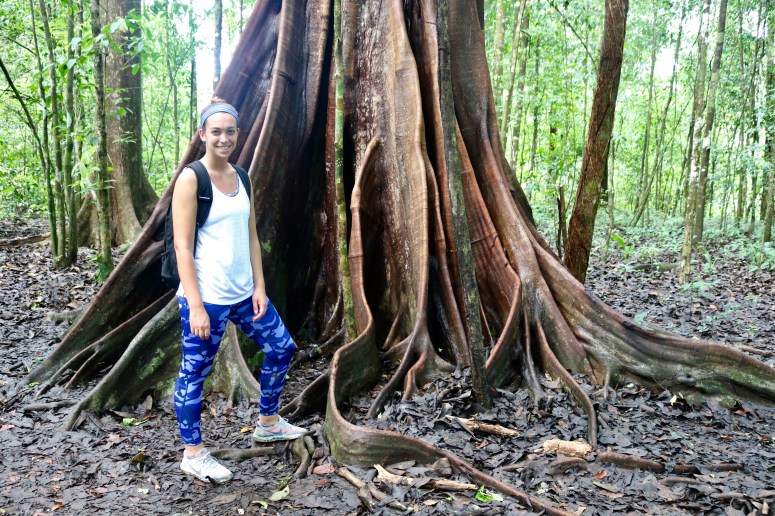


Sirena Contact Station for lunch. Note the large cabin with stacked bunks inside mosquito netting. Overnight tours are now on my bucket list. (Awakening at 3AM for breakfast by 3:30 in order to hit the trail early enough to find animals.)


Can you spot the hidden Pokemon?

It’s a Caiman and it was hiding out in a stream with three others nearby. Below is a boring pic of Rio Sirena during our hike. Such a calm and muddy river…flowing to the Pacific Ocean…and hosting populations of American Crocodiles and Bull Sharks. It’s a long journey from this place to emergency medical care.
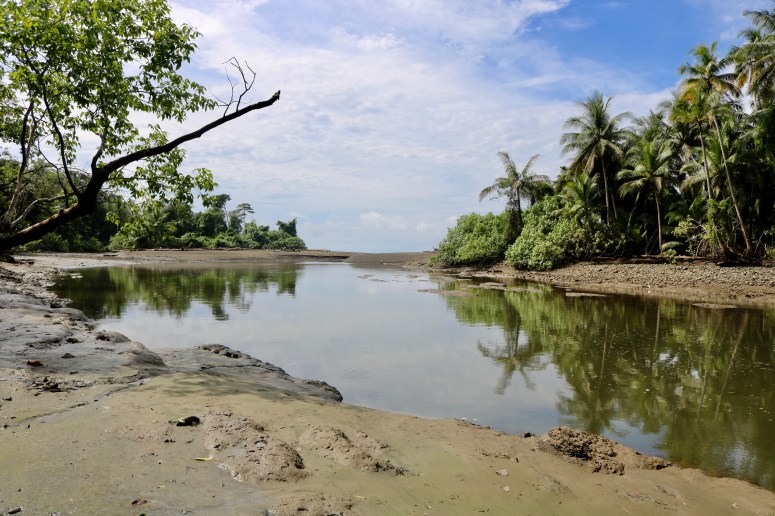
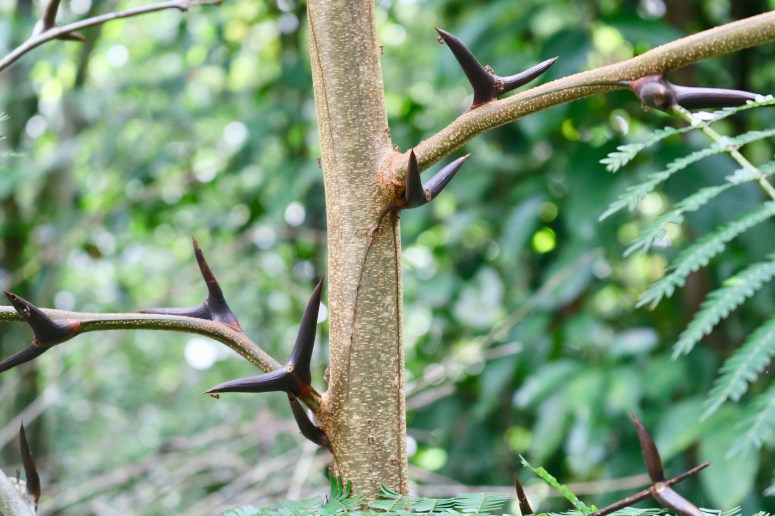
Wherever you go hiking or walking through slick mud, be cautious when grabbing onto trailside flora for support.
CHAPTER ELEVEN
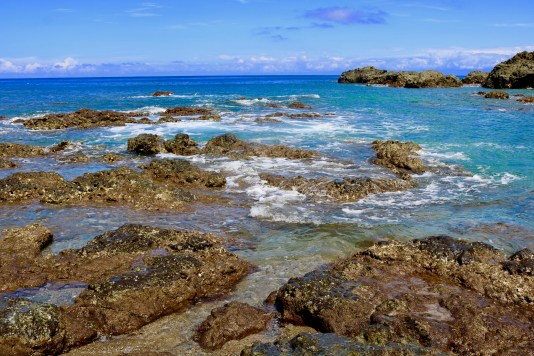
Isla del Caño Biological Reserve off the coast of Parque Nacional Corcovado doesn’t seem to have a chance in a world where alarms are sounding throughout the scientific community about the future for Earth’s coral reefs. Some warn the Earth might lose 90% of its coral reefs in the next 30 years. Others say all of Earth’s essential and irreplaceable coral reefs will be gone in 30 years.
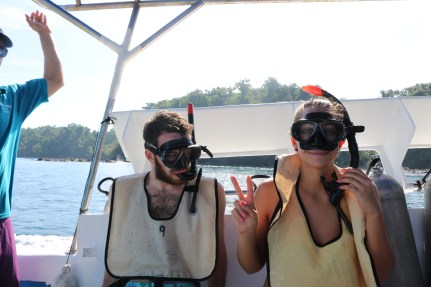
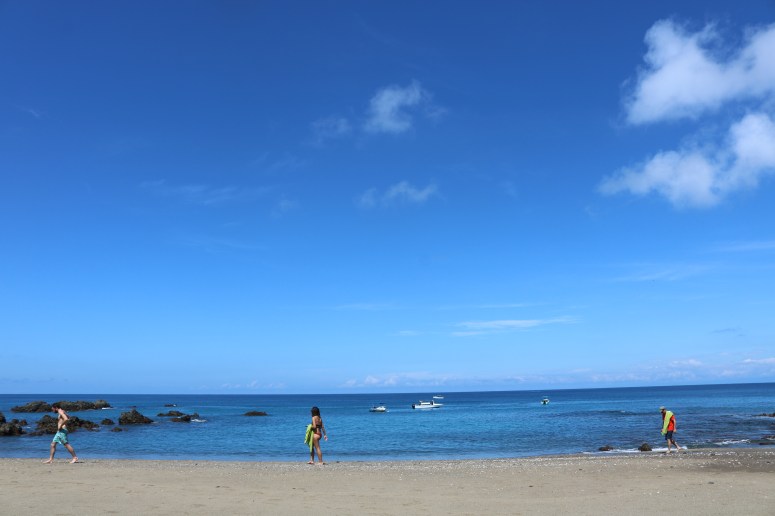
You can still dive and snorkel through the protected and splendid coral reefs of Caño Island with a guide. A tour allows time to relax on the island’s remote beaches with the most charming collections of hermit crabs crawling around and hiding inside individually precious shell houses. Our guide, a marine biologist decorated with tattoos of marine life, told us one story of an unfortunate encounter with a Stingray. The side of her foot made contact with the animal’s vicious tail as she stepped into the Pacific Ocean to go for a swim. “I just didn’t see it,” she said. She also said the pain was excruciating, there were stitches and meds, and it wasn’t a big deal. After proceeding to educate us about the marine life we might encounter and raising our consciousness about the fragility of the biological reserve, she made a final announcement: “Please, remember to enjoy yourselves!”
We snorkeled along walls of coral teeming with a lot of our favorite fish, got accepted into an elite school of high-achieving fish, saw a Zebra Moray Eel, and observed several graceful Stingrays gliding through their own marvelous worlds under the sea.


CHAPTER TWELVE
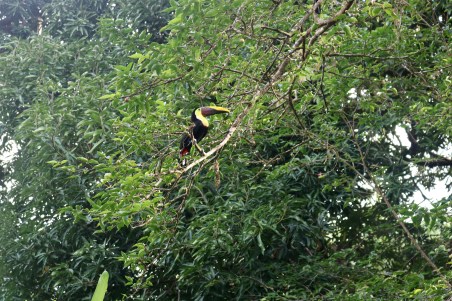
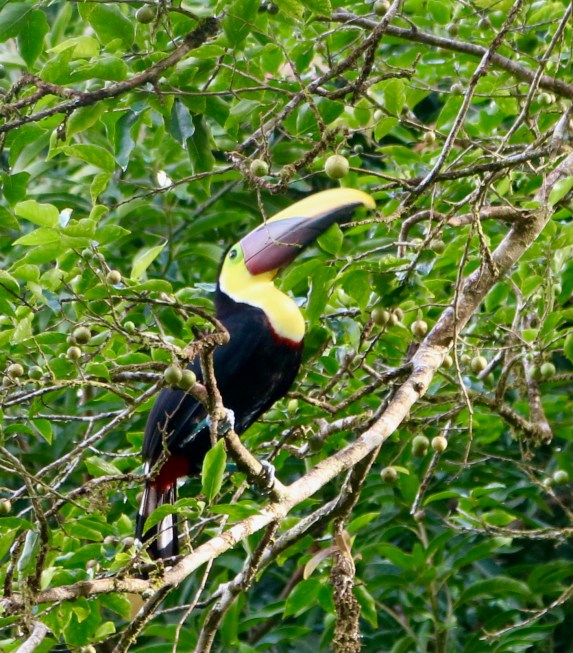
“Toucan!”
Such extravagant achievements of Mother Nature! Up close and personal (they delighted us every day at Casa Nirvanita) these birds supersede their images as cartoon characters and cereal box ambassadors.
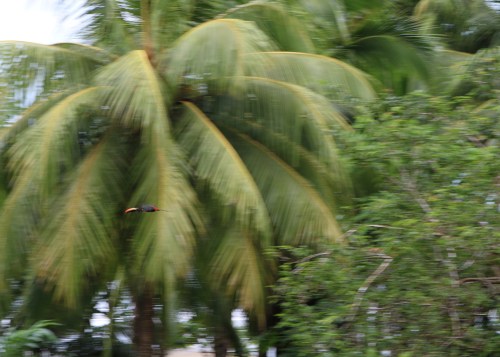
A Toucan in flight!
CHAPTER THIRTEEN
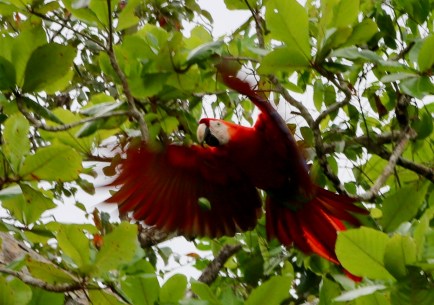
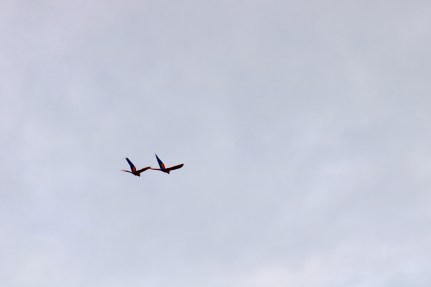
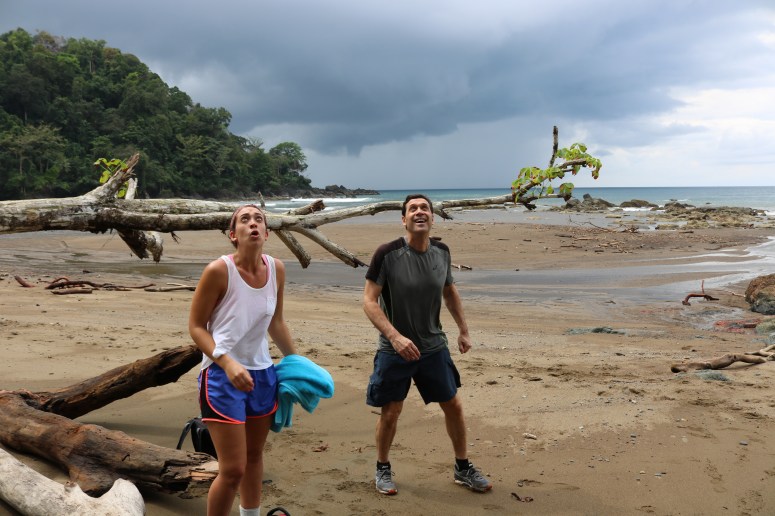
As for the Scarlet Macaws. 😦 Costa Rica’s Osa Peninsula is a surviving outpost where these largest of parrots still exist in the wild. The birds are far too prized as pets and must be protected from poachers. They are intelligent, noisy, adorned with royal avian plumage, and several of them lived in the jungles along our beach.
Scarlet Macaws mate for life.


CHAPTER FOURTEEN
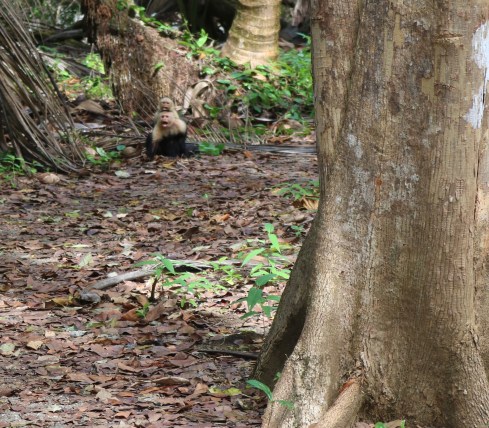
What about the monkeys? Captivating, cute, ferocious, and eerie. Never have the unfathomable spans of evolutionary history come to such a howling stop as the moment I watched a White-faced Capuchin Monkey—after days and days of observing them swinging, sailing, and lounging in the jungle canopies—stand up and take a few steps. Spine tingling and funny bone shivering.
All four species of Costa Rica’s native monkeys inhabit the Osa Peninsula. Three of them, the White-Faced Capuchin, Geoffrey’s Spider, and the Mantled Howler swing through the treetops using prehensile tails, which are like an added limb. A fourth species, the Central American Squirrel Monkey, uses its tail mostly for balance.
Those prehensile tails gave a colony of White-faced Capuchins an unfair advantage over us when we entered one of their fiercely protected territories while hiking from Casa Nirvanita to Playa San Josecito. The little rascals probably wanted any picnic hidden in our backpacks and from what I observed, they were good at getting what they wanted—the wrack line near their territory was cluttered with tourist debris. (But no dead bodies.) The monkeys outnumbered us by about 20 and they closed in from every direction, snarling, screaming, and chasing. We’d been enjoying the meditative daze of a good hike, weaving in and out of the jungle, up and onto sandy coves, over rocks and through rivers. The surprise attack left us no way out—we were the monkeys in the middle! So we picked up the pace. So did the monkeys. We hollered at them. They screamed back. My husband grabbed a giant stick. The monkeys grabbed sticks. Then, my husband began whipping a big palm tree branch around—trying to take out and sweep away as many agile aggressors as possible. And that’s when I saw an alpha male wrap his prehensile tail around one of those really big palm tree branches and begin running at us with it! The battle of wits only ceased when we made it through that monkey pit and out the other side, where Playa San Josecito sparkled in the sun.
We waited until the tide receded far out before hiking home. Low tide gave us a much-desired option for skirting the monkey zone (we could hike out on the beach, through rocks) and when we began to intrude too close to the monkey pit, they approached the edge of the jungle—some of them venturing out onto the rocks—just to let us know we’d made the right decision about where to walk.
Watching monkeys in the trees.
White-faced Capuchin Monkeys.


Hiking through a colony of bold monkeys. Note the alpha male with a soldier on his back screaming in harmony at us.
The world-class hiking trail that passes in front of Casa Nirvanita to Playa San Josecito crosses Rio Claro (best to try it at low tide) near a sea turtle sanctuary.


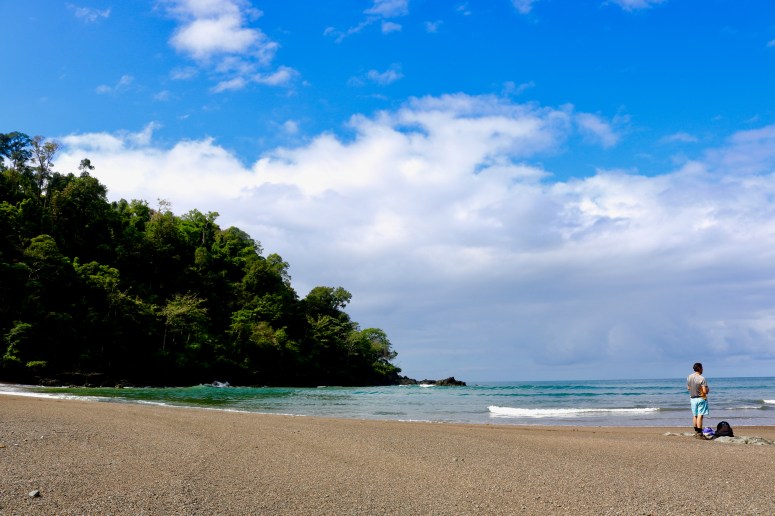
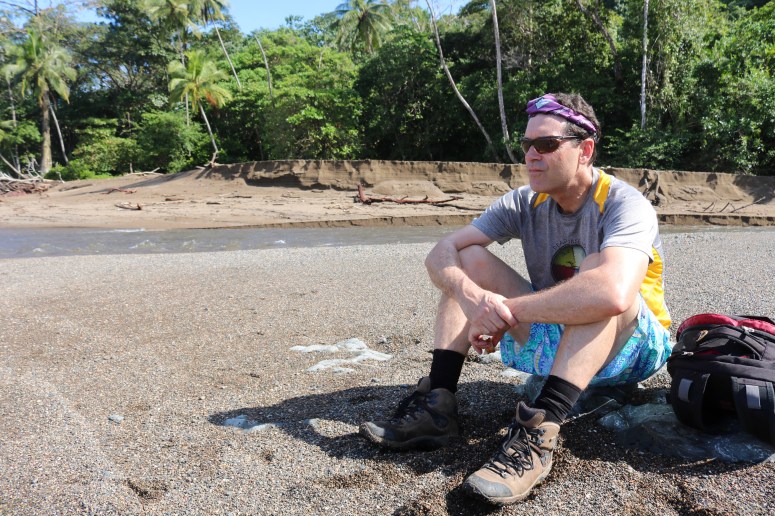
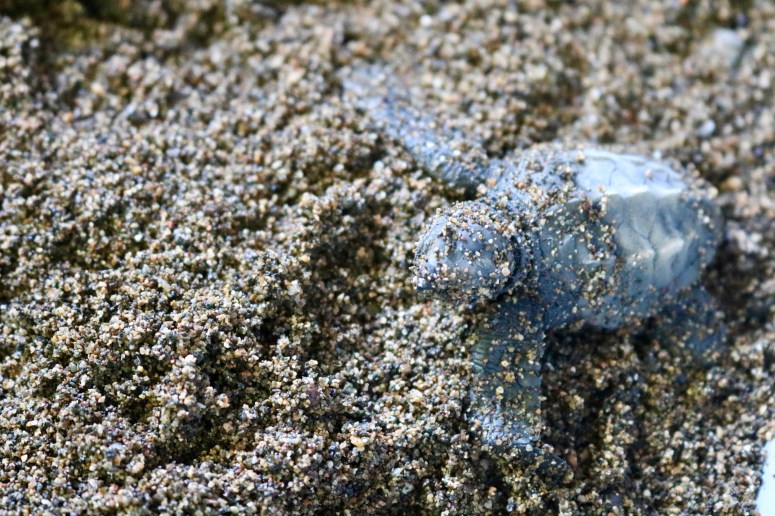
Newborn turtles at the sanctuary!
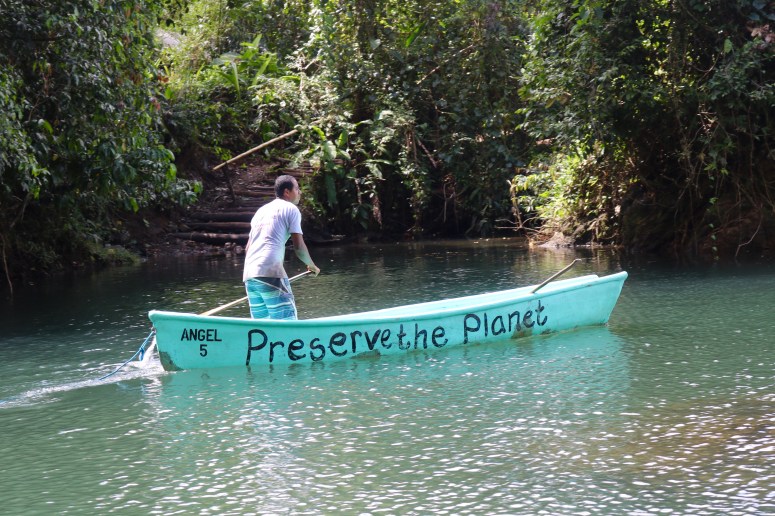
The current in Rio Claro is strong. When the tide is high, or if you don’t want to try wading through, there’s an option to take a short boat ride over the river for a couple of bucks. The money funds the mostly-volunteer staffed turtle sanctuary.
Views from the trail inside the jungle.

Afloat at Playa San Josecito. Not a secret beach, but a beautiful one. Except for the nasty monkeys on the trail closer to the beach, the hike to get to San Josecito is mid-range rugged, spectacular, and muddy.

A Ctenosaur? Iguana? Ticos walking home with their impressive daily catch.


CHAPTER FIFTEEN
Confession time. We weren’t completely isolated from the real world at Casa Nirvanita. The same hiking trail leading to Playa Josecito in one direction, led to the modest (as of this writing) village of Agujitas about 3 miles away in the other direction. We took a walk one day, and found the trail linked up with one of the most elite eco-lodges on the Osa Peninsula. The town of Agujitas has a variety of good value lodgings too.
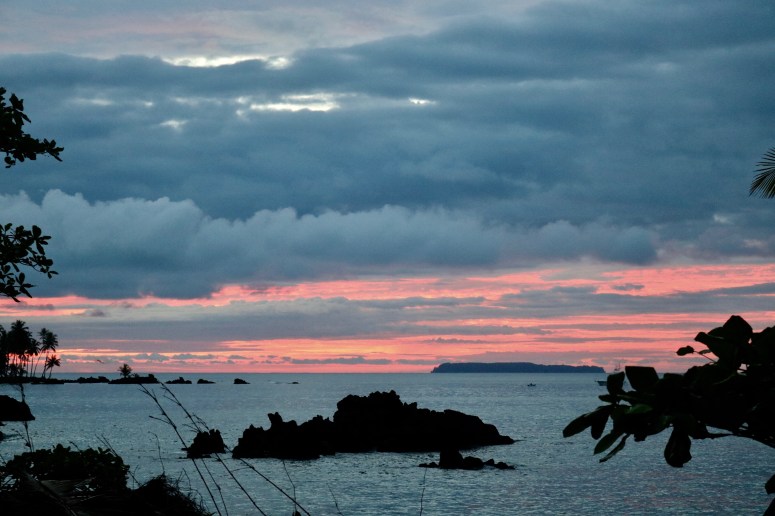
We left in the afternoon for our hike to Agujitas, found a great place to enjoy a drink and a snack, and hustled back onto the trail hoping to make a safe return to our Jungle Palace before dark. I was the last one—taking too much time to watch the sun set in various coves from too many stunning cliffs—and as the jungle was going dark, the Howler Monkeys began to cry out from the tree tops. Few experiences will raise the hair on your neck the way finding yourself alone in the jungle at night with Howlers hootin’ and yowling does. Their calls amplify sensations of feeling lost in an ancient (familiar?) and unnerving primordial otherworld.
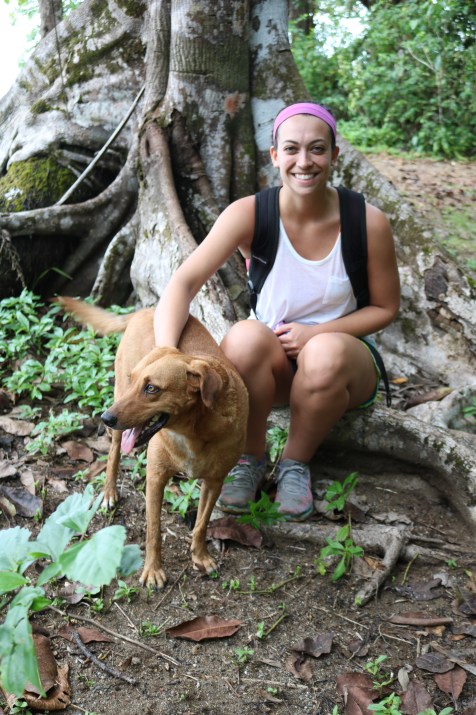
This friendly dog hiked all the way to Agujitas with us.
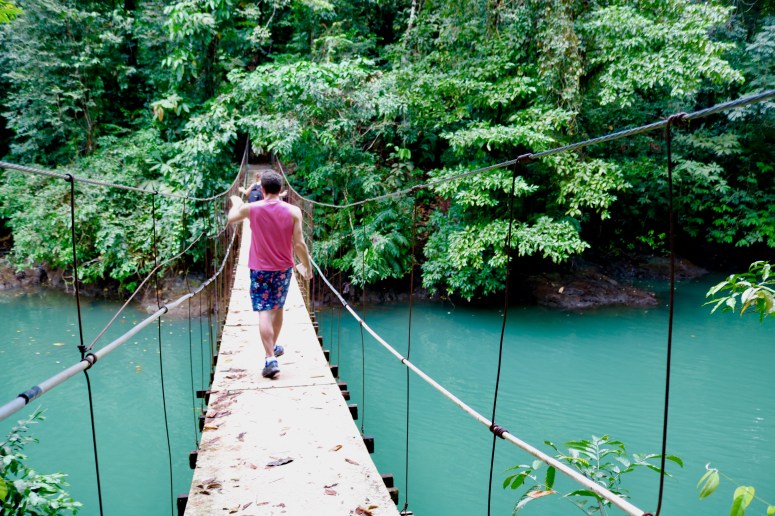
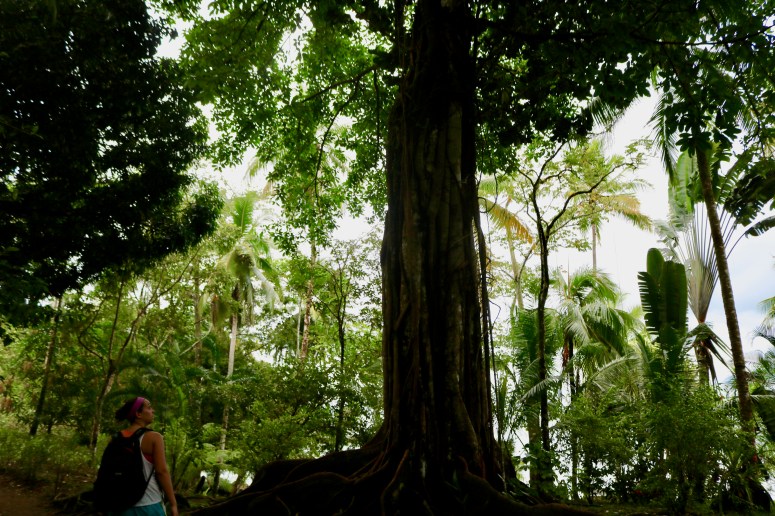
From Casa Nirvanita, it’s a 6-mile hike (round trip) to go have a beer or Piña colada or soda and a snack in Agujitas. Spectacular route with fun bridges over colorful rivers.


CHAPTER SIXTEEN
Unofficial list of wildlife we encountered:
Howler, Spider, Capuchin, and Squirrel Monkeys. Pale-billed Woodpecker. Agouti. Blue Crayfish. Smoky Jungle Frog. Scarlet Macaws. Tiger Heron. Stingray. Zebra Moray Eel. A lot of tropical fish. Pecarries. Coati. Caiman. The greatest variety of Hermit Crabs we’ve ever observed, moving around both on and off the beaches. Halloween Moon Crabs. Other crabs. Pelicans. Sea Turtle. Bats. Opossum. Parrots. Toucans. Hummingbirds. Vultures. Blue Morpho Butterflies. Other butterflies. So many colorful birds I am so sorry I didn’t record their names. Termites. Spiders. Iguana or Ctenasaur. Geckos. Toads. Frogs. Blaberus giganteus. Tailless Whip Scorpion. Leaf-cutter Ants. The tracks of a Tapir.
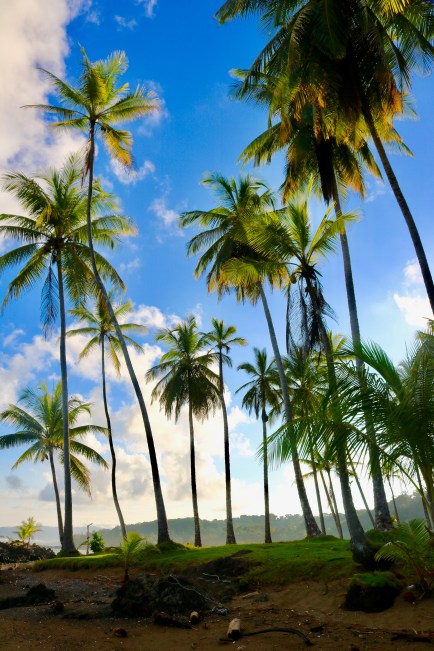
CHAPTER SEVENTEEN
Something has to be written about how we ate during our time as castaways on the Osa Peninsula: We forgot to buy crackers. There wasn’t any chocolate. No sugar. No ice cream. No cookies, cakes, muffins, or pies. No candies, syrups, or honey. No endless bags of various varieties of chips.
We prepared our meals using the foods of Costa Rica: Rice, beans, fruits, vegetables, eggs, chicken, shrimp, fish. We did have some peanut butter and jelly, too. After several days, we felt noticeably better. Perhaps this jungle diet has to be consumed while hiking every day, swimming in the Pacific Ocean everyday, and experiencing full-body pure humidity sweats all day/ everyday in order for it to bring on feelings of refreshment.
Maybe too, one is refreshed by the joys of preparing meals together and sitting down to eat them together while the music of the ocean plays in the background.
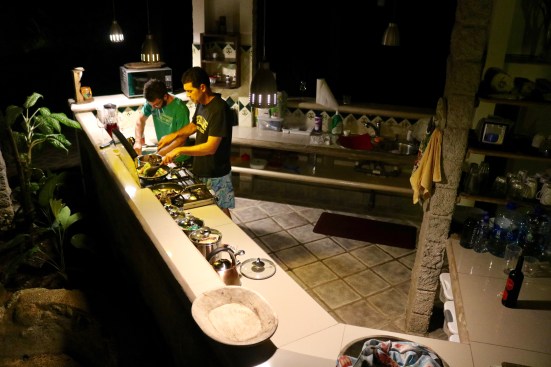
Artful meal prep in the kitchen at Casa Nirvanita.
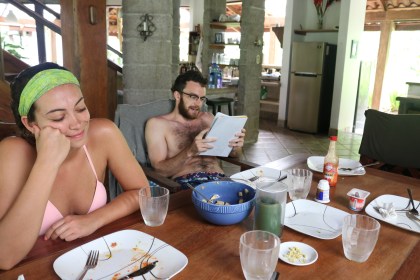
Poetry readings during brunch. (Poetry written on location, Osa Peninsula.)
I named several of our happy hour appetizers: Howler Monkey Nests. Pelican’s Pleasure. Green Iguana Slurp. Halloween Moon Crab Cakes. (Made with shredded carrots and rice, no crabs.)


Our hosts at both Eden’s Nest and Casa Nirvanita gave us chilled coconuts and we added the coconut milk to our fruit smoothie concoctions.

CHAPTER EIGHTEEN
One more pass through the once-in-a-lifetime sanctuary of peace and tranquility where I never had to lock a door or close a window or turn on air conditioning or fire up a heating system.
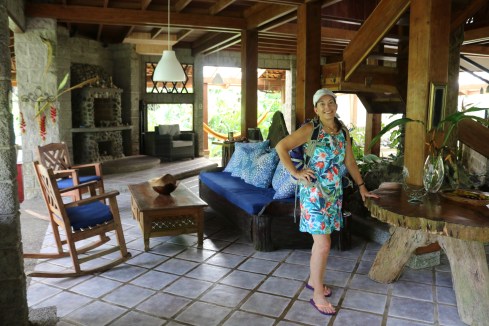
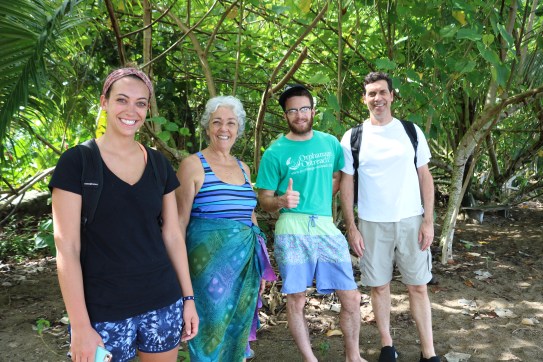
Farewell smiles with our host at Casa Nirvanita, Clara.
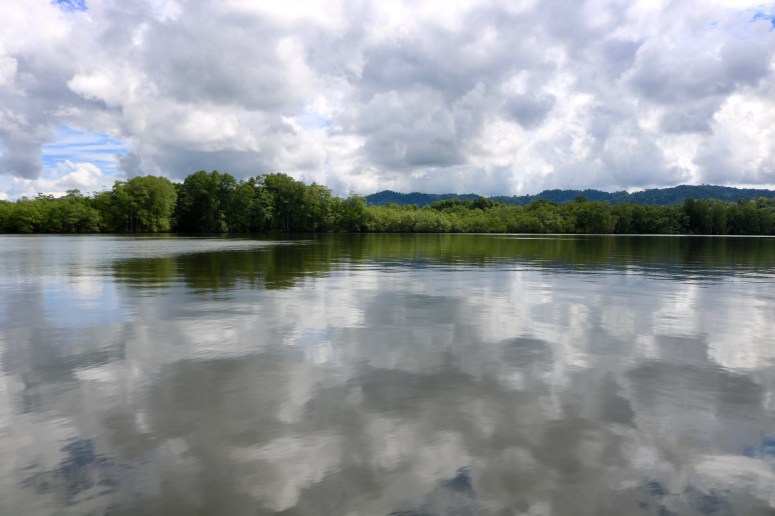
Rio Sierpe, homeward bound.
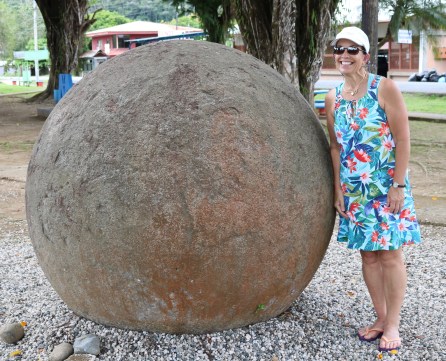
Grabbing some last-minute mana from one of the mysterious pre-Columbian stone spheres in Sierpe.
EPILOGUE
A traveler through the coastlines and jungles of Costa Rica’s Osa Peninsula won’t find grand monuments commemorating so-called glorious reigns of kings and queens. No cathedrals, tombs, or museums filled with artwork, weaponry, furnishings, or other tchotchkes of human existence disrupt the landscapes. It’s a small place, for sure. Maybe not much happened—in the storybooks of human history—on the long sweeps of curved shoreline where the Pacific Ocean has stroked the edges of magnificent jungles since forever ago. Or, perhaps, maybe some of the things that did happen—through the actions of humans recklessly searching for gold and other riches, exotic plants, exotic foods, exotic animals, slaves—were never deemed worthy of enshrinement.
All I know is that my luck did not fail me when I decided I wanted all of my family to see and learn more about one of Earth’s last surviving worlds of natural biodiversity. I hoped it would be one of those lost worlds still at work cranking out—for plucky travelers—soul sprints brought on by the one and only: Mother Nature. My good luck had to work overtime. Jungle safaris are undeniably booby-trapped with danger. Never did thoughts of Pit Vipers and the safety of my children leave me alone, especially at night when we spied an opossum in a tree and I remembered that the Fer-de-Lance likes to eat them and that a big snake was only recently seen in the very environs into which we had ventured. I also needed to find sanctuaries where we could merrily pass the time collecting shells and exploring tide pools while soaking up the sun. Somehow, we were able to sneak in 8 unforgettable days at Casa Nirvanita before the owners removed their Shangri-La from the rental market. Hopefully, it will come back on the market, because if I am ever lucky enough to return to the Osa Peninsula, I would stay at Casa Nirvanita again for all of my jungle safari adventures.
There is no other place on the planet like the Osa Peninsula.
From Osa Conservation.org:
Once an island floating in the Pacific, the Osa evolved in isolation until it merged with mainland Costa Rica by way of the same fault system that extends to California. Located along the Central American isthmus, Costa Rica itself is a hotspot of biological diversity, as innumerable species poured into the land bridge created when the two American hemispheres joined together. When the Osa Peninsula joined the mix nearly 2 million years ago, the area became a tropical landscape of unprecedented richness. The Peninsula is estimated to house 2.5% of the biodiversity of the entire world – while covering less than a thousandth of a percent of its total surface area – truly earning its title as the most biological intense place on earth.
One of the last places in Costa Rica to be settled and still sparsely populated, the Osa is covered almost entirely in magnificent, virgin rainforest extending all the way to the Pacific Ocean. Separating it from the mainland is the Golfo Dulce – one of only four tropical fjords on the planet. The Golfo Dulce is in fact the only place on the globe where populations of both Northern and Southern Humpback whales meet to birth their young. The Osa packs an unparalleled amount of land and marine species and diverse ecosystems in an incredibly small area, including:
- The most significant wetland ecosystem and mangrove forests of Central America
- The largest remaining tract of lowland rainforest in Pacific Mesoamerica
- 2-3% of flora found nowhere else in the world
- 323 endemic species of plants and vertebrates
- The largest population of scarlet macaws in Central America
- More than 4,000 vascular plants
- More than 10,000 insects
- More than 700 species of trees (which is more than all the Northern temperate regions combined)
- 463 species of birds
- 140 mammals, including 25 species of dolphins and whales
- 4 species of sea turtles
These incredible ecosystems provide invaluable services to the people who depend on them for clean air, drinking water, food, jobs, cultural resources and a stable climate – and so their conservation is critical.
GO OSA. SAVE THE PLANET.
 Excursions