O! Canada. And a Recipe for Relief.

America keeps coming undone. We act so shocked, but, honestly, what would America do without the drama of dysfunction? It’s as though a plague of uncivilized humanity has escaped from Hater’s Anonymous rehab to indulge in PDR’s: Public Displays of Relapse. They dream of reestablishing a culture of coddled cads who think PDBB’s—Public Displays of Boorish Behavior—should be acceptable forms of discourse.

It’s utterly repulsive. I don’t like America right now. I’m not feeling the love and I loathe what is becoming of my country. America—with its farce of an election—is being dominated by a cesspool of withered minds and floppy mouths belching forth a stench so foul, I can’t breathe without gagging. This does not mean I’ve lost faith in America. But still—my broken heart!

The good news is, there are some bright horizons—like the one to our north, and downeast from Maine. If any Americans out there, (like me), are seeking some relief, stop for a minute and say a prayer of gratitude for our position on the planet next to Canada.

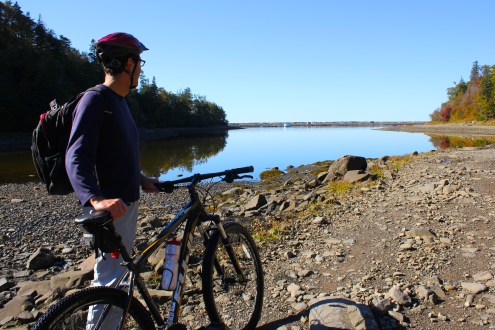
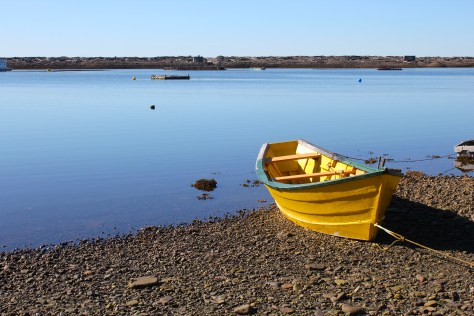
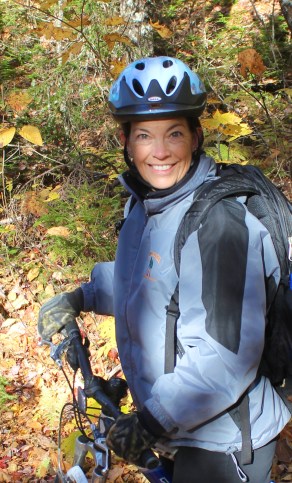
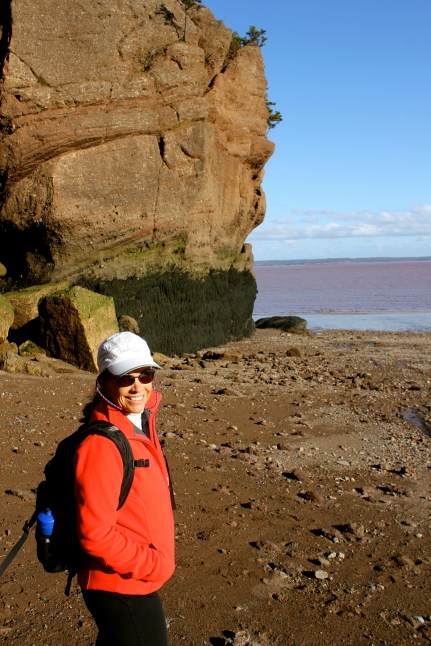
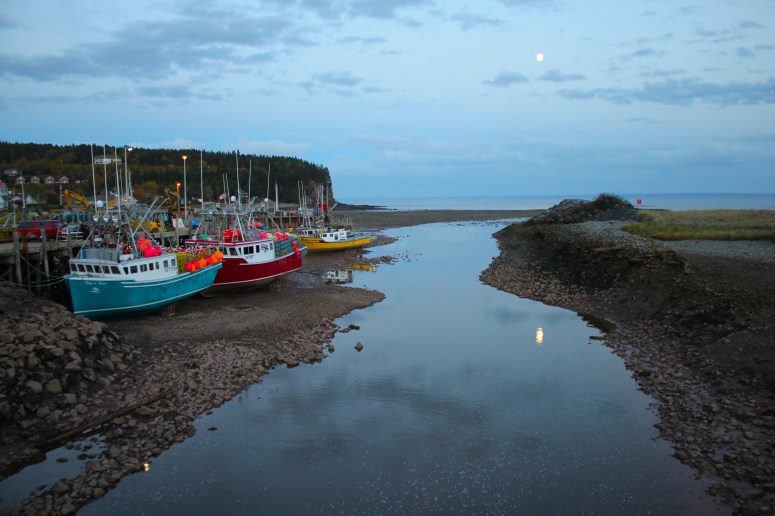
Because across the border and into the Maritime Provinces, my husband and I have always found kindness, resplendent scenery, powerful tides, rejuvenating hikes and bike rides, nurturing food and drink, and wonderful music. These maritime—“of the sea”—lands include Nova Scotia and Cape Breton Island, Prince Edward Island, and New Brunswick. I’ve traveled to all of Canada’s Maritime Provinces, though not as often as I’d like. From where I live, Halifax is an easy flight out of Boston. Prince Edward Island and New Brunswick are road trip excursions. At the end of those road trips, a soulful and quiet peace awaits. It’s a welcomed type of slow travel that rarely moves beyond first gear, especially if you travel late into autumn which is what my husband and I just did.

On one hand, the Canadian Maritimes-style peace is so slow and so quiet that I don’t want to tell anyone about it. On the other hand, I’m not so sure people are interested in true peace anymore.

—Or their own souls.

—Or the souls of others.


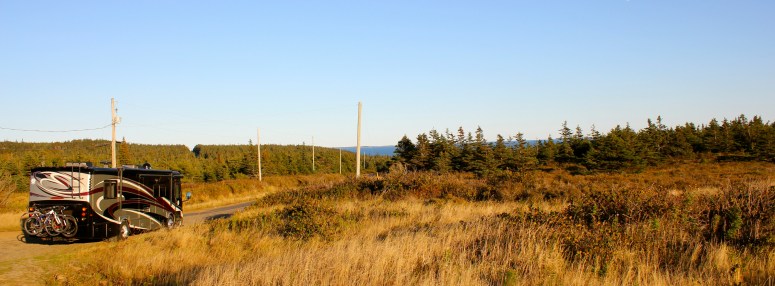
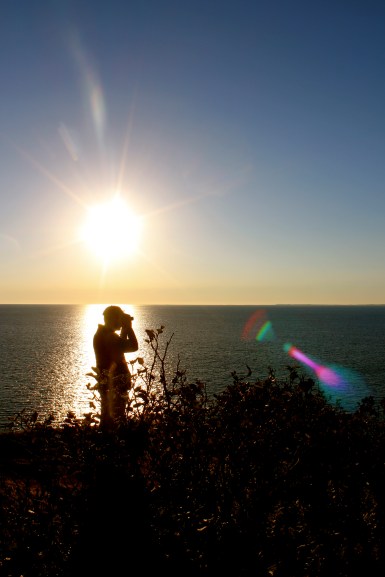
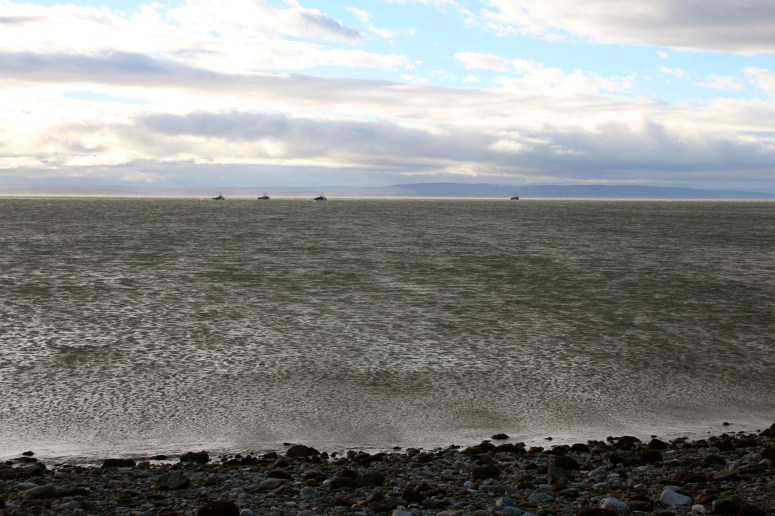
Upon arrival in Canada, we stayed in a campground overlooking the Bay of Fundy from the town of St. Andrews, New Brunswick. The date was Canada’s Thanksgiving holiday weekend. We cooked dinner outside, the sun set, and soon a fellow camper stopped by our campsite to invite us over to his campsite for an evening of music. Thus passed our first night away from America as we found ourselves taken in—and taken away—by a fiddle player, guitar players, and singers performing songs and hymns in the distinctive, Celtic-derived traditions one looks forward to hearing in the Canadian Maritimes.

A few days later, my husband steered our motorhome into the belly of a ferry bound for Grand Manan Island—part of an archipelago of islands afloat in the mouth of the Bay of Fundy. The great American woman and writer, Willa Cather, spent many peaceful summers on Grand Manan, which is how I first learned about the island.
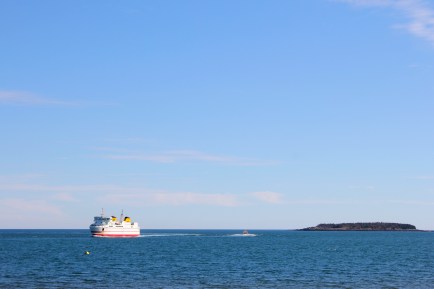
img_2238

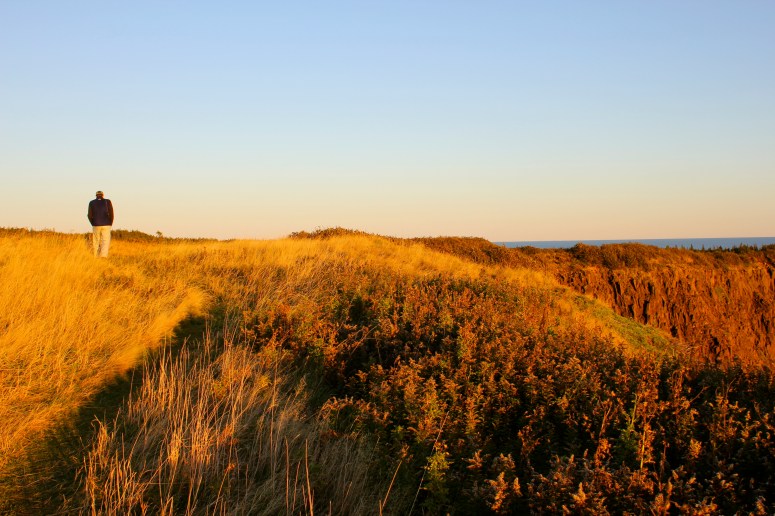
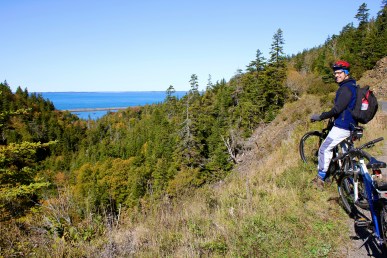
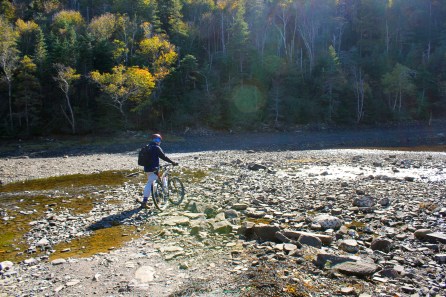
On Grand Manan, we found North Head Bakery and bought ginger molasses cookies, macaroons, warm baguette, sugar donuts, and still-steaming raisin bread. We found walking trails at the very edge of majestic cliffs with only fresh air to steady our wobbling legs. We found islanders that waved hello whether we were driving our huge motorhome on their narrow roads or riding our mountain bikes up and down their hilly routes.

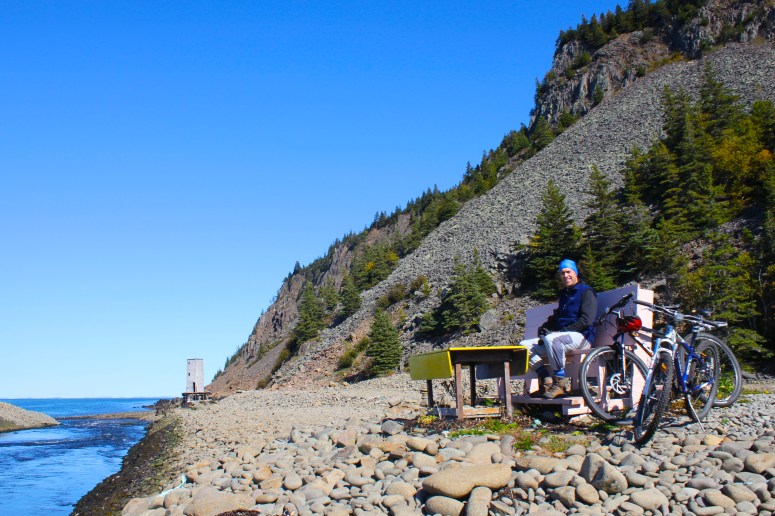
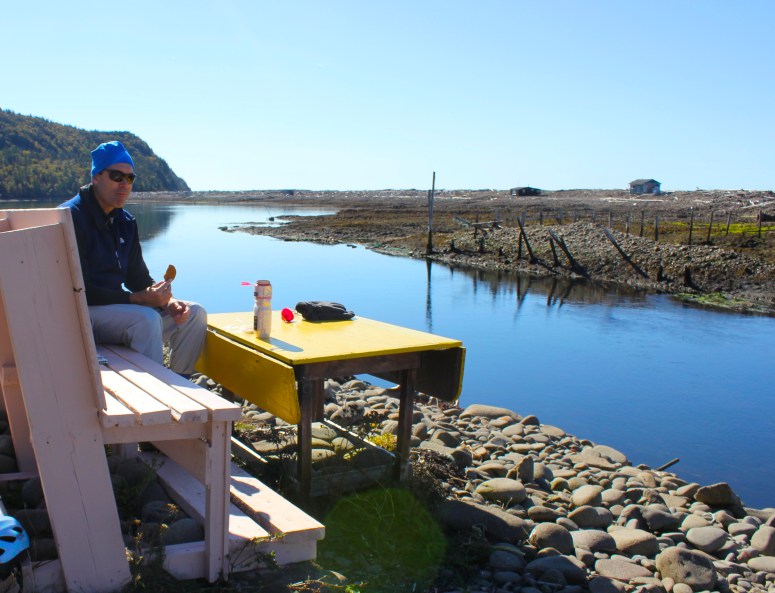
We biked to the infamous island outpost of Dark Harbour where we enjoyed a unique place to have a picnic. We discovered dulse, a superfood sea vegetable (aka seaweed) harvested by hand from the ocean and dried on rocks under the summer’s sun.
img_2107

img_2146

img_2152

img_2136

img_2142

img_2156

img_2163

img_2141

img_2160

img_2164

Willa Cather wrote: When kindness has left people, even for a few moments, we become afraid of them as if their reason had left them. When it has left a place where we have always found it, it is like shipwreck; we drop from security into something malevolent and bottomless.

America is shipwrecked. It has been sunk by malevolent and bottomless madding crowds.

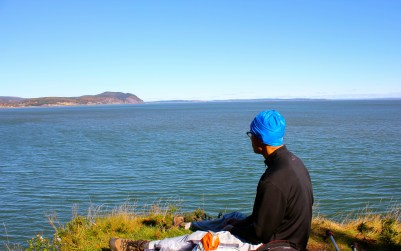
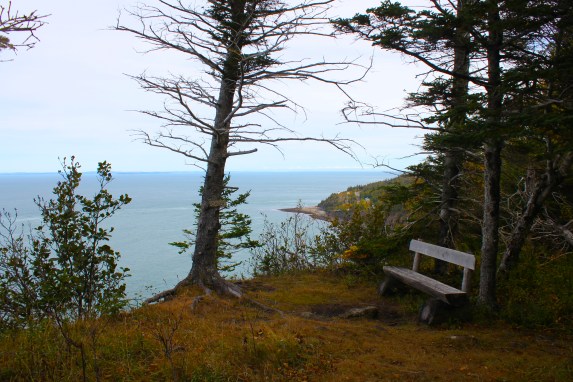
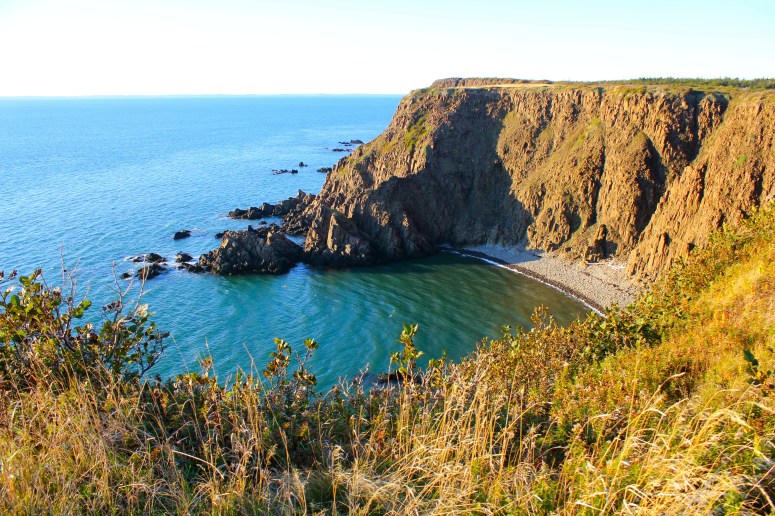
A history of shipwrecks surrounds Grand Manan Island. Her cliffs are dangerous, wild, and windswept. One stands on the edges of the island in the year 2016 and considers the consistent tug of Earth’s greatest tides, those forces always at work eroding the truths we no longer seem to value and uphold as self evident. Indeed, a faraway island can leave a traveler like me, a woman unmoored from her own country, feeling hopeless and stranded. I found myself wishing the tides of the sea could take me away. Then I wanted them to promise to bring me back. I wanted to present the Bay of Fundy tides to the rest of the world, so everyone could notice how powerful and precious and vast they were, and how small each and every one of us becomes when we stand facing the phenomenon of Earth’s relentless waters.

img_2229-2

img_2231

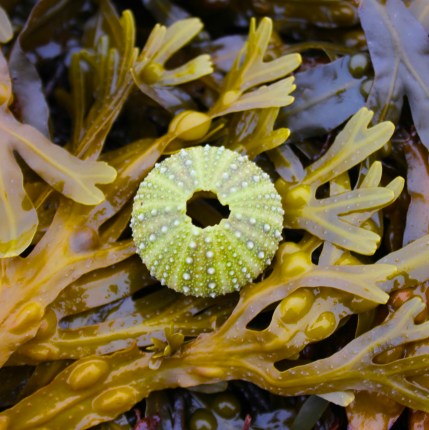
I asked the tide to bring me sand dollars—

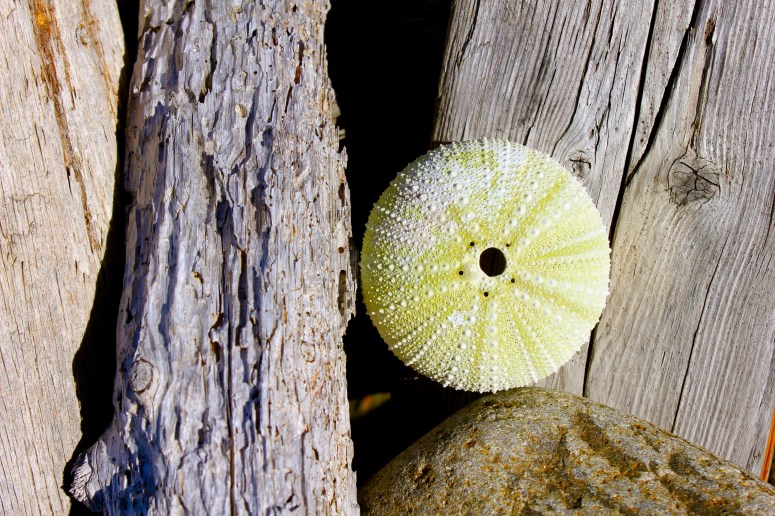
Intact sea urchins—

Pretty sea shells—

Fossils from a time when the Earth was not yet ravaged by the egos of men and women.
img_2172

img_2187

img_2167

img_2177

img_1962

img_2224

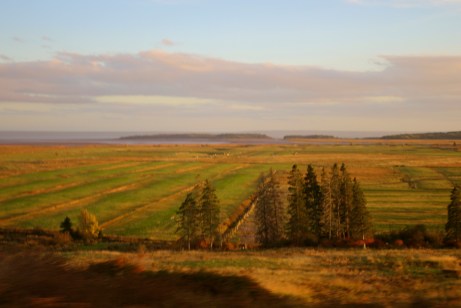
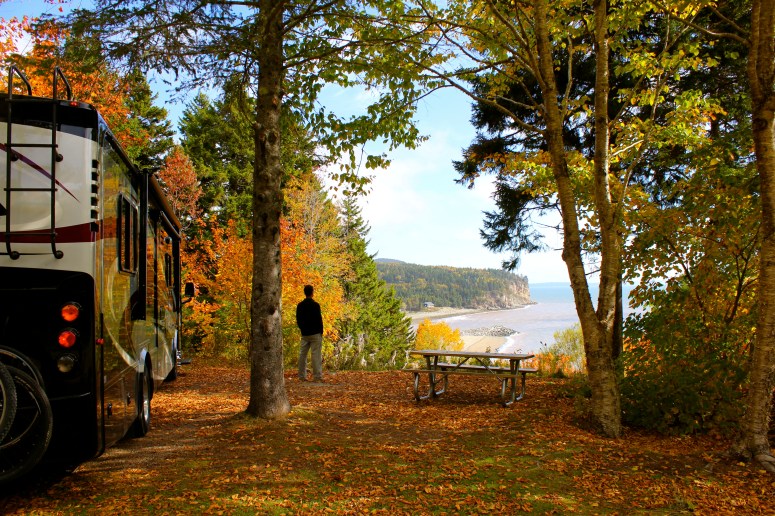
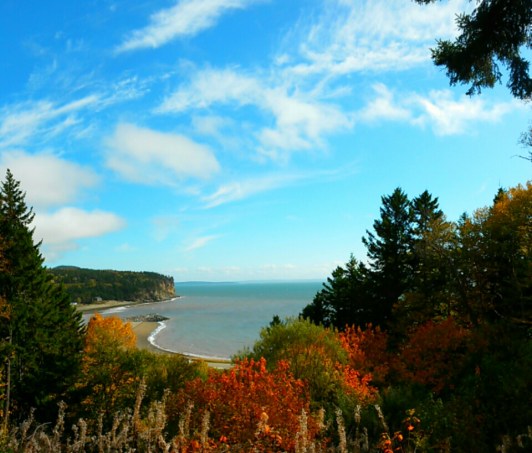
The tide took me from the island of Grand Manan to Fundy National Park where one of the most stunning campsites, Site 59, overlooked the whole wide world, in peace.
img_2257

2016-10-13-10-57-38

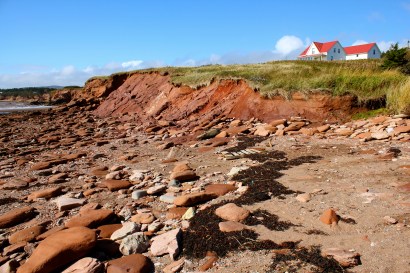
Our hikes there included premier trails through coastal forests, good doses of satisfying physical exertion, and solitude. Our bike rides and walks upon the ocean’s exposed floors elevated our spirits to our most grateful selves while pastoral settings inspired us to believe romantic thoughts about life. Cliffside picnics made our egg salad sandwiches taste royal enough to be served on golden paper plates.

img_2391

img_2264

img_2314

img_2382

img_2376

img_2417

img_2299

img_2310

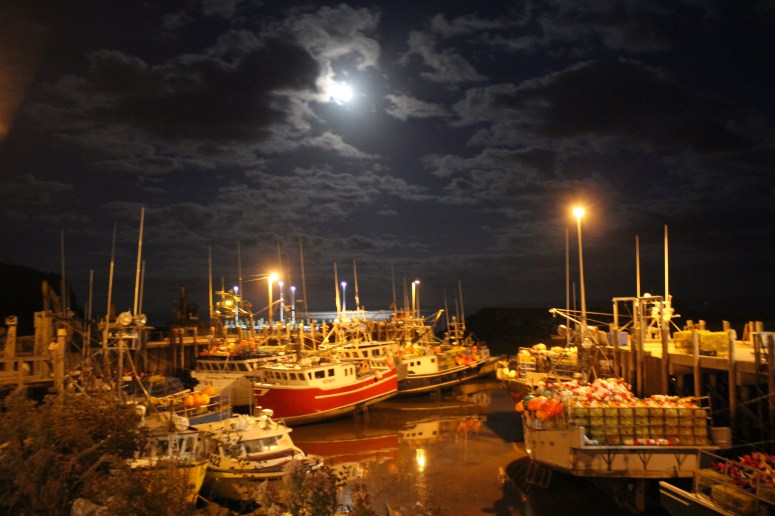
We found friendship in the small, small village of Alma at the base of Fundy National Park where we were given the last of the season’s fish chowder on an outside deck at Tipsy Tails as the weather began to turn. Our server said: “Two bowls of chowder, two beers, and two blankets?” then she invited us to join in with the town later that night to celebrate the morning’s anticipated launch of the lobster fishing fleets when the tide would be high enough to float all boats. From our campsite, perched over the village, we heard the music commence as the moon was rising. We bundled up and walked into town using a sturdy, cliffside staircase comprised of more than 100 steps. Sea ballads, Scottish and Irish folk songs, and more hymns filled the night. The next morning, a bagpiper played as gale winds and dark clouds cast shadows over the faces of babies snuggled in the arms of mothers and grandmothers and aunties. Young men clung to boats jammed with lobster traps and before long, the boats sailed through the winds and out of sight. All of the fishermen faced long, hard, hopeful days at sea.

img_2323

img_2319

img_2317img_2329

IMG_2349.jpg

img_2366

20161014_080727


Upon re-entry into the United States, a guard asked us if we had any plants, fruits, or vegetables from Canada in our motorhome. We said no. He said he was going to have to come on board and see for himself. He opened our fridge, seemed satisfied, handed us our passports and said, “Welcome home.”

We did have one vegetable on board and I’m glad it wasn’t confiscated. It was the dulse, which hid itself well in spite of smelling like the boldest of low tides. The taste of it, right out of the bag, is just as strong and gamey as the aroma. But it is a legendary superfood with phantasmagoric health benefits and I was determined to learn how to cook with it.

Within a day of our return, I created my own version of fish chowder inspired by travels through the Canadian Maritimes and our discovery of the world-renowned dulse harvested in Dark Harbour, on Grand Manan Island. I used simple ingredients kept stocked in our kitchen. As I cooked, I reminded myself of how kind the people in Canada had been to us. When speaking about America’s sordid election, the Canadians we met didn’t hesitate to express their faith in America and many showed compassion for the unfortunate relapse into dinosaur-brained recklessness going on throughout every state. One man assured me, “America will do the right thing.”

But I don’t know…Willa Cather’s peaceful visits to Grand Manan ended in 1940 when safe passage to the island was threatened by German submarine activity in the Bay of Fundy.

If America wants to be great again, it must become kind first. Where there is kindness, there is reason. Where there is reason, there is peace.


COMFORT AND KINDNESS FISH CHOWDER

4 cups chicken stock (I used a 32 oz. store-bought carton)

2 cups chopped onion

1 T butter

1 T flour

1 cup half and half

1 big carrot, peeled and cut into half moons

6 red potatoes chopped into half inch squares

8 scallops (I keep a bag of Trader Joe’s jumbo frozen scallops handy)

1 handful of langostino tails (also a Trader Joe’s frozen seafood product—tastes like a combo of lobster, shrimp, crayfish)

3/4 lb. of fresh cod, cut into one inch pieces

Chopped thyme, chives, and parsley from the garden

2 T chopped dulse 

2 handfuls of dulse, cut into strips for frying in olive oil

Slices of baguette bread

Saute the onion in the butter until soft, but not brown. Blend in the flour, cook slowly and remove from heat. Slowly pour and stir in two cups of the broth. (This is a Julia Child all-purpose chowder base.) Add the carrots, add the rest of the broth and cook until just before the carrots are tender. Cook the potatoes in a separate pot of water until just before they are tender. Drain them and add them to the broth and carrots. Heat on low. Add spices, salt and pepper, and chopped dulse to taste. Pour in the half and half and gently heat up without boiling. Place all of the seafood into the chowder and let cook for ten minutes. The fish will break up, adding texture and flavor to the broth.

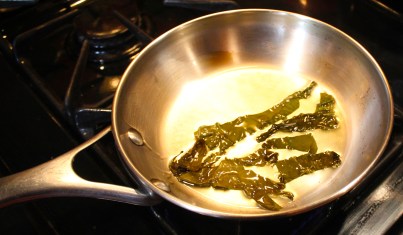
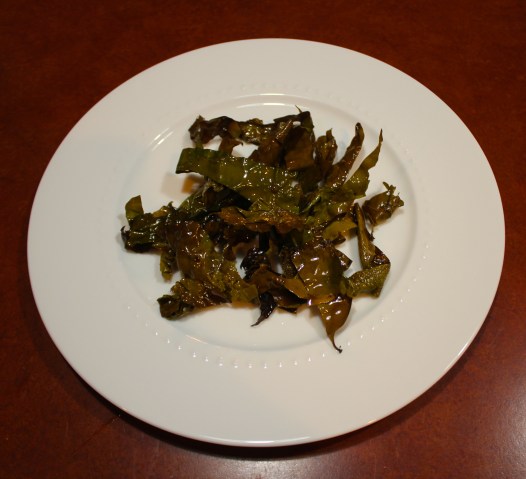
Heat olive oil in a pan. Working quickly, fry the strips of dulse, turning them once and draining them on paper towels. Toast a few slices of baguette in the olive oil. Fried dulse is tasty! It’s good dipped in salsa, too.

Serve the chowder hot with fried dulse on top and on the side.


Dulse from the market in Canada.
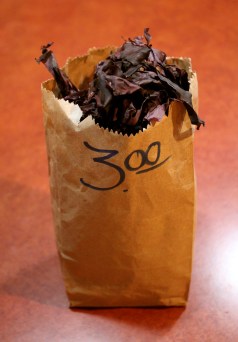
img_2462

A handful of dulse.

img_2468

Dulse separated into strips for frying.
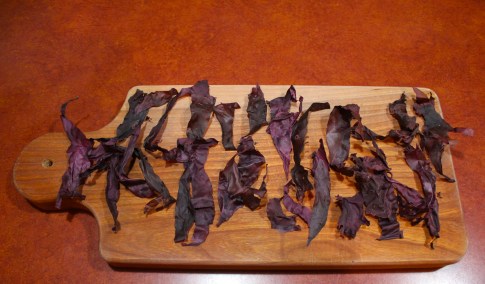
img_2469

Fried to a crisp, glossy green.

img_2470

img_2471

Baguette dulse-flavored by toasting in the remaining olive oil.
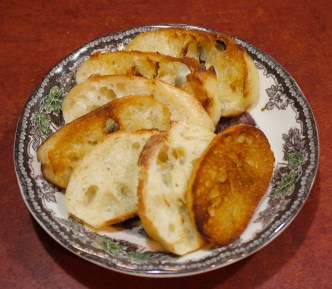
img_2473

The chowder only needs some pepper and fried dulse on top.
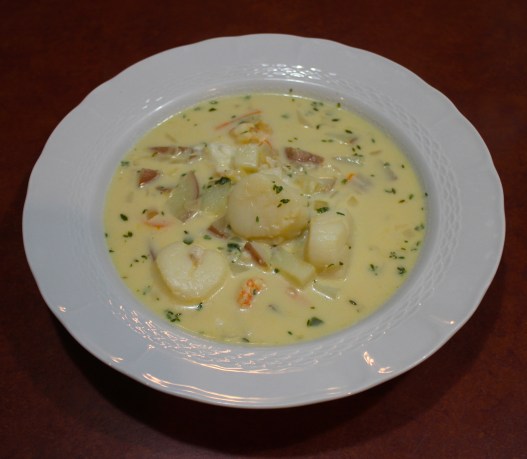
img_2477


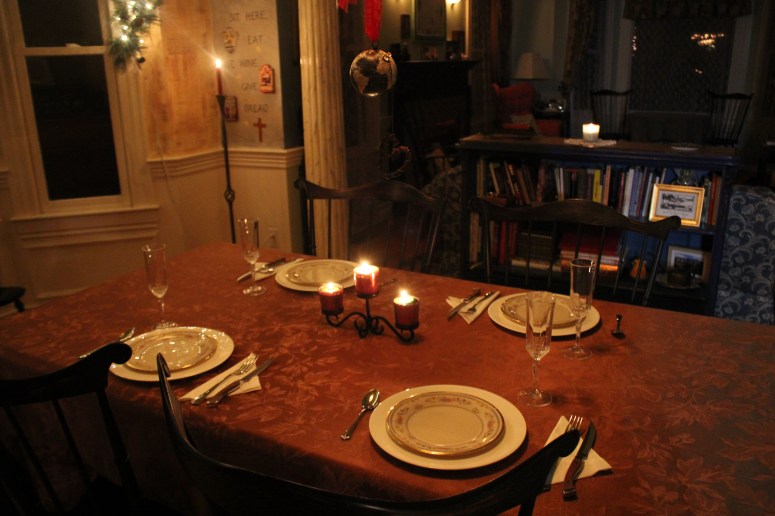
I set our table with a small arrangement of buttercups I found on the edge of our last mountain biking trail in Fundy National Park and some thyme and lavender still blooming in my garden went we came home. I found the vase at NovaScotian Crystal in Halifax when we traveled through on our way to Cape Breton two summers ago. The vase is perfect for small and sweet bouquets from the garden.
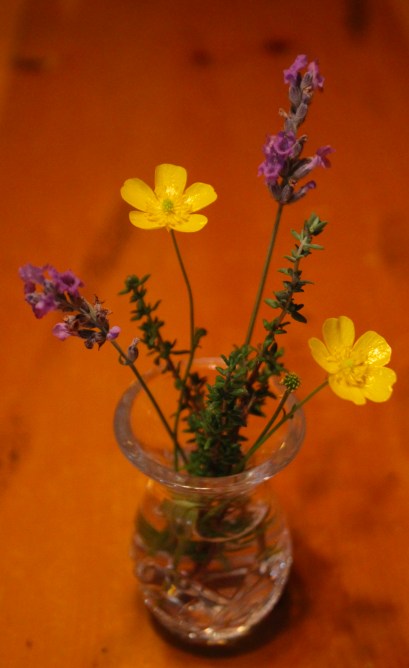
img_2464

Believe in kindness.

Tools for Sustainable Loneliness.

What do you have to show for all of your loneliness? Destructive addictions? Obsessive behaviors? Too many hours spent staring at the cobwebs cluttering up your vast funks? You ask the spiders: Are you depressed? Or are you lonely? They bite you.

Same.

One of the most pleasurable obsessions I have to show for all of my loneliness is an attraction for tools. I especially love hand tools and have loved them since my own days of yore when we young ones were neglected and allowed to play with really cool, authentic things that didn’t come to us road-blocked behind rules, regulations, age restrictions, or trigger warnings.

On any given summer’s day in the times of yore, I’d take a few slow laps around the family garage before setting out to wander through the fading frontiers of America’s un-gentrified, suburban free ranges. Many family garages displayed a good selection of random tools and mine was one of the best being managed, as it was, by my dad, the United States Air Force man who grew up as the oldest boy on a farm. I went for Dad’s hammers, saws, shovels, maybe some pliers, and an ax. I’d load my wagon with Dad’s tools and leave home. Texting Dad in order to ask permission for engaging in the behavior of helping myself to his tools was, blessedly, not possible. Besides, I was following orders from Mom: Go outside and play.

On my way to the ancient childhood hinterlands, I’d stop at new-home construction sites, peruse their junk piles for lumber and add choice finds to my wagon. I planned to repurpose everything into an outpost. My outposts were repeatedly attacked, sacked, and plundered. I repeatedly rebuilt and reinforced. Dad would ask, whenever one of his carefully maintained tools went missing: Why? Why can’t you remember to bring the tools home? Why can’t you put them back where they belong? Why can’t you return them in the same condition you found them? Where are they?

They are somewhere in the woods of Indiana and/or the foothills of the Sonoran Desert in Arizona. It was in those places where I learned, on my own, how to love being lonely. A lot of children discover how to love their loneliness within the pages of books. For me, it was tools. If you take a hammer and hold it like you mean it, it becomes like a divining rod—leading you on to worlds of creative possibilities and sustainable satisfaction. Pounding a nail true, hits the spot every time. Success. Pleasure. Purpose.

I’m still a lonely girl, and I’m still loving—and losing—tools. Recently I lost one of my favorite gardening tools—my soil knife. She is a substantial hunk of steel fastened onto a sturdy handle. Her hunk-of-steel blade has one sharp edge and one serrated edge, making her a champ for slicing into the soil to lift out weeds and/or for sawing apart the gnarly root balls of plants. There’s also a handy v-notch cut out of her blade for ripping through twine. The handle of this tool, BTW, is neon orange—designed especially to help lonely wanderers, afflicted with an array of distraction disorders, find their tools when they lose track of life. My gardening tool will come back to me when my prayers to Saint Anthony make it though the queue. Until then, I’ve distracted myself with the old pitchfork, an outstanding hand tool for the quiet work of digging out unsustainable turf in order to replace it with beautiful, and more sustainable, gardens.

********

So it should come as no biggie surprise that when a lonely girl like me lands, in her luxury gypsy motorhome, in the parking lot of a truck stop near Gardiner, Maine, late at night, with the husband she met when she was too lonely to care about boys, and that husband says what do you want to do tomorrow—Lonely Girl looks at a map, opens a couple of cold beers, and can’t wait to answer the question. I open the windows, too, and speak to the hum of idling truck engines, all at rest after long days on the road. I keep romantic ideals about what I want to do and what I hope to find tucked in, and simply suggest a list of options for the next day’s adventures:

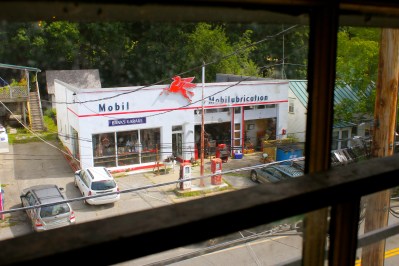
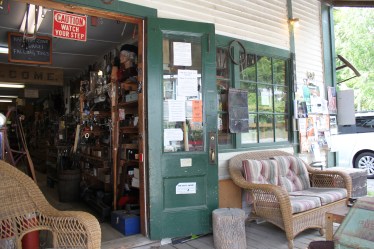
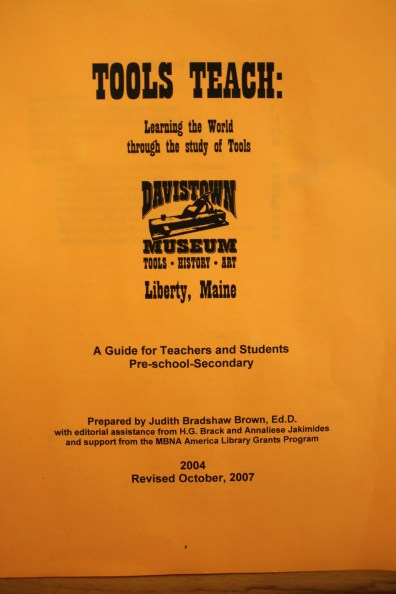
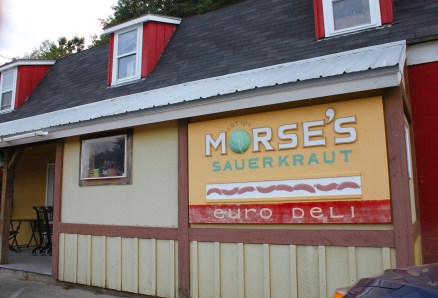
The Liberty Tool Company in Liberty, Maine. The Davistown Museum, across the street from Liberty Tool. And Morse’s Sauerkraut Euro Deli in the middle of one-of-the-best nowheres, which just happens to be on our route to Camden, Maine, the next day’s destination.

To lonely people everywhere, I say go to where lively spirits live their obsessions. You might discover that what you thought was loneliness might only be a longing—for what’s real and what’s cool and what’s peace and what’s good.

There are a lot of places in Maine where scholars, intellectuals, and classic passionate folks maintain playgrounds for those of us who choose to sustain our most lovely lonelinesses through the practice of learning all we can about what we like. For those of us who aren’t lonely at all, unexpected excursions and serendipitous discoveries are just plain fun. Liberty, Maine is an amusement park for the brain. (Go before the bourgeoisie litter the sidewalks with their Starbuck’s cups.) Even just watching the following video, about The Liberty Tool Company, offers the viewer a restful excursion:


********

If you go to Liberty, remember to pace yourself. The Tool Company will take you far, far away. I found a prayer card for fifty cents, a book by William Trevor for a buck, (The Day We Got Drunk On Cake), a chisel engraved S. J. Addis from London (late 1800’s?) for $2.50, an L.S. Starrett Co. divider for $3.00, and two Road and Track Magazines for $3.00 each. My husband found tools to keep in the motorhome for random repair work.

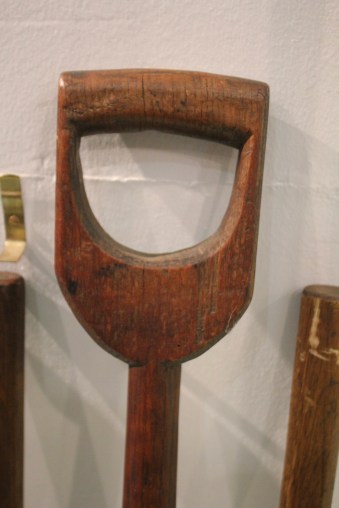
Hopefully you’ll reserve some brain power after your excursions through the tool store, because a trip across the street to the Davistown Museum will pretty much set your brain on fire. It’s a hands-on experience. You can touch and hold tools from a long time ago. Like a pitchfork from the days of the Revolutionary War, procured from Concord, MA. Slip your hands through the wooden handle and think about the work you might have performed, while keeping three day’s worth of provisions and weaponry strapped onto your body. You were an elite Minuteman, one of the Sons of Liberty in Massachusetts and, as such, you lived your life ever ready to enter into battle at a moment’s notice.

Or kneel beside the cobbler’s bench and examine its piles of tools. All of those tools and one artisan needed to fashion shoes, by hand.

Peer through a hazy glass case at a curious collection of wampum, one of the largest in New England on public display.

There’s a historic Wantage Rule—used to measure the volume of beer—it’s one of the earliest examples of American colonist’s Robert Merchant’s fine workmanship which came to equal the quality of work being produced in England long before the Revolutionary War.

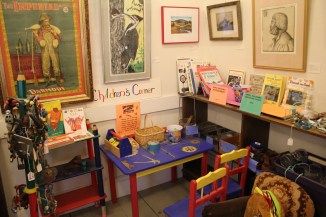
There’s a fabulous children’s corner. Children can invent and build tools. Adults can gain access to research and resources supporting the value of studying the art and history of toolmaking.

There’s art—a lot of great art by contemporary artists at work in Maine.

There are so many tools, from so many chapters in history, to admire.

There’s a Civil War crutch.

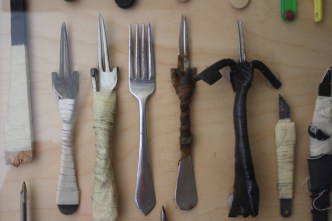
There’s a chilling display of prison tools—made to be used as weapons by prisoners.

Some things are for sale. I bought a painting and two hammers. One of the hammers is completely hand made.

If you need to take a rest, there’s a nice porch where you can sit awhile.

********

After our time in Liberty, we hit the road for Camden State Park where we planned to set up camp for the next several nights. En route we had no choice but to stop at Morse’s Sauerkraut Euro Deli as per a recommendation from our son. He goes to Union, Maine with his comrade-in-drumming arms and fellow Slow Roasters musician, Freedom, to mine stone from ancient quarries for building percussion instruments. They also study drumming and percussion practices from secret sources. Upon hearing that we would be rolling through Union on our way to Camden, our son alerted us to the existence of a gastronomic outpost known for serving and supplying all comers with the most flavorful German food in the universe.

As it turns out, Morse’s wasn’t the only unexpected German-themed thing that happened to me as a result of my road trip via Liberty, Maine to Camden. There was a surprise literary excursion into one of those Road and Track magazines I’d acquired…an issue dated May 1972…which I thumbed through before packing them up to be sent away to my son in Brooklyn.

That part of my adventures and special finds in Liberty, Maine must remain secret until my son receives the magazines. He is the most passionate automobile enthusiast I’ve ever known—and Maine has plenty of places where that kind of lovely loneliness is sustained, too. Like the Owl’s Head Transportation Museum in Owl’s Head, Maine, (not far from Camden), where we went a few times when he was a little boy. There, his lovely, often lonely, attraction to automobiles and cool airplanes was sustained. We enjoyed car shows and once, we flipped out over the super-exciting experience of watching—and listening to—a GeeBee Racer airplane fly.

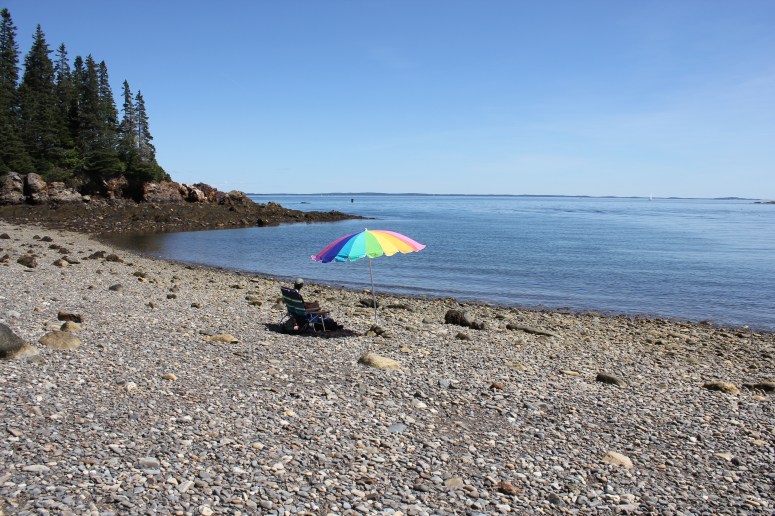
The state park at Owl’s Head is free. The rock beach there still rocks.

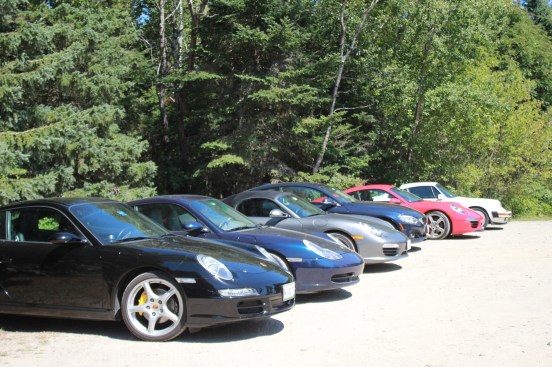
Random collections of Porsches were sunbathing in the parking lot of Owl’s Head State Park when we made our most recent journey there while camped in Camden.

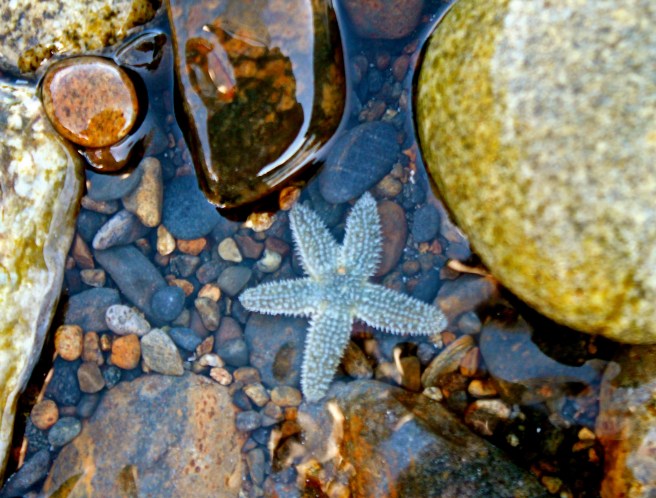
And the tide pools…

It all makes me want to get lonely.

********

Liberty, Maine.

IMG_0297

IMG_0300


IMG_0307

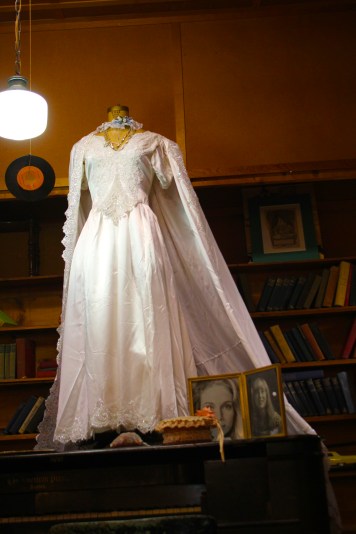
You can buy books and a wedding dress.

IMG_0304


Children’s Corner at Davistown Museum.

IMG_0316

IMG_0313

IMG_0311.JPG

IMG_0315


Cobbler’s Bench.

IMG_0338


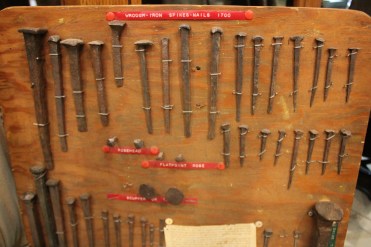
Historic tools.

IMG_0321

IMG_0327


The hand-carved handle on a pitch fork from Concord, MA

Revolutionary War period.

IMG_0324

Creepy weapons made by prisoners.

IMG_0336


Always-welcome Maine humor.

IMG_0343


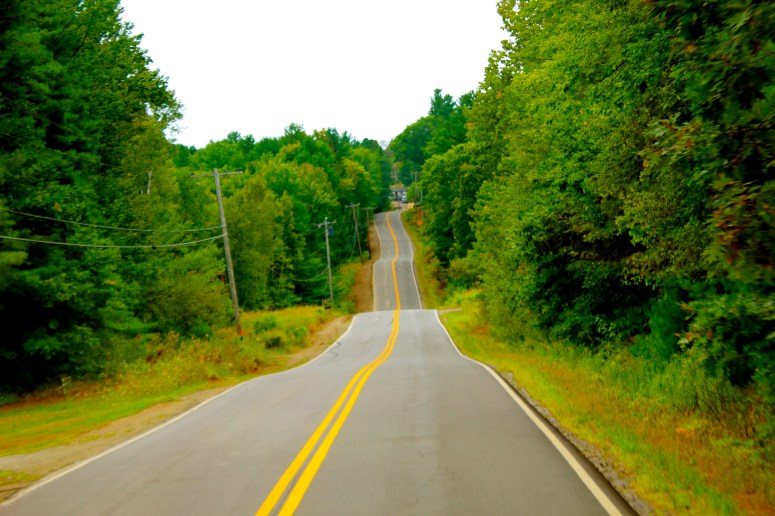
On the road to Morse’s Euro Deli in Maine.

IMG_0357

IMG_0373


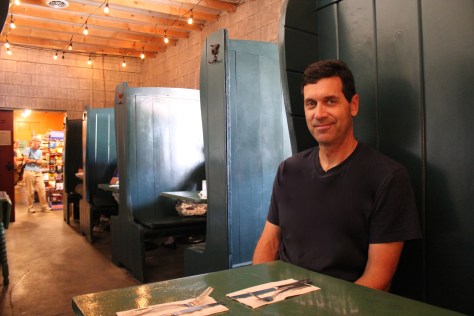
It’s no secret. You might have to wait a while.

IMG_0368

Sunny day display at Owl’s Head State Park.

A group of enthusiasts, no doubt, cruising the coast.

IMG_0442


Our rainbow beach umbrella, propped up with rocks.

Lovely loneliness.


IMG_0453

Along the tide’s edge, there is an underwater world to obsess over

as you stand in Penobscot Bay

and never notice how cold the water is.

IMG_0451

IMG_0471


The Princess and the Pea*ce.

If you’ve ever wondered whether or not royal blood pumps through your veins, try this: wander the earth for days and days in the rain until you find a castle where a prince and/or a princess lives with a dad (the king) and/or a mom (the queen). Or two dads as kings or two queens as moms. Or the dads can be moms and the queens can be kings.

Knock on the door, introduce yourself, and say that you are so exhausted you’d appreciate a warm, dry bed with a fresh pea under the pillow. If you wake up the next morning with a pounding headache, chances are someone in the castle put a frozen pea under your pillow, not a fresh one.

IMG_5845

At the breakfast table, ask a simple question. Did someone put a frozen pea under my pillow last night?

If this question causes the castle dwellers to drop their tea cups onto their eyefones and crack the selfie screens they use to put their pictures on the app Cinder, (which helps people find a real prince and/or a real princess), brace yourself. Someone is going to pop a gasket and say: How dare you suggest we believe in frozen peas in this castle!

Ask the next question. I woke up with a wicked bad headache and that never happens when I sleep with a fresh pea under my pillow. Did someone put a stone under my pillow?

Now you’ve done it. Hold up a piece of toast to shield your face from the spray of saliva aimed right for you when they sputter, collectively: Are you calling us stoners?

Keep your composure and say: Okay then. Does anyone know the answer to this question: Is a pea a vegetable or a fruit?

If everyone starts to laugh, offer to prepare a peas-ful dinner for later in the day.

********

IMG_5843

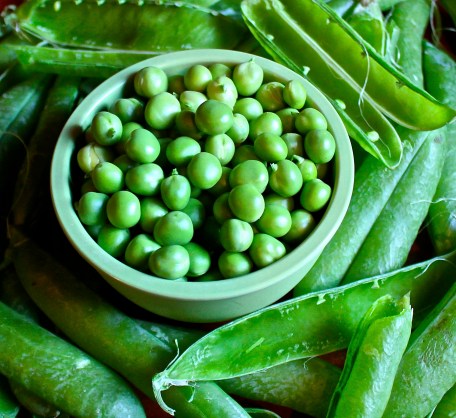
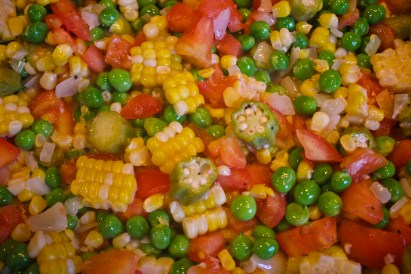
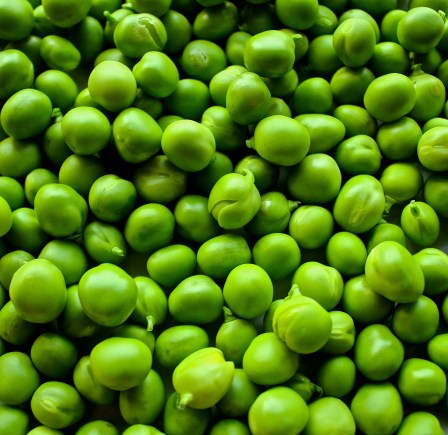
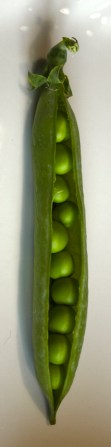
This blog post and the recipe that follows were inspired by a dull day of wandering around all the way over to the local farm where a pile of fat pea pods looked really good. I bought about 30 of the plumpest pods. I bought two ears of fresh corn. I bought some okra. I bought tomatoes from Maine.

IMG_5852

I took everything back to my castle. (And really wished it would rain. We need rain!)

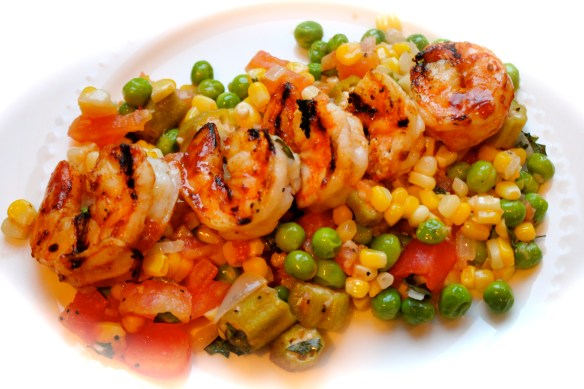
The plan: Cook some form of succotash. Pile it onto a plate. Rest a skewer of barbecued shrimp on top. (Using Dinosaur Bar-B-Que Wango Tango Habanero HOT Bar-B-Que Sauce.)

Here’s the recipe, for use during the season of FRESH peas:

SUFFERIN’ SUCCOTASH

Saute FRESH peas in butter or olive oil with chopped onions and garlic.

Saute fresh peeled and chopped tomato with okra sliced into half inch pieces. (Drop tomatoes in boiling water for a few seconds to get the skins to peel off easily.)

Cook fresh corn, then slice the corn off the cob.

Mix all the vegetables together and add seasonings of salt and pepper and a teaspoon of sugar with a tablespoon of cider vinegar. (Or something like that or other seasonings you like.)

Add fresh chopped or hand-torn basil.

Barbecue some shrimp. Put the shrimp on the succotash.

My husband and I loved the meal. It was a great alternative to serving fish over rice. (We ate the leftovers the next day with grilled salmon on top.) My husband had never tasted a fresh pea, raw or cooked, in his life!

********

IMG_5859

IMG_5860

IMG_5840

IMG_5848

IMG_5837

********PEAS BE WITH YOU********

Seductions. Irresponsibility. Italy.

IMG_4662The soul concentrates, wholly, on strong impressions of pleasure or pain—so writes Dante.

Yes.

And desires to experience pleasure instead of pain often lead to hapless experiences of seduction.

Which are often followed by consequences.

(Perhaps such consequences are worth every journey through Italian flavored, frescoed, and hand-crafted purgatorios?)

Yes even more!


*************

We (humankind since forever ago) obsess over the desires of our fugitive souls. Then we obsess over whether or not we can ever control those desires. Then we obsess over discovering a way to find, or establish, a heavenly paradise where our obsessions rule the world. (Led there by our true loves!) Then the pain of obsessing over what we wantbut cannot have—becomes such a waste of time that we engage ourselves in the useful arts of Deliberate Distraction:

We weed the garden. Reply to emails. Earn our keep. Think of others. Play with social media. Paint pictures. Arrange flowers into vases. Meditate. (“There is more right with you than wrong with you.”) Breathe into the tips of our toes and the ends of our earlobes. Eat right. Exercise. (Walkwalkwalk.) Stop at one glass of wine. Get some rest.
I’ve been distracting myself in all the right ways.

But I still want to board a plane and fly to Italy. Now.

I went to Italy in January of this year. I was there a few weeks ago. I’ve been there for two other trips of a lifetime long before January.

But I want to board a plane and fly to Italy again.

I want to check out. Go away without leave. Just do it.

For once in my life, I want to wave arrivederci while standing on my toes in a pair of sassy-ass shoes. I want my hair to be colored perfectly and cut bouncy. I wish to be sporting a smart piece of luggage stuffed with sketch pads and intense works of literature and M&M’s.

I want to have some money to take with me. Enough money.

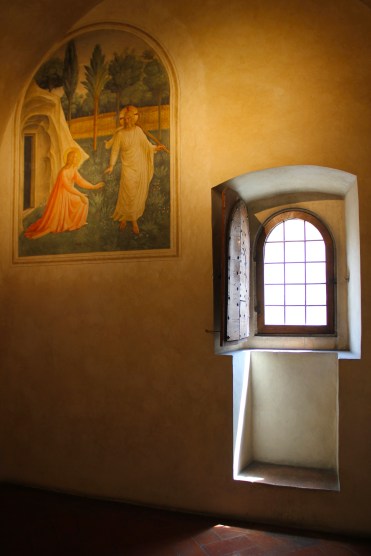
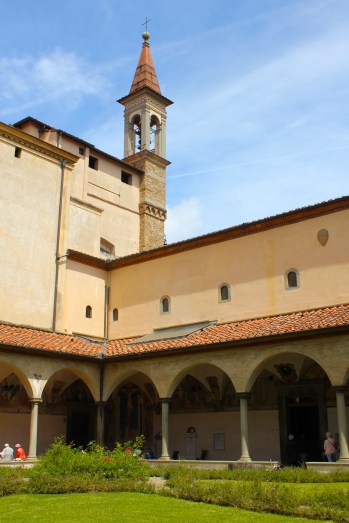
I want to leave behind the piece of my heart that would pump weepy and worried for my family, and take only the pieces that will throb gushy and gorgeous over every little thing. (Like the frescoes! By Fra’ Angelico in Florence. Seduction via the renowned Annunciation at the top of stairs leading to austere hallways with doors opening into small cells where Dominican monks lived their medieval lives. Every little thing is in the lawn and Angel Gabriel’s wings—I am trying to grow a lawn like that and am contemplating sprucing up the colors of my own wings. Coming upon this work of art is a long-remembered experience of pleasurable feminine grace in a city dominated by masculine stone and little boy grittiness.)

IMG_4526

********

Flights to Italy.

I’ve looked them up.

Places to stay. Monasteries.

I google and google and google. Then I reject my computer and cuddle up with my books. About Italy.

ItalyItalyItaly.

I’m not even Italian, but I was raised Roman Catholic.

And ended up far more Roman than Catholic.

This happens all the time. I get obsessed about something. The next thing you know, I paint the walls of the house all over again and install new gardens, (designed in the spirit of a Renaissance palace overlooking the Tiber River with a loggia painted by Raphael), or I come home too pooped to clean, cook, and save the world because I spent the day walking to the moons of Saturn and back, (the ones named by Galileo), or I polish off a box of Trader Joe’s Dark Chocolate Peanut Butter Cups while scribbling nonsense into journals, (in the spirit of Marcus Aurelius and his Meditations I attempt to make myself perfect and well managed, yet I become perplexed, wondering why Marcus was never struck by an amazing grace that would have ended savage gladiator battles, Christian persecution, and his own failures as a parent to protect the Roman Empire from the cruelest son a man could ever have, that fully wicked Commodus!)

Once the chocolate sets in, I let the wish centers inside the insatiable pleasure zones of my brain seduce me. Deliberate Distraction goes awry. Pleasure zones that are stoked by myth and romanticism and idealized versions of time travel and pretend play conquer rational thought. Even at my age. Let’s pretend we’ve cashed in our savings, abandoned America and its contentious politics, and we’ve been hired to prepare a Roman feast to be served at an opening featuring my artwork on display at Peggy Guggenheim’s Venetian palace, (overlooking the Grand Canal!), for a guest list to include a cast of reincarnated characters from Florence.

********

When I arrived in Italy a few weeks ago, my husband hid our travel euros in the apartment we rented in Rome. We brought the load of cash with us to pay for VRBO accommodations all along our route from Rome to Florence to Venice. We often rent charming, owner-operated digs in which the owners might not speak English very well and/or prefer to do business on a cyber handshake. (No down payments.) In other words, we hang our travel dreams on excursions that may or may not be realized, with human beings and agreements that may or may not exist in the universe.

If all goes well, an accomplished musician might play enchanting music that will float through our fourth-floor medieval hideaway on its way to heaven.

IMG_4500

Renting owner-managed VRBO’s can feel like taking a free fall dive into a desperate trust, for sure, but I continue to allow myself to be seduced by the fairy-tale potential of the found travel poetry that arises from these kinds of acts of desperation. Using excerpts from an exchange of emails regarding a place to stay in Venice, here’s how such emails blossom into poems my fugitive soul can’t quit:

Found Travel Poem, 2016 AD

You don’t need to send any advances

So please you’ll pay cash at your arrive

in Venice Thanks

I’ll give you apartment when you arrive

I prefer meet you under the clock at train station

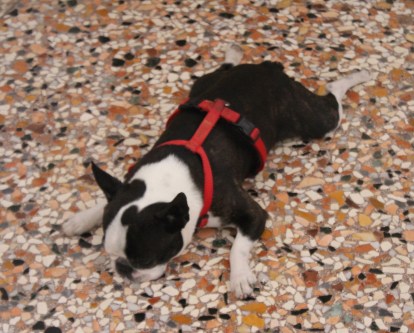
I will wait with my small dog Boston Terrier

Together we will go to the apartment only ten minutes I prefer walk

We wait.

Sincerely.

********

Darkness threatened to wilt the glow of our romantic spells when my husband forgot to pack the money hidden in our Roman love nest. He didn’t remember this divine tragedy until our train was puffing forth from Rome to Florence. Who cared? We’d deal with it in Florence.

In Italy.

We’d deal with our divine comic tragedy in Florence Italy where we were going to meet up with our daughter, who was studying abroad.

The process to rescue our money took part of a morning and all of another afternoon. There were anguished calls followed by missed deliveries followed by siestas and a lot of not today maybe tomorrow. It was the one afternoon we had set aside for shopping with our daughter, who was doing what we had always dreamed of doing when we were her age—taking art classes in Italy. It’s true what they say about helicopter parents—they encourage their children to experience the dreams they (the nutso parents) never realized.

My husband and I didn’t go to Europe until we were well into our 30’s.

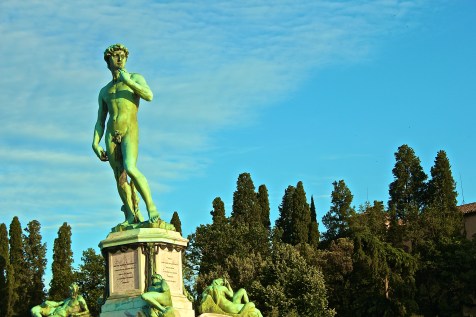
By the time I first saw the David.

The rest of the world was so done with David.

But the thing is, if you stare long enough and David senses you’re a goner, he’ll wink at you. All your sins! Forgiven in the wink of an eye!

ItalyItalyItaly.

Italy!

********

So now I have journeyed more than half of my blog’s way, I have found myself within a shadowed forest, I have lost, as usual, the path that does not stray. (Apologies Dante!)

Furthermore, instead of getting on a plane and going back to Italy, I am resolved to the fact that the best I can do is send my daughter a list of the shops where I’d hoped we could have spent an afternoon getting all gushy and gorgeous over every little beautifully-Italian-made thing.

Only in  I T A L Y. 

Before sending the email, I asked the spirits of my new Murano glass rosary, (purchased near our Venetian hideaway) to remove the pain of glumness and bratty regret from my soul. I chose this rosary for the rainbow beads and the big yellow “any-prayer-of-intention” bead at the center. Yellow is my daughter’s favorite color. This rosary was presented to me as an option from a collection of unseen rosaries stored away inside a drawer in the back room of an art gallery, by a young lady as bright and beautiful as my daughter. The young lady watched me examine other rosaries on display and asked if I wanted to see one of her favorite rosaries. She told me she hand picks the beads from the Murano glassmakers and then the owner of the gallery strings them into rosaries.

IMG_5472

Soon, after I sent my email to my daughter and rubbed the yellow bead on my rosary, I received a found poem via email from my daughter about her experiences going on one of the shopping excursions from my list. After reading my daughter’s email, the pleasures of laughter condemned the pain of my glum brattiness to the infernos of hell:

Found OMG Poem, 2016 AD

OMG!!!!! Aquaflor is such a beautiful store! And the ladies who work there are so nice! I wanted to smell and buy everything! It was too expensive for me though!!!

It was in a small alleyway I would have never gone down! The door was so small I walked up and down the street! Then I found it!

I’m reading on my little balcony now. Nice peace and time to myself.

Except

I did have a run in with a pigeon!

I’m resting and reading and I hear something slamming into the walls!

Then I see it come walking into the living room!

It flew into our living room!

They are so annoying!

I locked myself in the bathroom until I heard it fly outhahaha!!!

*********

Ittaleeeeee!

********

Boston Terrier. Waiting for us at the train station. Venice.

IMG_4914

Boston Terrier wiped out after climbing up and over all the canal bridges.

IMG_4918

********

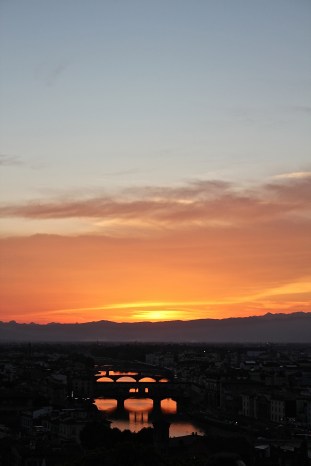
Fake David watches the sun set over Florence and the Arno River every day.

With tourists more fashionably dressed up.

Festive and fun Piazzale Michelangelo.

IMG_4594


IMG_4625

********

One medieval monk’s cell overlooking the cloisters at Museo di San Marco, Florence.

Artist and Saint Fra’ Angelico painted frescoes to aid the monks in commanding their souls to control all forms of harmful pleasure and pain.

IMG_4527


IMG_4514

********

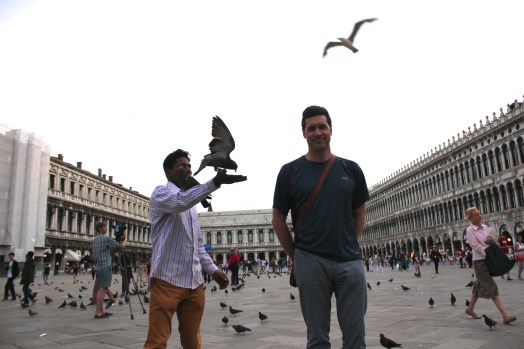
The annoying pigeons and their more annoying partners in crime

appear in your snapshots whether you want them or not.

Piazza San Marco, Venice.

IMG_4987

********

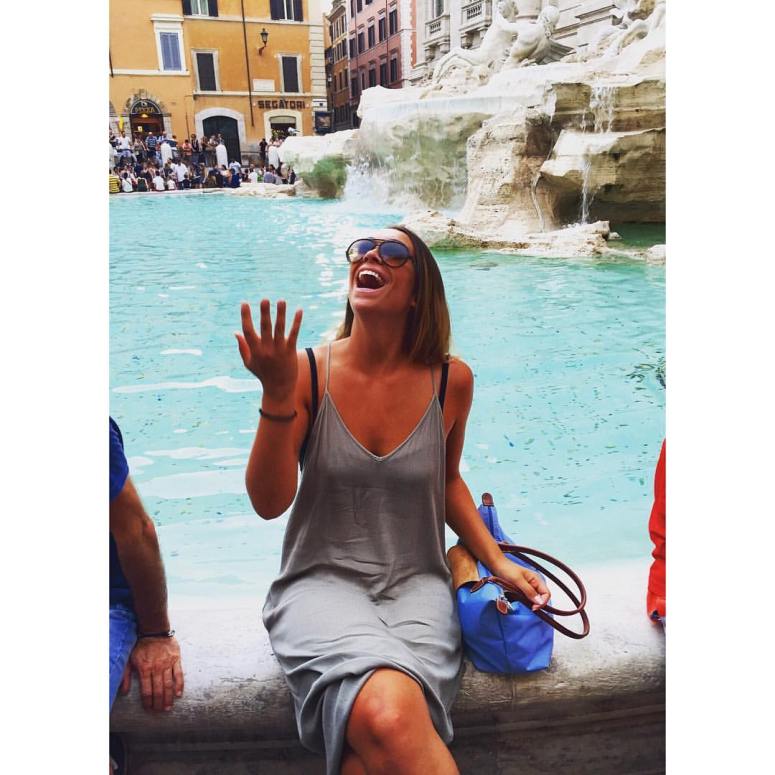
My daughter in Europe.

OMG!!!  ITALY!!!!!  EUROPE!!!

13498154_10153763556066849_8851170691873799038_o

SEDUCE OUR FUGITIVE SOULS FOREVER!!!

IMG_4649

********


Gypsies. Tramps. Thieves.

Peasants. Criminals. Prostitutes.

Slaves.

My husband. My son. My daughter. Myself.

Rome.

********

No one makes it through life without a little hunger.

And, we are all slaves—

to our stomachs, to the beat of our hearts, to the madness of our desires. It is, of course, best to become a slave to your own desires, rather than the desires and expectations of others.

Yet here I find myself, living in a time in history when people all around me wish to become the slaves of other masters promising to coach them, cut them apart, and put them back together into idealized forms of god and goddess-like perfections. They seek to confess their crimes, vanquish their poverty, and avoid being seduced by authentic beauty and pleasures. They worry about how people have sex, how people eat, and how people use grammar.

They worry about how people judge each other as authentic or not.

Maybe it’s just me.

Best to leave my American bourgeois grumblings for a week and go to Rome for some attitude adjustment, with my family. Because, as my son says, the Romans were so badass. It’s true—every time I go to Rome, I excavate more and more of my humanity and can never be sure how badass I might have once been. Could I have been a vestal virgin? A peasant? A papal servant? A champion gladiator? A designer of fountains? A stray cat? A chanting monk? A trapped lion? A good Catholic? A happy Pagan?

We decided to go to Rome in January, a time in America when the new year is celebrated with gatherings of great councils of experts and social media gurus at work selling post-humanist “ta-da!” processes for achieving perfection, and post-humanist wonder drug formulas for brain boosting, and post-humanist public humiliation platforms for incorrect use of the comma.

It’s also the time of year when colleges are on break which meant my daughter was able to travel with us.

On our fifth day in the Eternal City, we walked from the ancient exile zone of the Jewish Ghetto (where we were staying) across the Tiber River to the ancient exile zone of Trastevere. We wanted to learn the art of preparing a typical Roman meal.

We were—every “perfect-American-family” one of us—hungry.

So hungry.

********

Sycamore trees bow into the now-walled-up Tiber River.

IMG_1760

IMG_1761

IMG_2129

********

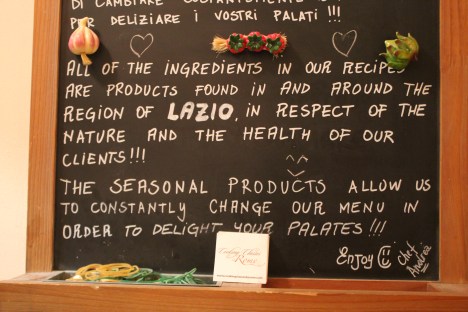
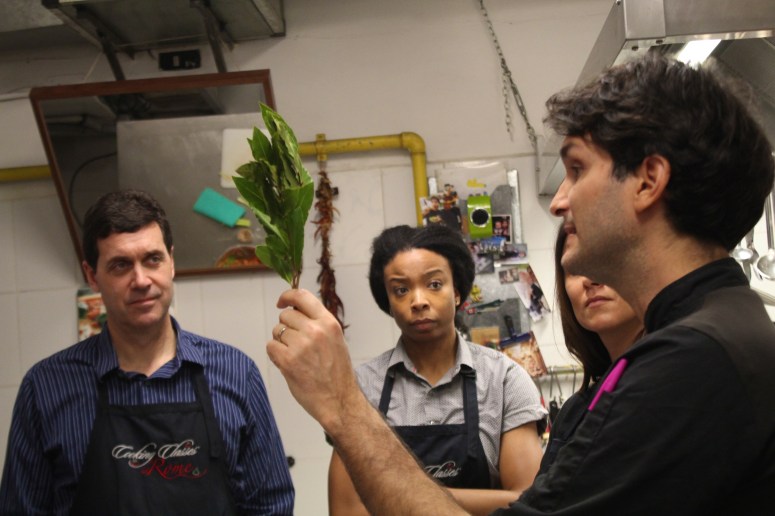
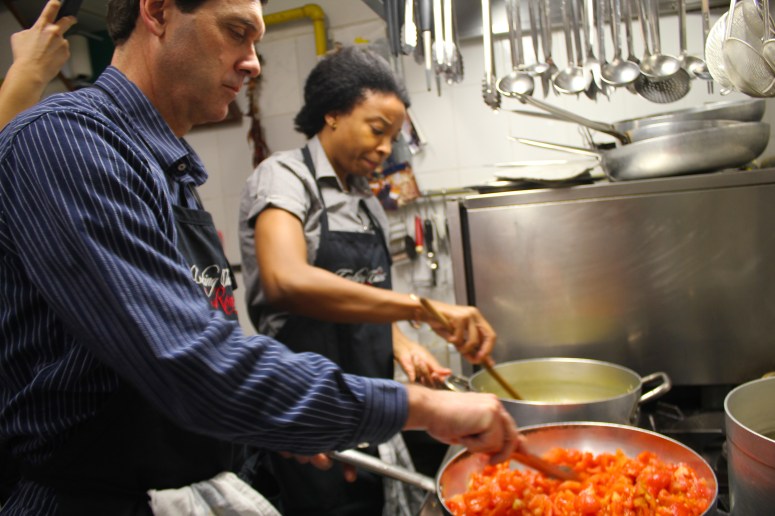
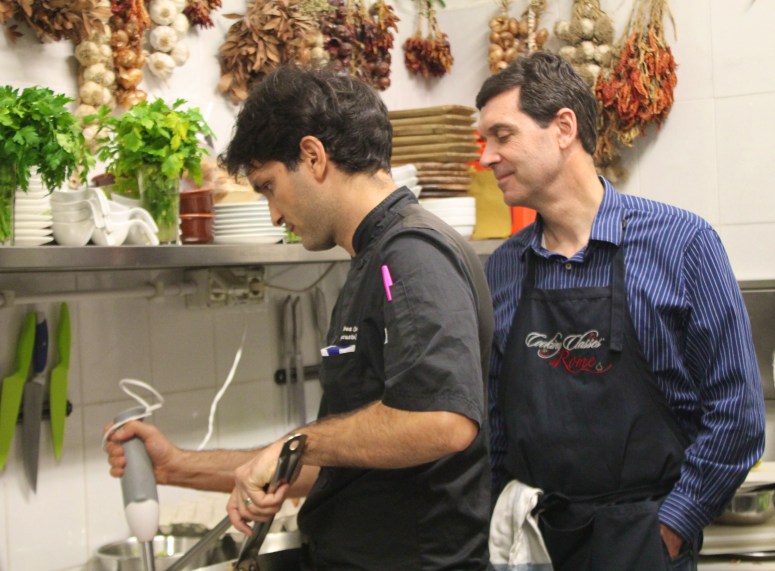
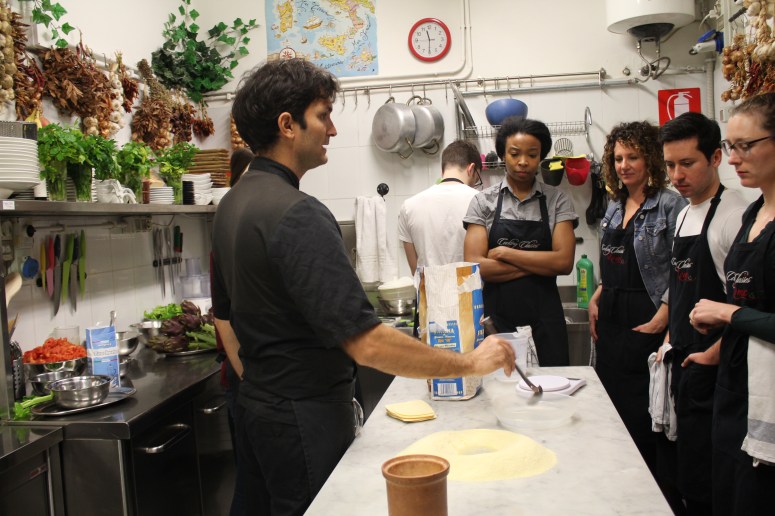
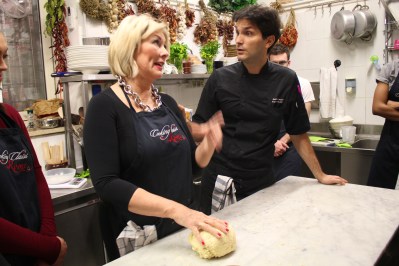
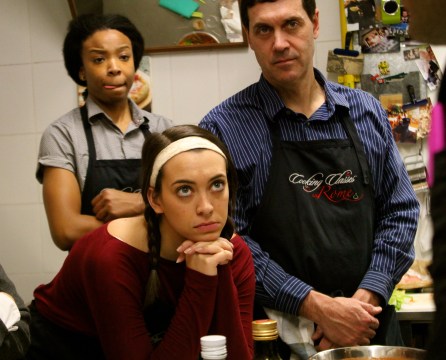
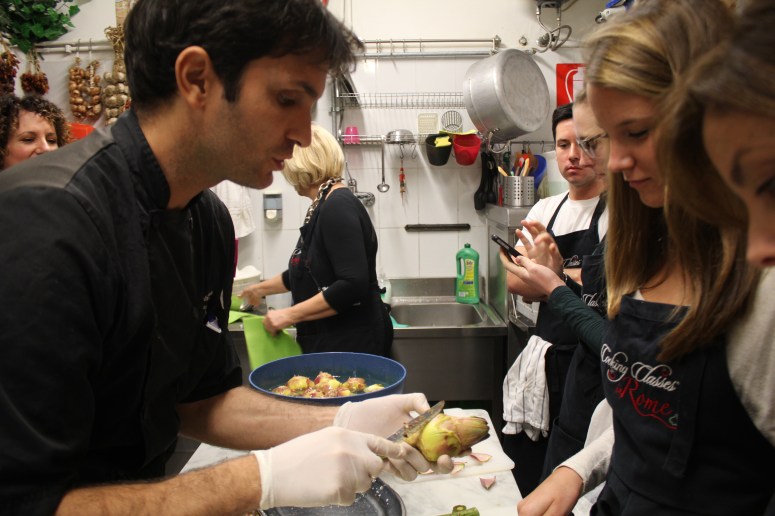
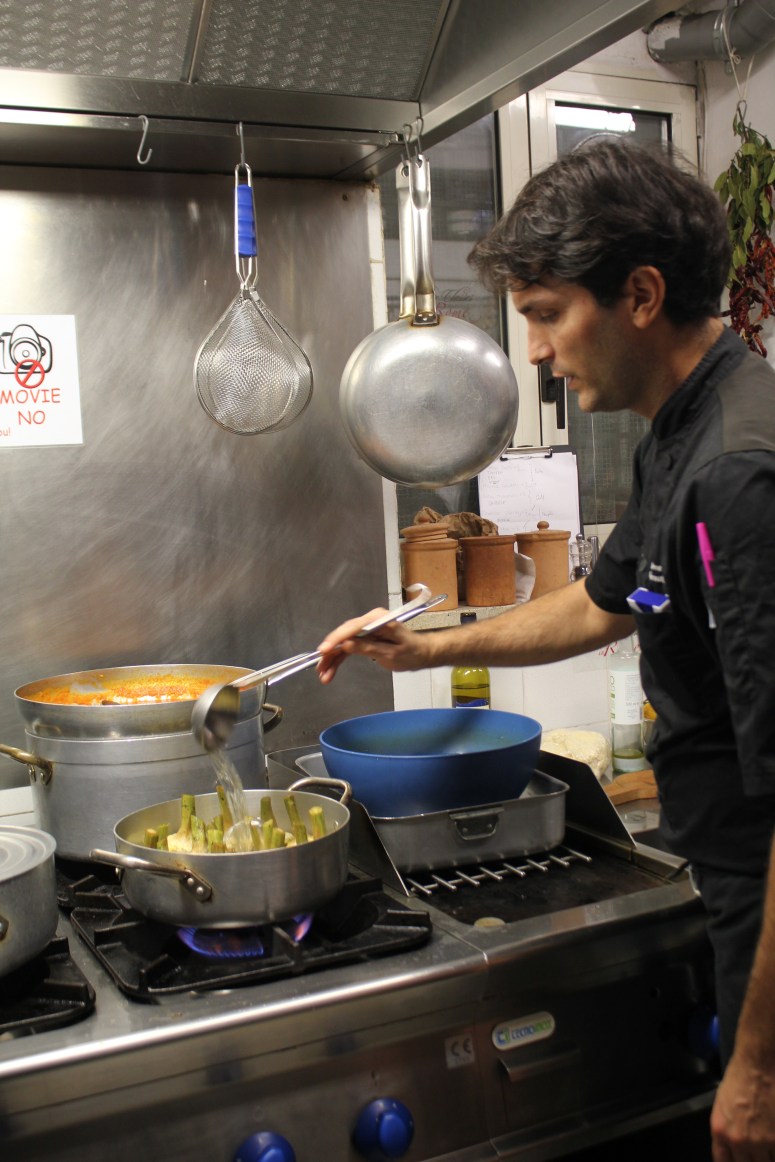
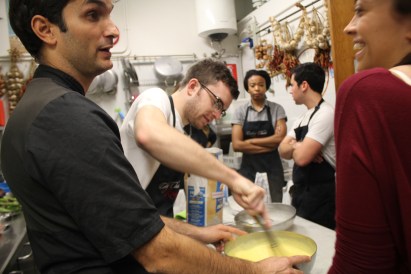
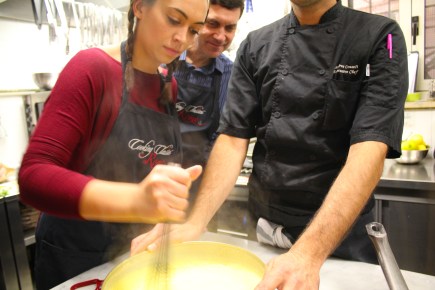
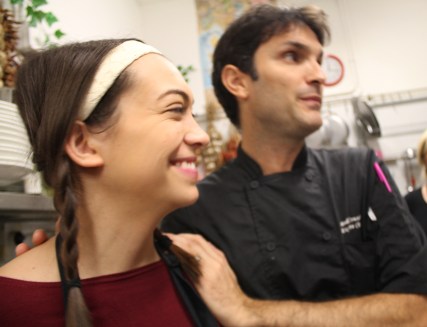
Somewhere in the maze of the narrow streets that make Trastevere so irresistibly charming, Chef Andrea welcomes students into his kitchen at Cooking Classes in Rome. Don’t be late—it was the ugliest American thing we did. I go to Europe to find beauty in details. If you are late to Chef Andrea’s class, you will miss out on his special attentions to delightful beginnings for your day.

IMG_2249

IMG_2179

********

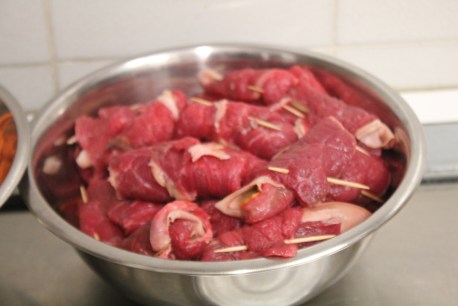
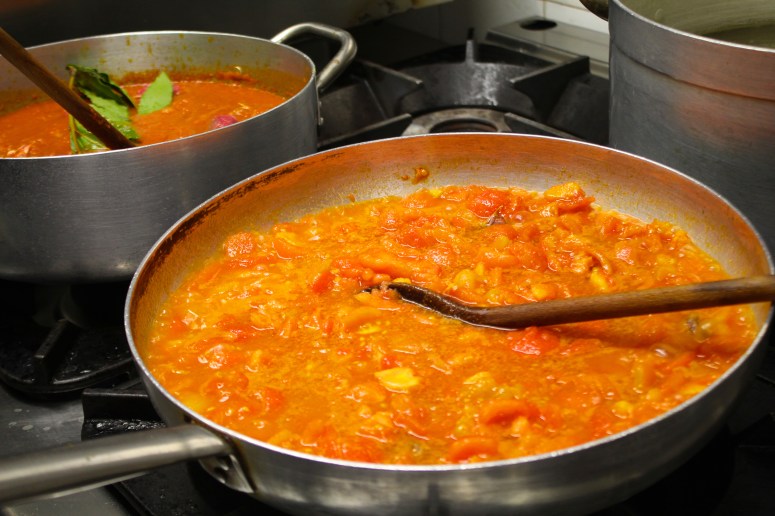
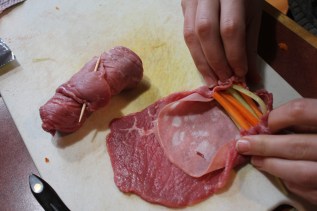
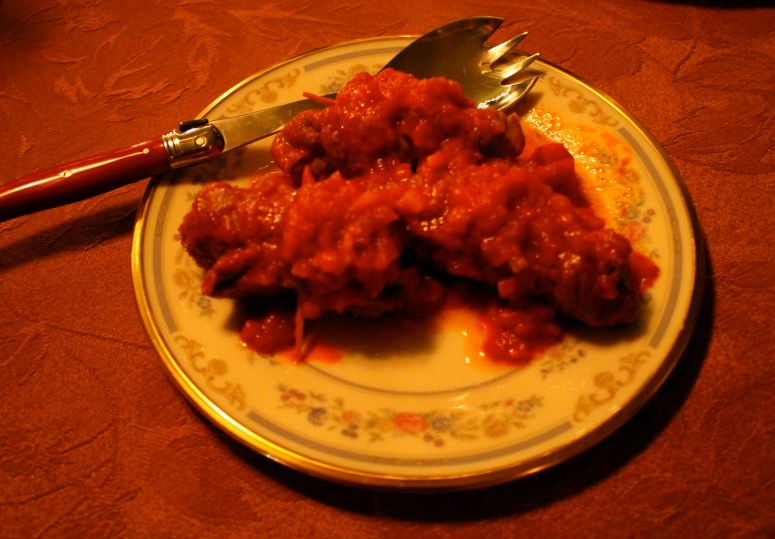
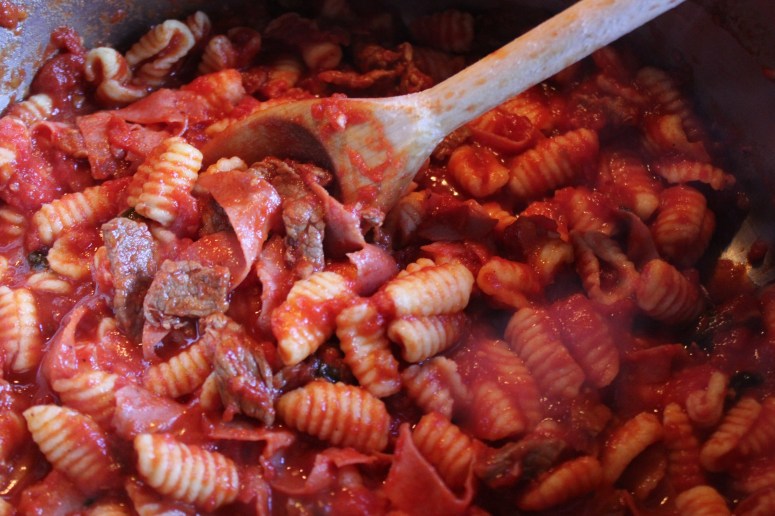
Involtini alla Romana. (Roman style beef rolls in tomato sauce.)

IMG_2147

IMG_2134

IMG_2135

IMG_2143

********

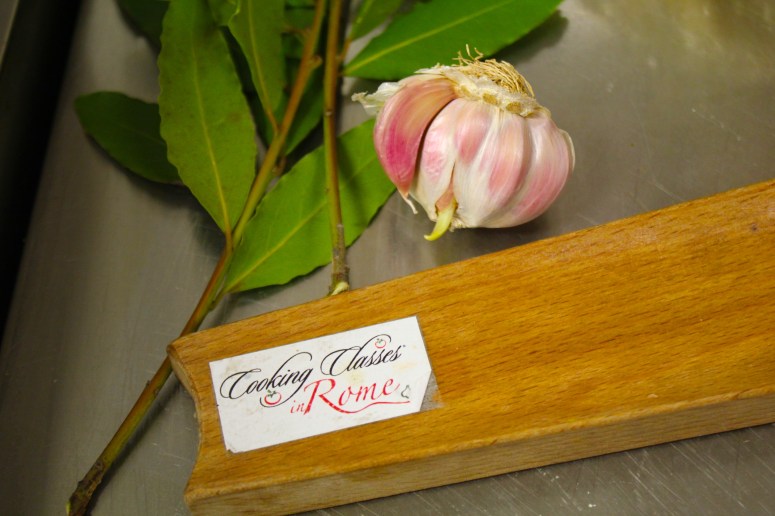
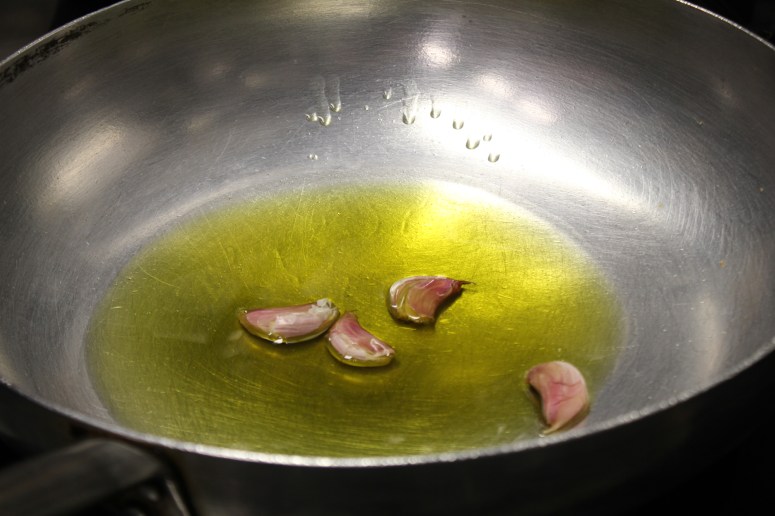
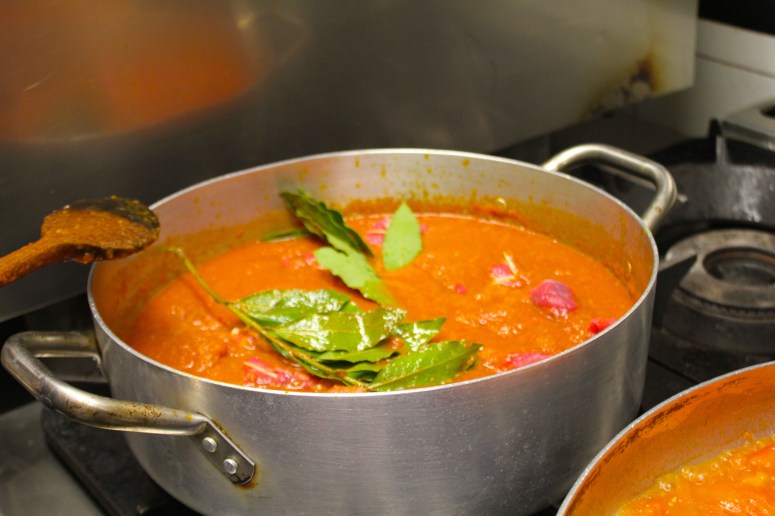
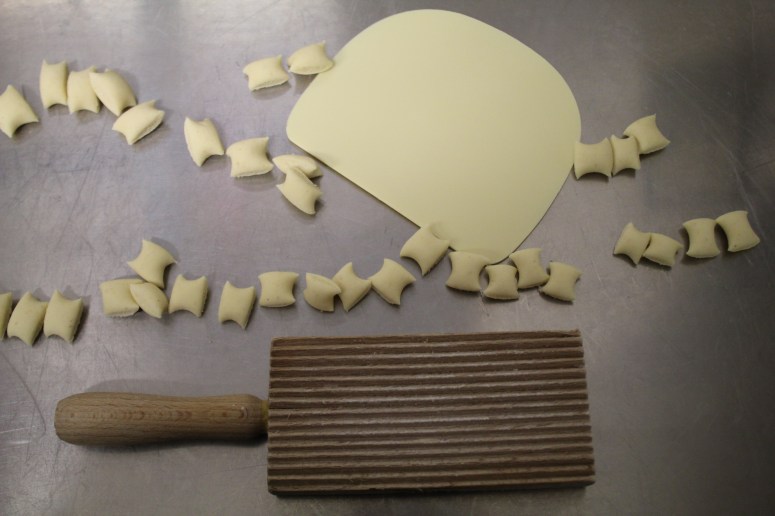
Bay Leaf. The Romans take it from plants growing everywhere. We learned how to prepare two forms of tomato sauce. One was used to submerge the Involtini alla Romana and let it cook, the other was for our handcrafted Cavatelli pasta.

IMG_2184

IMG_2174

IMG_2187

IMG_2182

IMG_2217

IMG_2188IMG_2211

********

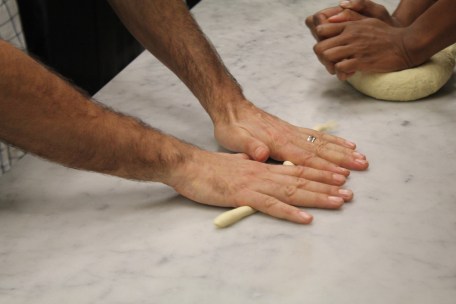
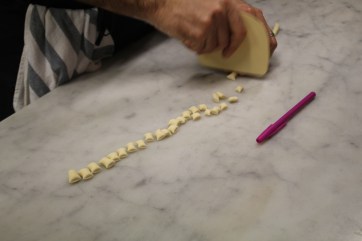
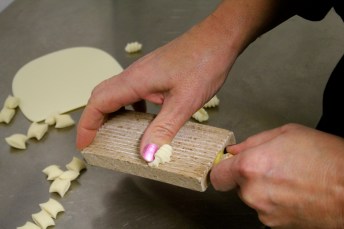
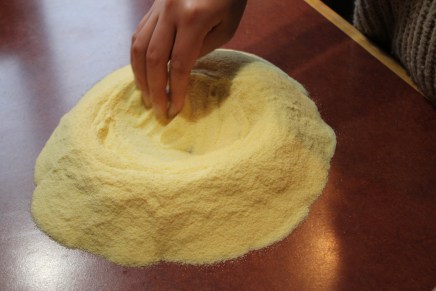
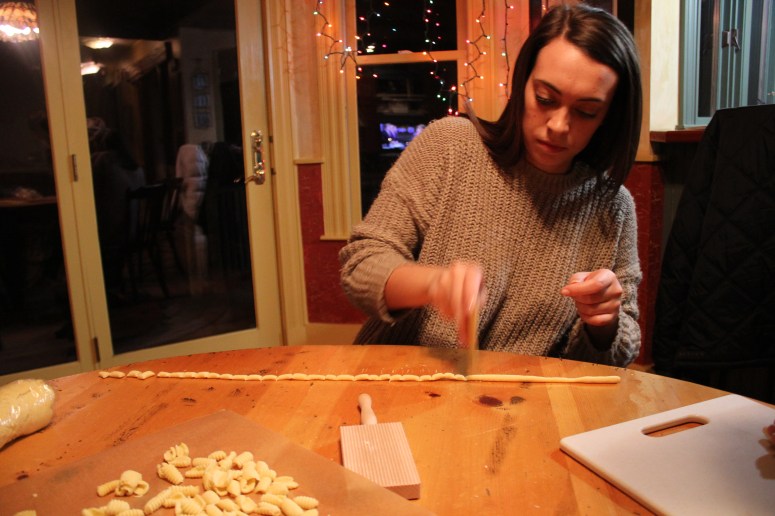
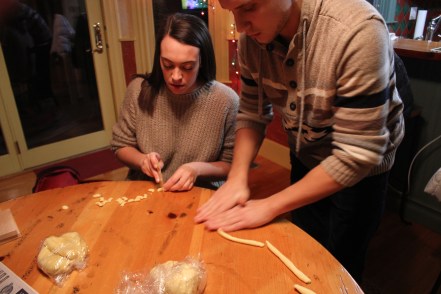
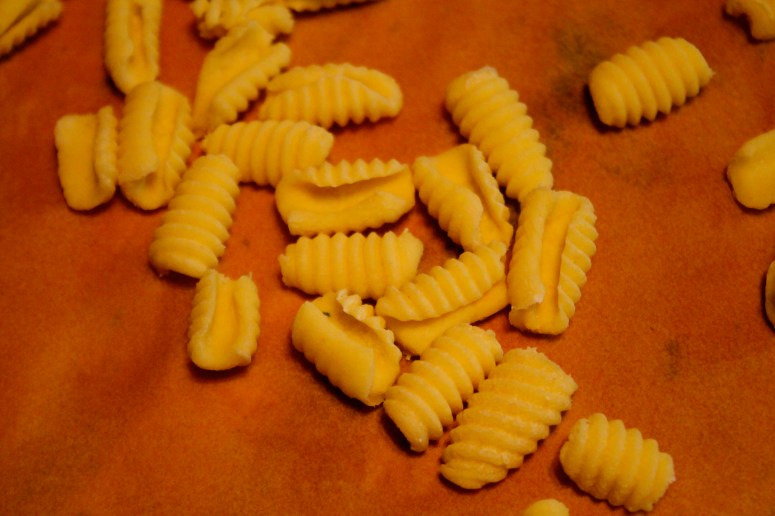
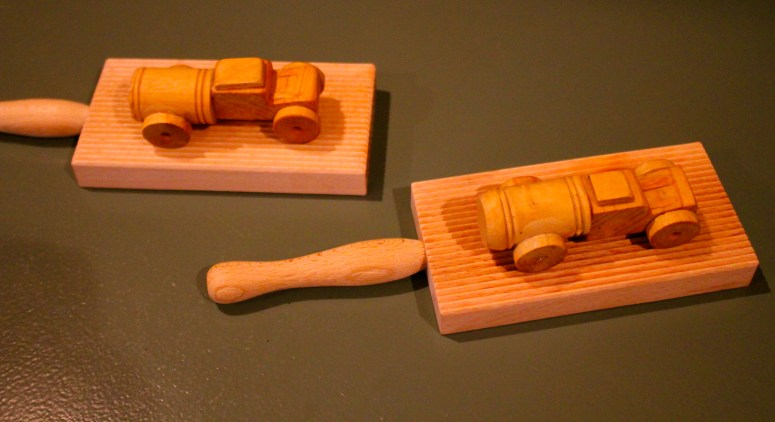
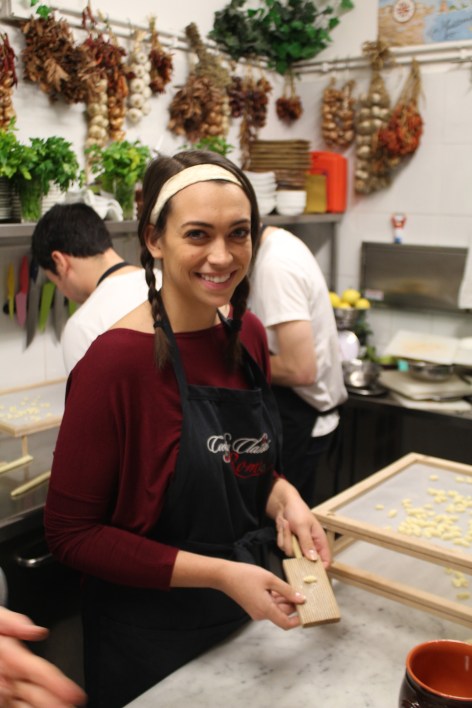
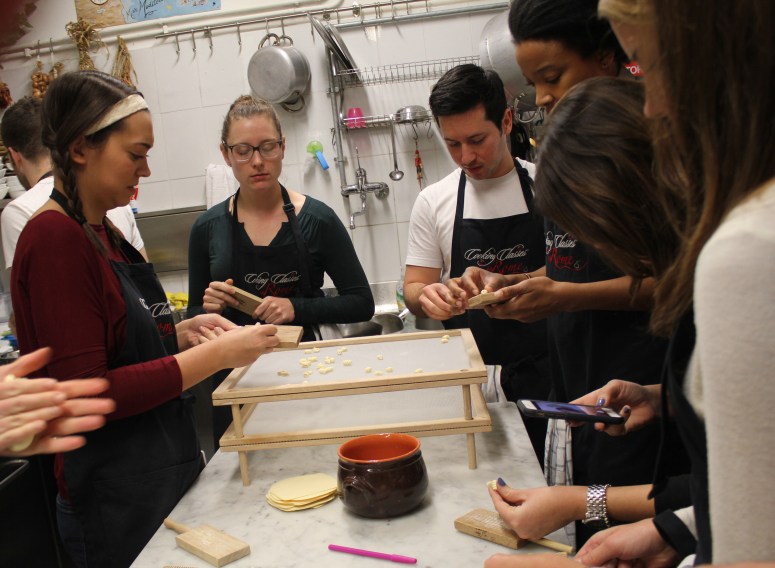
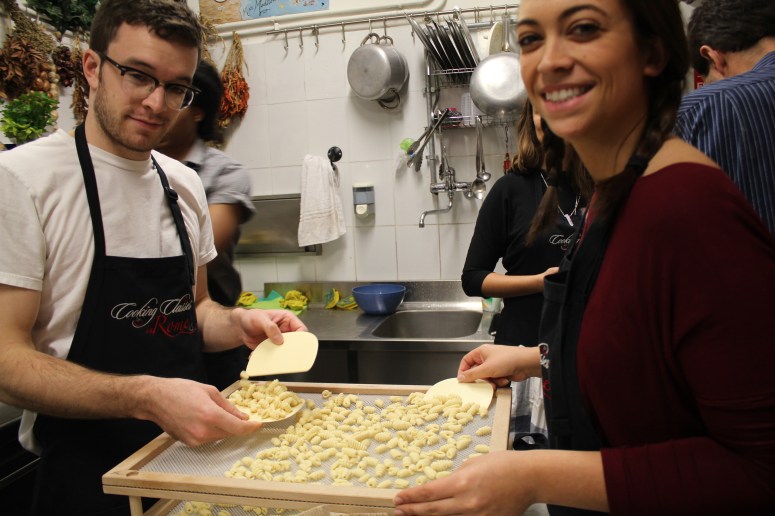
Using Italian-made hand tools to handcraft Cavatelli pasta. Very zen.

Every piece of pasta has someone’s heart rolled into it.

IMG_2141

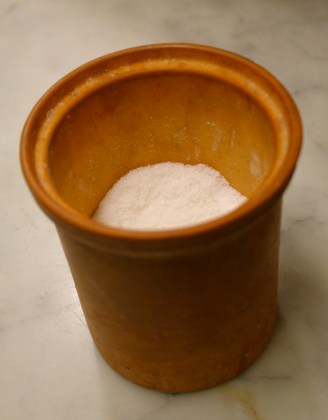
How much salt? One pinch per person.

IMG_2148

IMG_2154

IMG_2183

IMG_2223

IMG_2225

IMG_2233

IMG_2235

IMG_2239

IMG_2237

IMG_2231

IMG_2244

********

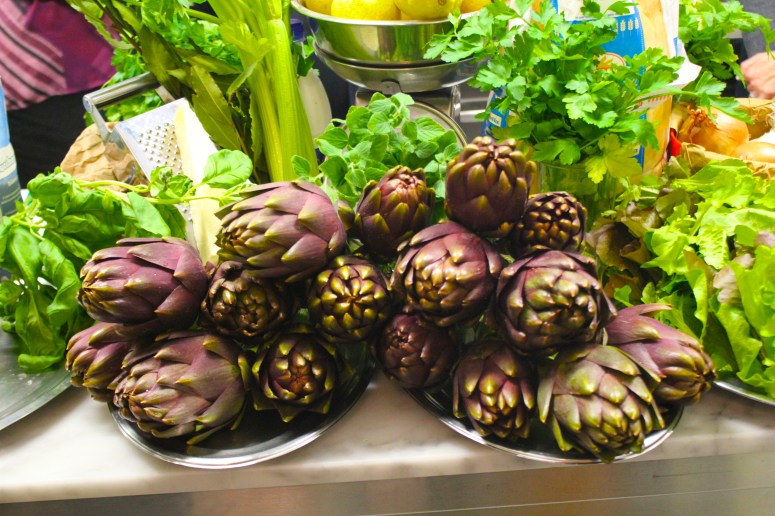
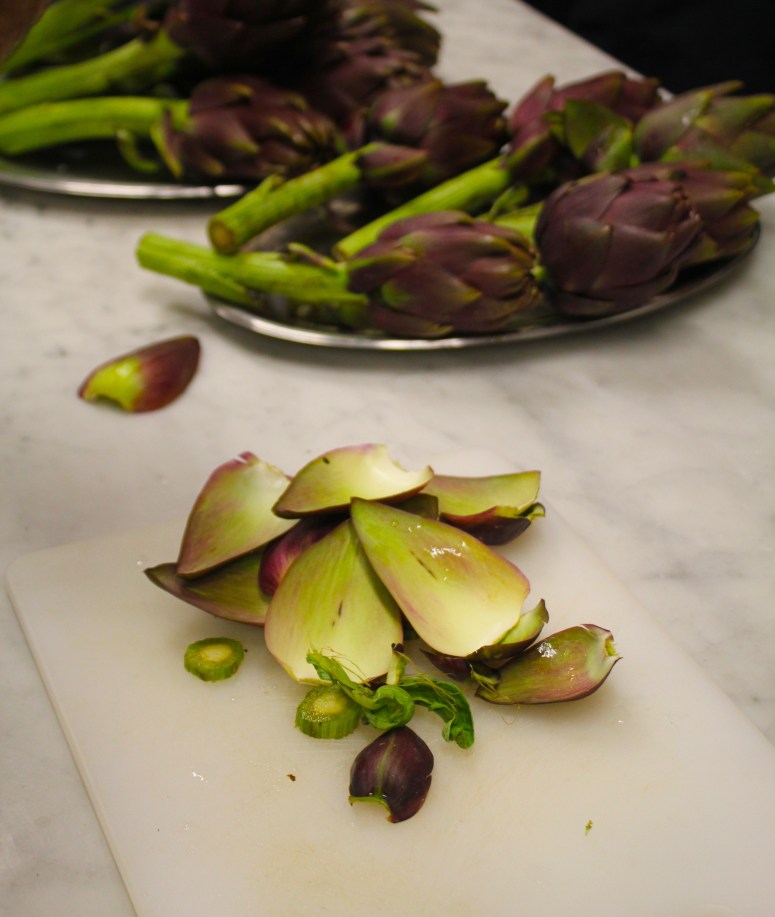
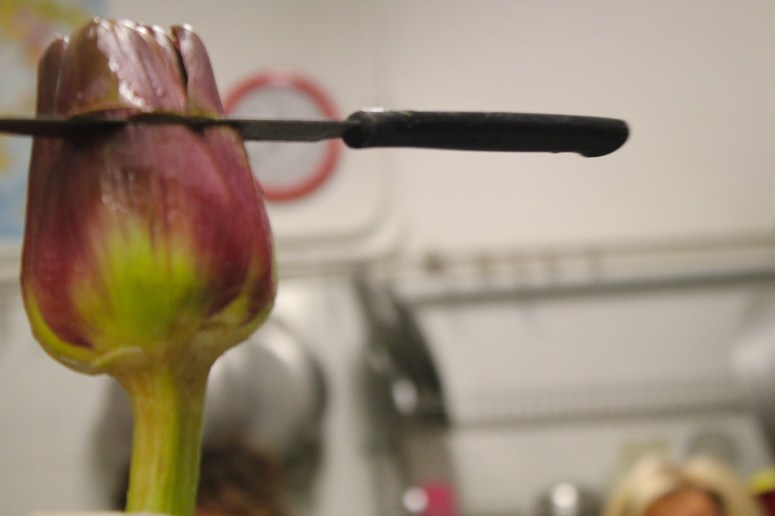
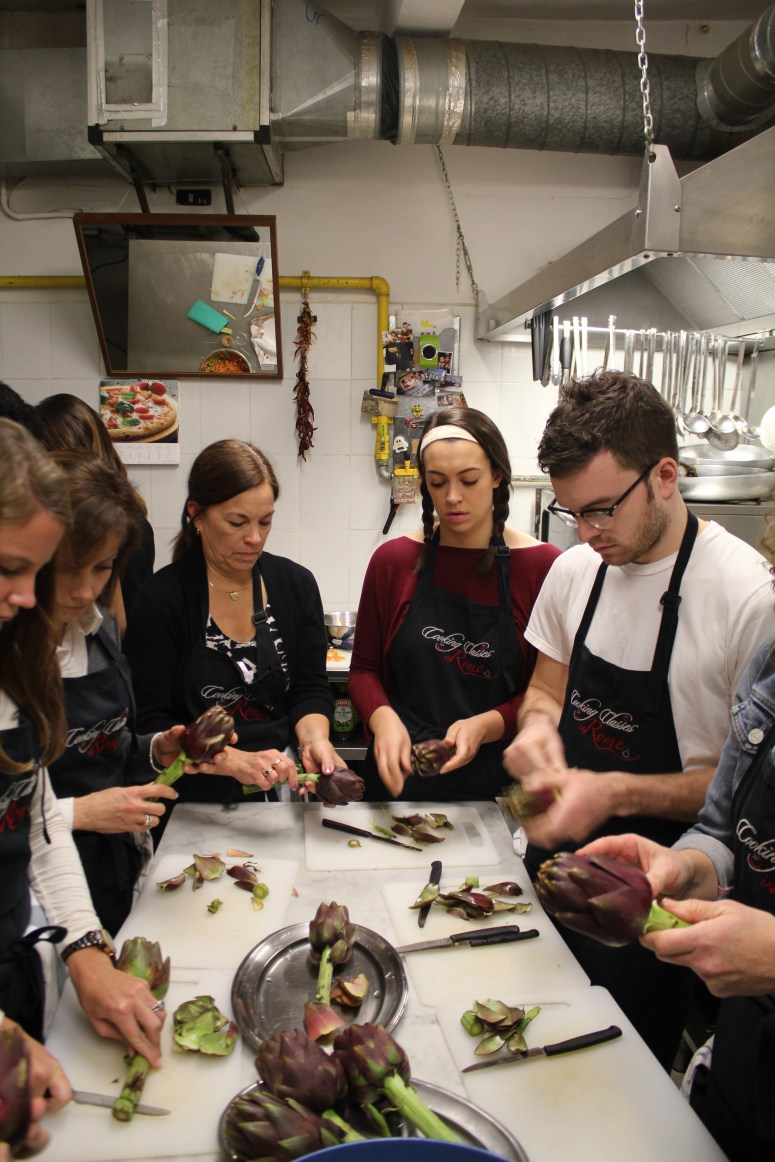
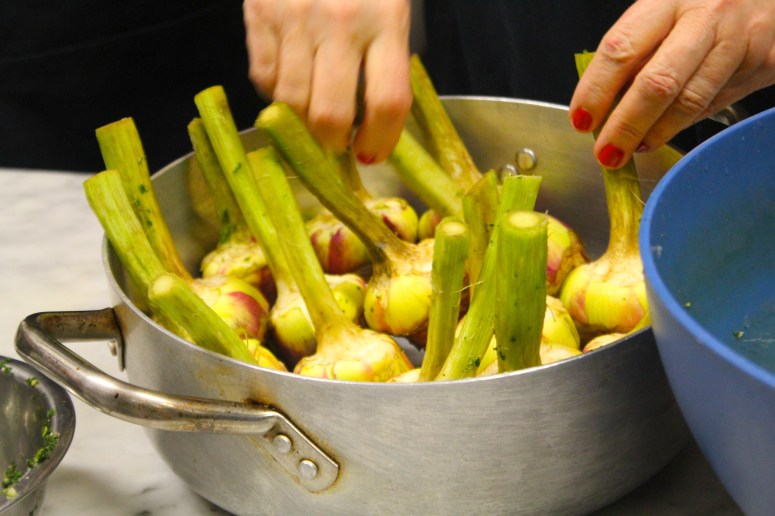
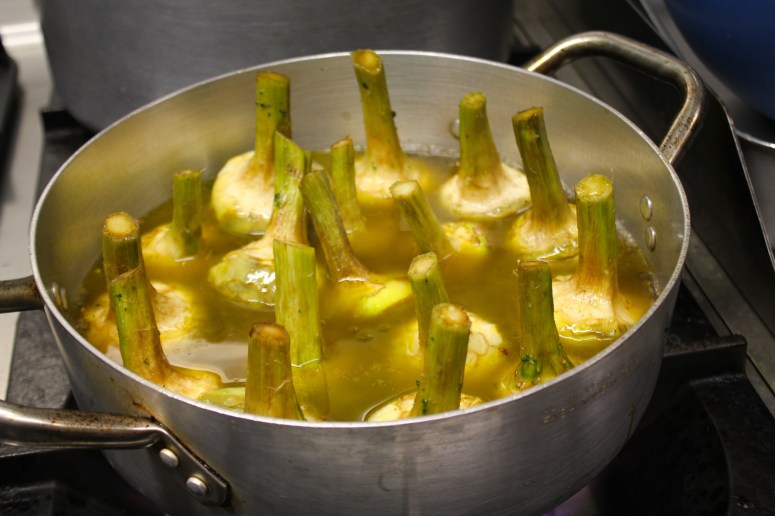
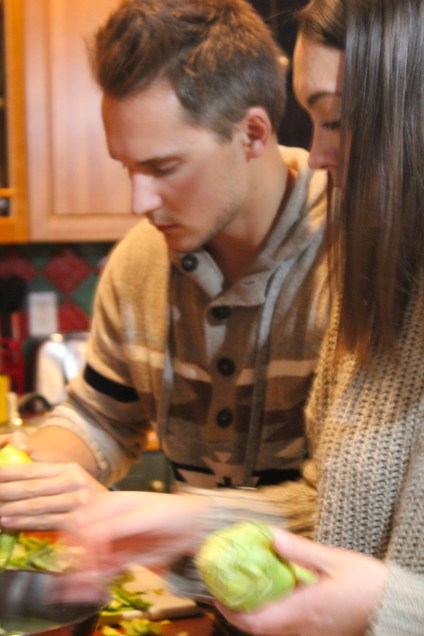
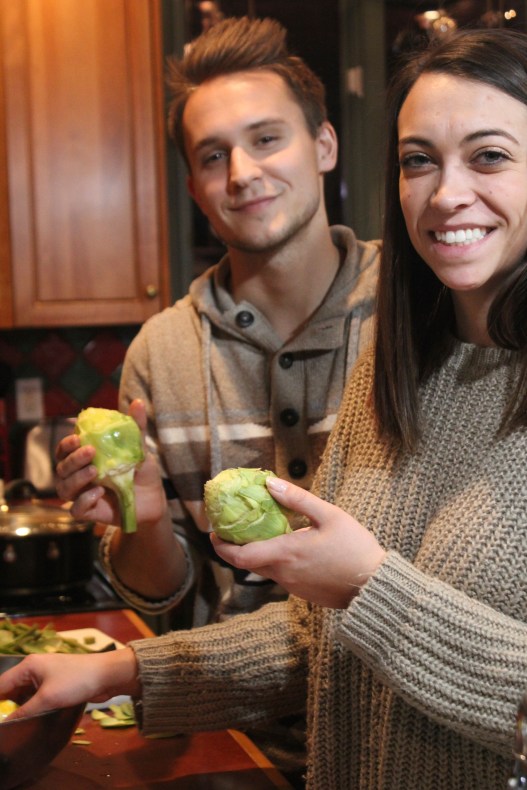
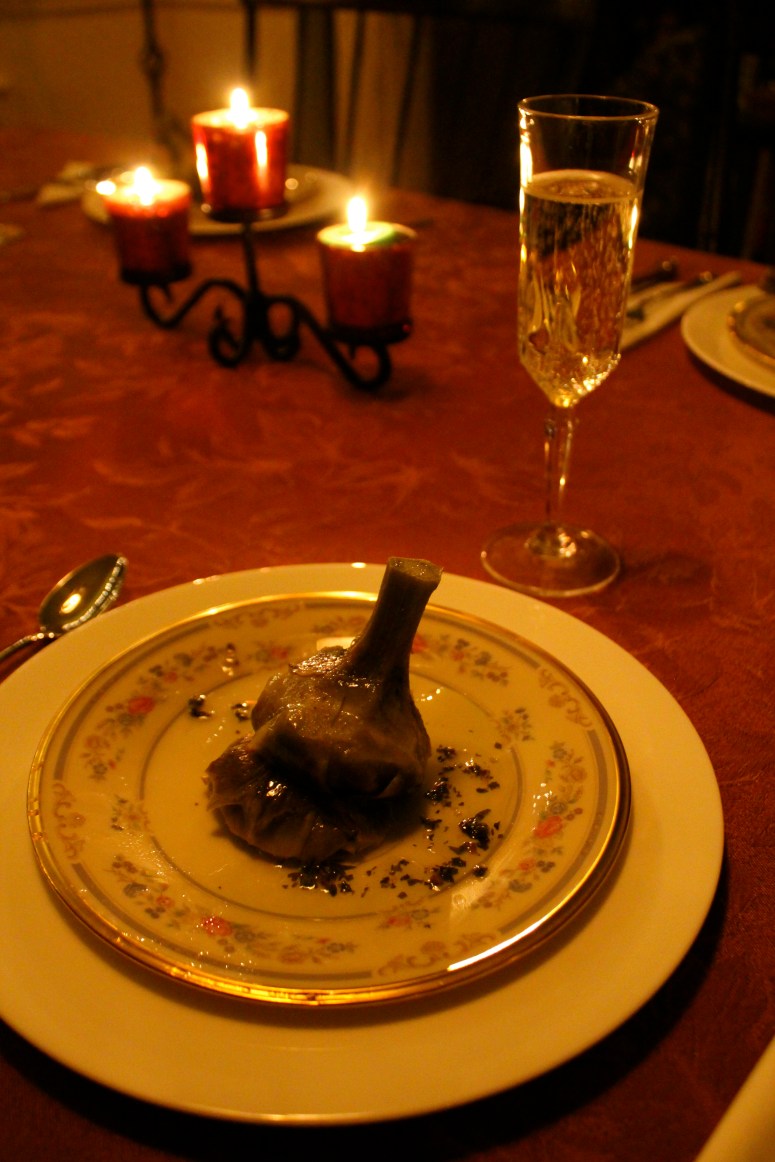
Carciofi alla Romana. (Roman style artichokes.) Roman-style artichokes are the food of the gods. American-style artichokes are for barbarians.

Goethe wrote in Travels through Italy: “The peasants eat thistles.” Supposedly it was a behavior he found too repugnant to ever enjoy.

IMG_2132

IMG_2192

IMG_2203

DO  NOT DO THIS:

IMG_2194

IMG_2200

IMG_2204

There is a secret stuffing prepared for the artichokes.

The most authentic stuffing uses a Roman herb growing wild along the Appian Way.

IMG_2210

IMG_2221

IMG_2222

********

Dessert. Crema al Limone con Kiwi.

And a lesson in which is the male and which is the female lemon.

IMG_2155

IMG_2160

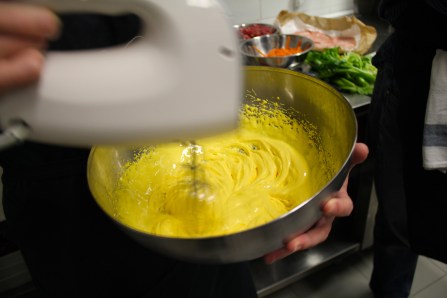
Using the electric whisk.

IMG_2161

IMG_2165

IMG_2163

IMG_2177

********

Our cooking instructions included intriguing history lessons and useful magical secrets about how to properly infuse artful details into your work as a chef in the kitchen. Many of the recipes are derived from necessity and are composed using the kinds of foods that were available to be used by the lower classes that lived on the “other side of the river” in Trastevere. The prostitutes learned to prepare and strategically place aromatic meals out into the narrow alleyways where the scents of sexy cooking became concentrated. Such tantalizing pleasures—on several levels—were impossible to resist by potential customers.

Indeed, cooking engages all the senses.

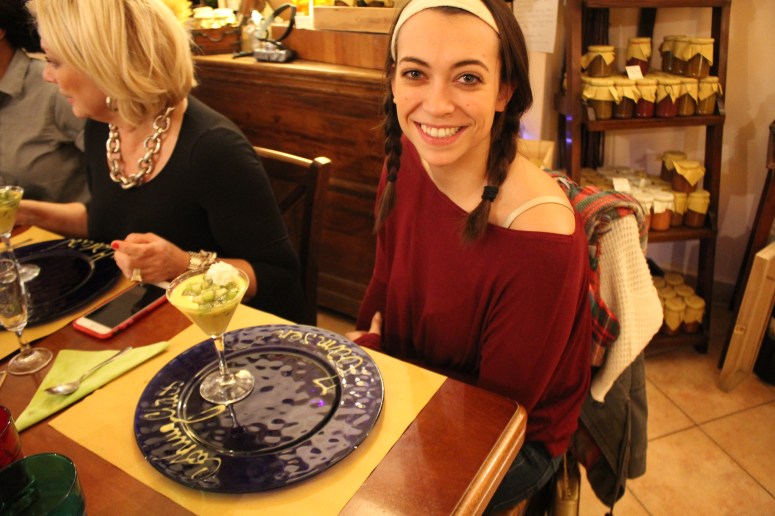
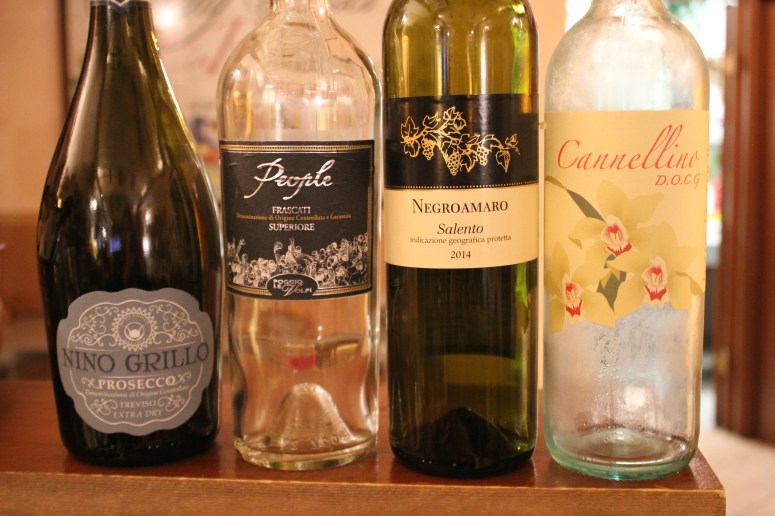
We opted to have wine pairings with our courses and Chef Andrea’s choices were exquisite.
My husband and I have enjoyed various styles of cooking classes in France, in other parts of Italy, and in the United States. Chef Andrea’s Cooking Classes in Rome exceeded our expectations and the price was surprisingly reasonable.
********

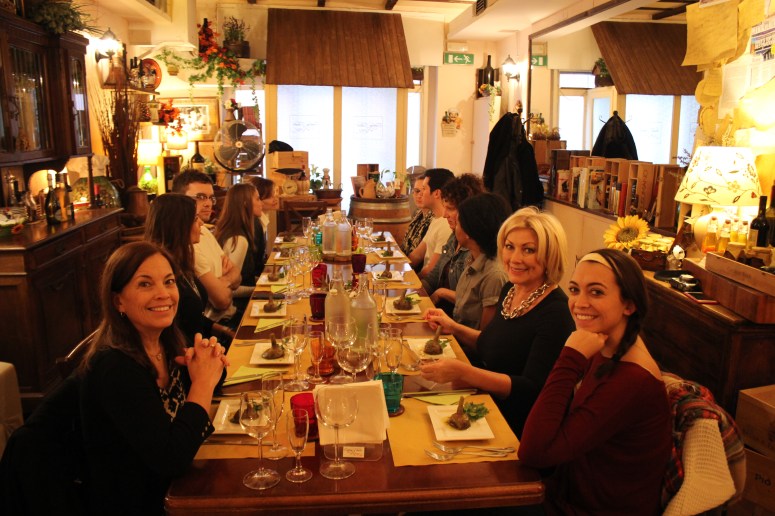
Time to eat our works of art with all of our new friends from all over the world.

The Carciofi alla Romana appetizer.

IMG_2257

Paired with Prosecco di Valdobbiadene.

IMG_2260

First course: Handcrafted Cavatelli fatti a mano con sugo di pomodoro fresco e basilico.

Paired with Frascati Superiore DOC

IMG_2264

IMG_2263

Second course: Involtini alla Romana.

Paired with Negramaro, from the heel of the boot in the famous and breathtaking

Puglia region in the south of Italy.

IMG_2270

IMG_2274

Dessert: Crema al Limone con Kiwi.

Paired with Moscato, 100% Malvasia del Lazio “gleaming golden yellow grapes”

harvested in late October.

IMG_2277

IMG_2278

IMG_2291

IMG_2293

********

At the conclusion of our meal, Chef Andrea asked if any of us would one day use the secrets we learned back in our own countries. What artist does not wish to change the lives of others for the better? And why go to Rome if you do not want to be inspired to create something great?! Or be transformed?

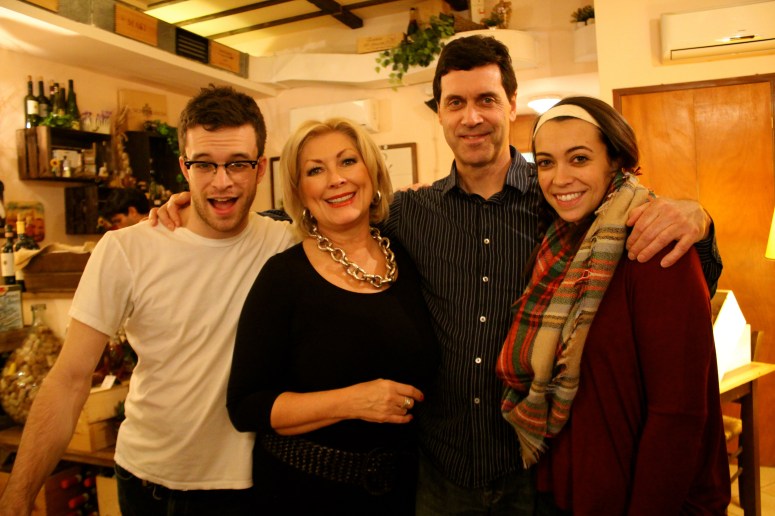
We returned home on a Saturday evening. By the next night—Sunday—our humble gypsy-camp kitchen in America was being transformed into a Trastevere-style trattoria. My daughter’s boyfriend wanted to learn everything we could remember from our day with Chef Andrea in Rome.

********

You don’t need a big, industrial, or high-tech kitchen in order to make art with food. In fact, most of our classes in Europe have taken place in kitchens as small, or smaller than, ours.

IMG_2588

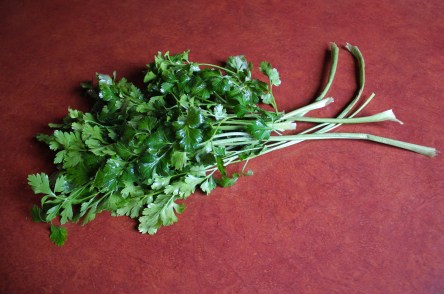
Rome in January was lovely, about 60 degrees. I was happy to find some parsley hanging on in my herb gardens, even though snow was on the way.

IMG_2593

For the handcrafted pasta:

IMG_2595

We had to ask for artichokes at the supermarket. They brought some out from the back storerooms. They weren’t as beautiful as the artichokes in Rome, but still worthy.

IMG_2599

In order to offer finely-grated Pecorino Romano,

this is the side of the cheese grater to use:

IMG_2604

Chopped herbs and garlic and SALT.

IMG_2630

The secret to cooking and eating garlic,

and still being able to get a sweet (not smelly) kiss from your true love all over Rome:

IMG_2625

********

IMG_2606

The artichokes will definitely require some more practice:

IMG_2628

IMG_2629

IMG_2607

IMG_2608

IMG_2612

IMG_2649

IMG_2633

IMG_2638

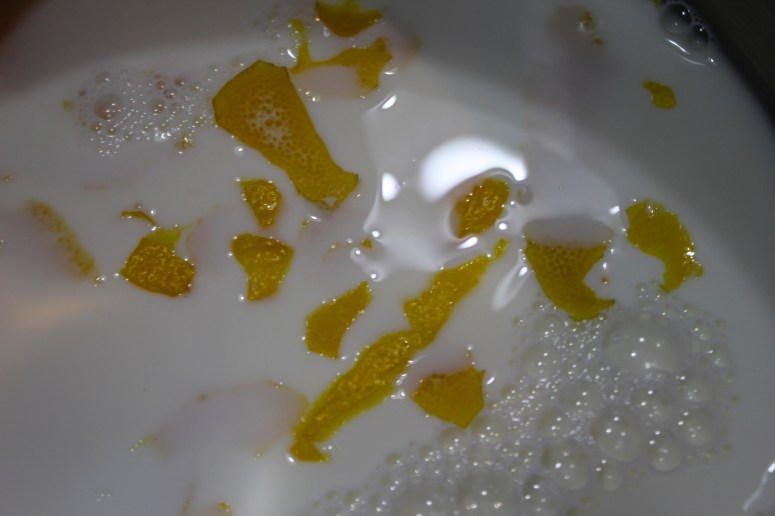
Lemon zest in the milk for the dessert:

IMG_2621

********

IMG_2655

IMG_2657

IMG_2666

IMG_2663

Beautiful snow began to fall during the last course. I set the dessert glasses out to be blessed before assembling the Crema al Limone con Kiwi into them.

IMG_2671

IMG_2675

A glass of limoncello for everyone.

IMG_2682

********

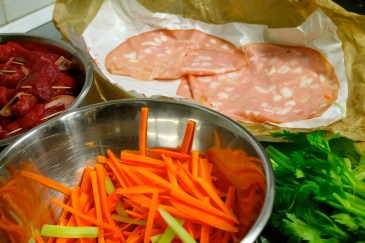
The next day, Monday, there was a generous slice of beef, a few slices of mortadella, and some pasta left over. I sliced the meats and dropped them, along with chopped garlic, into fresh tomato sauce and, borrowing a tip from the prostitutes of yore, began letting it cook. Sexy aromas floated up to—and swirled all around—the desk where my husband had returned to his workaholic self. (Monday was the Martin Luther King holiday. Though my husband had not driven into his office in Boston, he had begun work by 7AM and hadn’t left his desk even as the noon hour approached.) Soon, I heard my husband coming down the stairs, through the narrow alleyways, and finding his way into my kitchen.

We had a nice lunch together, planning our next trip to Italy, and a possible Roman feast at our son’s apartment in Brooklyn.

IMG_2692

IMG_2695

All roads leads to Rome. (Trucks created from random scraps of wood by my son when he was a toddler. Hand tools made in Italy for rolling out pasta.)

IMG_2687

********

If you want to know how to make the food Chef Andrea taught us how to make, you will have to visit him at his Cooking-Classes-in-Rome studio in Trastevere.

Is it worth it to travel all the way to Rome to learn how to make a typical Roman feast? And bring more beauty into your life? And spend time with your family making new friends over food? And feel more hopeful about our post-humanist world?

OMG.

Is the Pope Catholic?

********

A Truly Beautiful New Year’s Eve.

For about 58 pages or so into T Magazine’s (a NYT publication) Holiday 2015 issue, the reader flips through well-known worlds of conspicuous consumption ruled over by all the familiar party hosts. Ralph Lauren, Louis Vuitton, Prada, Cartier, Coach, Estee Lauder, Bloomie’s, Bergdorf Goodman, Tiffany (Since 1837!), and many more.

Maybe the magazine is not the best distraction for the start of what might be a lonely and/or disappointing New Year’s Eve.

But then the magazine presents a little letter from the editor declaring that the overall mood of the magazine will be set by an essay a few pages beyond (past Gucci and HUBLOT) making the case for the idea that “…when we try to create the perfect anything, we often end up stripping away the shaggier bits that may contain the spontaneous, the real, the personal and the one-of-a-kind—and thus, the truly beautiful.”

So then comes the essay, The Good Enough Holiday, about “gladsomeness” and the joys of family traditions and how the gift of a shiny penny used to make a starry-eyed child feel as though they’d become a millionaire.

And thenafter the essay, there are more and more and more seductive sexy alluring oh my gosh yes that and that and oh how thin and famous and RICH everyone is and look at those beards trimmed as perfect as the hedge around Versailles with revelers wearing diamonds on the soles of their shoes all aglitter like a Hall of Mirrors reflecting upon the sparkling and soothing salt waters of private lagoons and pre-fab fantasy forests! 

I can’t tell if I am supposed to take T Magazine completely seriously. It’s so absurd. It’s also funny, corny, interesting, and sumptuous. I think, based on the magazine’s website, that it strives to be influential, sophisticated, cultural, extraordinarily luxurious, stylish, and right on target with the “influences and ideas shaping this moment.”

The magazine came to my house a while ago tucked into a liberal newspaper—the New York Times—a prestigious newspaper that has done a great job reporting on wealth inequality in America which is an idea shaping the moment, but not an idea shaping T Magazine.

The magazine makes me wish I had a million available-to-spend-right-now dollars—a reflection of wealthy lifestyle influences bombarding Americans all the time.

The magazine feels, to me, like the energy at a gala charity event—money, money everywhere, a few good conversations, a few feel-good moments, and then that excessive “morning after” emptiness that can be so depressing when conspicuous consumption gets into bed with conspicuous contributing.

The magazine is like New Year’s Eve in America—it’s an enigmatic something marked by great expectations and foolish fantasies. It strokes the wondrous pleasures of indulging in ideas for fresh and trendy new beginnings. It sends exciting ideas tumbling into arenas of dream possibilities where attitude adjustments, fashion-upgrades, fine art acquisitions, exotic travel, and professional and personal lifestyle changes are casually woven into everyone’s everyday gig. Over a lot of drinks. And too much food. And loud laughter.

Though the magazine claims an affinity for the “shaggier bits” of spontaneity, and the real, and the personal, and the one-of-a-kind, I didn’t find any such “truly beautiful” examples of these treasures on the glossy pages. There were, most definitely, many beautiful things to look at and fascinating things to read about.

But to find truly beautiful, the magazine would have had to send their writers into the homes of the rest of us. For that is where the private galleries of the truly beautiful, one-of-a-kind treasures of the world are kept carefully displayed or robustly ready for joyful excursions into playtimes and gladsomeness.

I was charmed to notice, as I gazed at page after page of suggested purchases, that many of the beautiful items featured were similar to things I already have, and although the magazine’s chosen works of art were lovely, my works of art, in my humble opinion, are more truly beautiful.

What follows is my own version of a New Year’s Eve party game. Some of these things are not like the others. But they’re close.

********

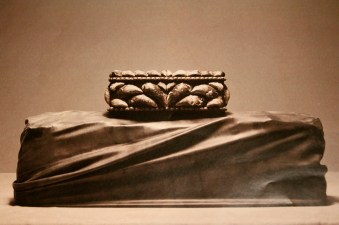
From T Magazine’s feature: Tangible Beauty. Exquisite, rare objects that honor the gift of giving. Photos by Anthony Cotsifas. Styled by Haidee Findlay-Levin.

Polygonal bronze bookends as artful as they are useful, left untreated to attain a natural patina over time.  $1,250.00 each.

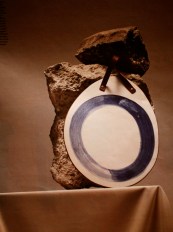
IMG_1558

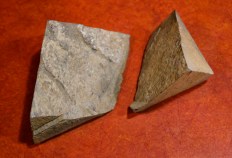
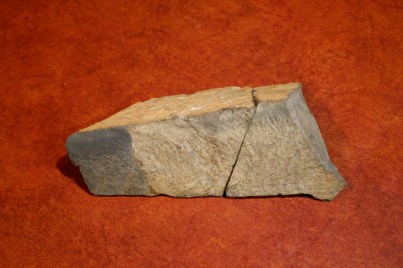
My Version of polygonal art: Ancient stone from the top of a random mountain (not a national park!) in Maine. An all-natural brain teaser made of sturdy materials bonded together by Earth’s own timeless forces. Found while hiking alone with my husband after locking our kids in the family camper at the trailhead because they were driving us crazy. Not as easy as it looks. (To be a parent, or to figure out this ancient puzzle.) Free.

IMG_1554

IMG_1547

IMG_1555

********

From Tangible Beauty. Wild mussels and periwinkles covering vintage objects, like a box. Wild, untamed sentimental keepsakes. About $300.00

IMG_1561

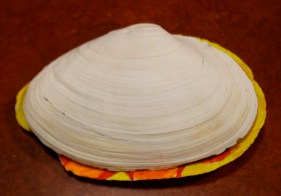
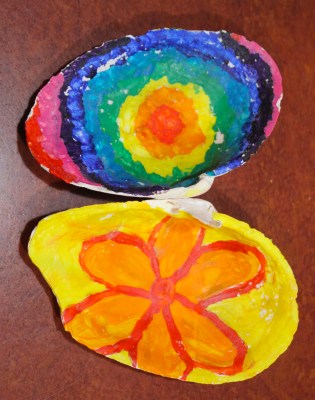
My version of sentimental shells and boxes: Wild clamshells claimed in the romantic Atlantic surf by my daughter. Sentimental glee painted by her own heart and hand inside. This shell is part of a series of shell paintings she called The Garden. Free.

IMG_1531


IMG_1533

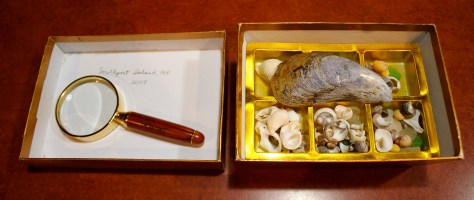
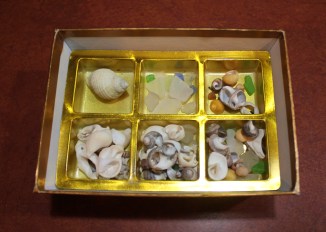
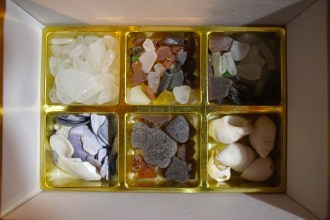
And, our version of a special box for treasures. An old chocolate box, repurposed as a box of curiosities found one day on a beach on an island in Maine. All shells might, or might not be, ancient. There is sea glass mixed in. You can rearrange the treasures however you like, in two tiers of compartments and closely examine them with the magnifying glass. Shells, free. Box of chocolates, can’t remember what they cost. Magnifying glass was a promo gift from an insurance company.

IMG_1570

IMG_1571

IMG_1572

IMG_1575

********

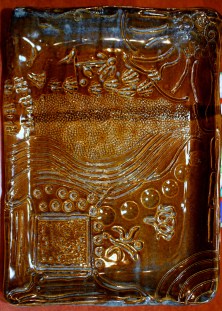
From Tangible Beauty. Refined and rustic terra-cotta platters influenced by folk architecture and agrarian tools and primitive symbols. The forms are affixed with leather handles which I like very much. $225.00

IMG_1560

My version of a folk art platter with primitive symbols: a slab of pottery produced by my daughter. Not free—the materials and studio at her school cost something.

IMG_1536

********

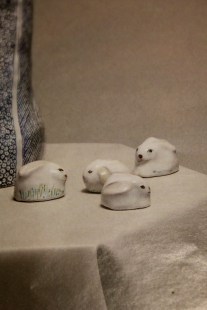
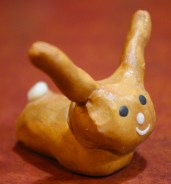
From Tangible Beauty. Sophisticated charm from the innocence of naive art. Whimsical creatures with free-spirits using a rare technique of maiolica dating back to the Renaissance. Baby rabbits, about $46.00 each. I love bunnies!

IMG_1564

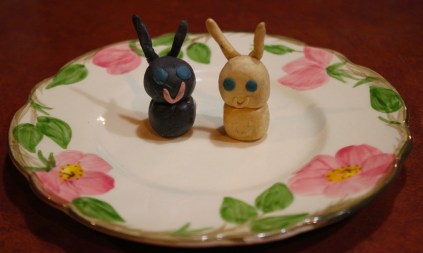
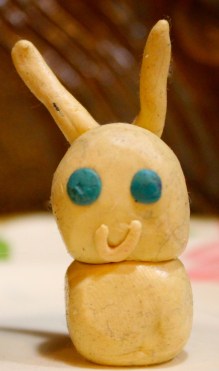
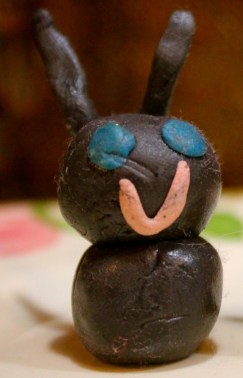
My version of precious, naive art bunnies. Sculpted clay creatures paired on a plate by my daughter—something my husband would joke about making a meal out of. But I have never disturbed the offering and after many years, there are lots of “shaggy bits” of dust on the bunnies. An all-natural effect of furriness! The white bunny has a pink tail on the back. Nice detail. Free.

IMG_1541

IMG_1538

IMG_1538 2

And another naive bunny I treasure, sculpted from baking clay, a gift from my niece when all of us had bunnies for pets.

IMG_1546

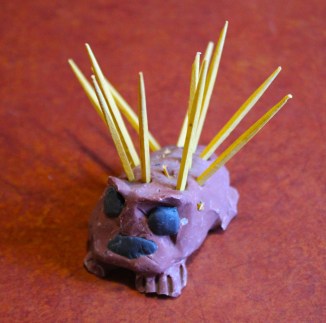
And one more naive creature. From my son. The gift of a clay porcupine using innocent toothpicks.

IMG_1579

********

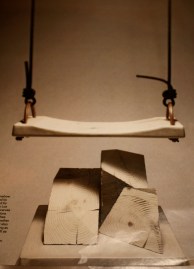
From Tangible Beauty. A swing. Hand carved with luxe leather loops. Functional and sculptural for swinging inside a grand loft space or for gliding in the great outdoors from a real tree. $2,500.00

IMG_1565

I don’t have a picture of my version of this. It was a disk cut from a hunk of oak that my husband drilled a hole into the middle of and secured on a single strand of rope with a heavy-duty, hand-tied knot. The rope was flung over a branch in the old elm tree in our backyard. The single-rope design meant you’d go flying in all directions and you had to hug the rope to save your life. A lot of spinning. Only one mishap—when a neighborhood daredevil jumped off and the swing swayed back into his forehead and left a delicate gash that needed a few stitches.

********

On New Year’s Eve, I hope we all spend some quiet time feeling starry eyed about the truly beautiful lives we already have and going for a stroll through our own galleries of priceless treasures.

And may 2016 bring more true, genuine beauty your way!

********

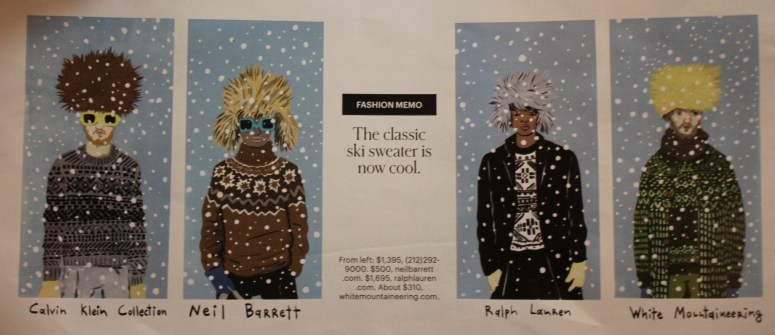
P.S. According to T Magazine:

IMG_1567

My take on this: The ski sweater, just like the ski mountain, just like the ski mountain bar, just like the ski mountain lodge, just like the ski mountain snowflake, just like the ski mountain french fries, just like the ski mountain home-packed lunch, has always been cool.

Think snow!

********


Bah Freakin Humbug.

There won’t be any snow for Christmas where I live in America’s northeastern Currier and Ivesville. The grass is green and supple, flowers are blooming, and the birds are taking baths without chattering beaks.

For some of us, 2015 has been the best of years and the worst of years. Worst of all, best didn’t do such a great job of overcoming worst. Sometimes, worst is worst—maybe the worst—and even if you were to fill the cathedrals of the world with every bit of your best from one year, your worst might still hum a mournful wail over the happy-ending high notes we all hope to hit at year end.

And then what!

Well, 2015 was one of the worst years for me. But not the worst. It was, however, the worst year for too many of the people I know and too many of the people I don’t know all around the world.

There is one tried and true practice that, in my humbug opinion, never fails to create notes of grace through times of troubles. It is simply this: Think of others.

Last night, my husband came home from work hauling his collection of briefcases and his guitar. “Why do you have your guitar?” I asked him. Had he auditioned for a rock band? Were we going to sell everything and return to the halcyon days of worry-free living in rent control with bold cockroaches? The days when happiness was stored one block away at the local dive, where we’d go to drink cheap beers and watch Larry Bird show Magic Johnson how Indiana comes to Boston to shoot hoops? Pre-craft-beer glory times! When we used to donate blood to the lab rats at Boston U Med every week or so—on our way to work—for twenty five bucks which was the price of one lift ticket at posh Sugarbush or a couple of lift tickets at wicked uber-rad Mad River Glen, and a whole season of tickets at forlorn Hogback, which is now just a ghost mountain.

No. My husband was not planning to abandon our troubles. We’ve been in this place before. Things have been worse for us. And they have been better. And so it goes. (Vonnegut, with a long face.) And it’s a wonderful thing to be married to a dude who is steady and sensible, because if he had loaded that guitar into our motorhome and stuffed every dollar we’ve ever earned into the overhead cabinets and said to me something like Baby we were born to run I would have clipped a blinking Rudolph nose above my Grinchy frown, harnessed myself to the front of that leviathan rig, and yanked it high into the sky. Far, far away. As far away as far can go.

“I took my guitar to a client meeting today,” my husband said. He told me who the clients were—a lovely couple he enjoys very much—and I remembered that 2015 hasn’t been the best of years for them. One of their daughters has been seriously ill and one grandchild continues to battle heroin addiction.

“What was it like when you brought your guitar in?” I asked.

“I didn’t bring it in right away,” my husband said. “I wanted to see how the meeting went first. But after we got through their financial reviews, I said I wanted to do something different for them and that I’d be right back. Then I went and got the guitar. I said that I was sorry they had had such a heart-breaking year and that I wanted to give them a few minutes to sit, relax, and listen to music.”

“Did you feel awkward?” I said.

“Kind of,” my husband said. “At first. But then, it was just—nice.”

He played: Do You See What I See? Silent Night. And, Angels We Have Heard on High for his clients. A private and intimate performance, unexpected, all in the comfort of their quiet home, on a warm winter’s evening. I know how sweetly beautiful he plays those songs and I am sure his clients were touched.

My husband asked how my day had been. “Well,” I said, “I cried a little bit in the morning. Talked to my sister. Talked to your sister. Went for a walk in the early evening. You know. Did some work. Cleaned up.”

He opened a beer. We split it. He took a hot dog out of the freezer and cooked it on the grill. We split the last scoops of ice cream.

Another night of beer and ice cream for dinner.

********

One day, during the recent fall season, we had a lot of fun tailgating at a UConn football game. My husband’s favorite cousin and his wife joined us for a day of sun, fun, food, and Left, Right & Center—which my husband’s cousin rallied a large group of my daughter’s friends to play. It was a happy day when my husband’s cousin and his wife showed up to care about us during the most stressful days of our 2015, and everyone had a great time.

Only a few weeks later, on the Sunday before Thanksgiving, this favorite cousin died unexpectedly the morning after his birthday—one of the best birthdays he had ever celebrated.

When we went to the funeral, the day after Thanksgiving, I wandered away from the crowd at the funeral home and found a small bookshelf in a private sitting area. The collection of books covered all kinds of grief, all kinds of death, all kinds of life’s challenges. I reached for Viktor Frankl’s Man’s Search For Meaning and settled down to read it. The book is filled with shocking passages about the depths of human cruelty, human suffering, and human triumph. There are pages and pages of wisdom, philosophy, psychology, and suggested life practices.

I don’t imagine it was a book my husband’s cousin ever read, though he was an avid reader. He just didn’t need such books. He was content with his life, including all of its attendant heartaches and joys, and accepted, without too much judgement, the ways of the world. All families need a cousin like him, more than they need books by people they will never know. We will always miss him, and will always be grateful to have his spirit to see us through.

12109969_10206730075881908_4042360677964198636_o

********

For those of us who are, no matter what, in need of books like Frankl’s Man Search for Meaning, and find ourselves often tormented during the holidays by the joys and sorrows of lives as layered as an enormous vat of figgy pudding prepared to feed the hordes of revelers whooshing around on the ice at Rockefeller Center, there are ways to enjoy navigating the emotional minefields of Christmastime.

Of course there are.

First of all, take your family and friends and Internet bloggers up on some of those out-of-the-ordinary suggestions for holiday-season entertainment. My sister recommended my husband and I go see “The Curious Incident of the Dog in the Nighttime” during a visit to New York City. Neither of us had read the book. We woke up early on a Saturday morning, dressed up, drove a fast three hours to our favorite cheap (but nice enough!) hotel in Long Island City, Queens, (written about in my first blog post when 2015 was just getting underway), took the 7 Train directly to the theater district and settled in for a matinee performance. We thoroughly enjoyed the inventive and exciting play.

20151212_135652

Afterwards, we let a pedicab rip us off for a thrilling ride through the insane crowds and tightly-packed vehicles of Times Square. (It was so warm out! We feared for our lives!)

20151212_165336

We were on the way to the Morgan Library Museum, where we met our son and rushed through exhibits on Matisse and Hemingway. After that, we strolled in the tropical temps to the lounge at The Bowery Hotel for a quiet place to have drinks before dinner at Upstate Beer and Oyster Bar in the East Village—a place recommended by one of our son’s good friends. We ordered oysters, sea urchin, smoked trout, crab cakes, clams and fettucine, all served small-plate style in an intimate, dark space that’s lucious with crazy-loud happy eaters.

Another fun place for drinks with festive decorations: Pete’s Tavern near Gramercy Park. O Henry lived nearby, but did not pen The Gift of the Magi while drinking craft beers at Pete’s.

IMG_2877

Another suggestion: Listen to Patrick Stewart’s A Christmas Carol on the CD player in your car if you have to drive long distances alone. So superb.

20151215_123708(0)-1

Another suggestion: Bake cookies that require a lot of time and effort. Lose yourself in the long moments required to make a big mess and clean it up. Don’t get all Martha Stewart about how to decorate them. Hand the job over to the kids. Even if they’re big kids.

IMG_2774

IMG_2775

IMG_2778

IMG_2783

IMG_2782

And the old stand-bys: WALK through the woods! Early mornings and late afternoons are lovely. Later, drive around and look at Christmas lights. Professional displays are nice:

IMG_2623

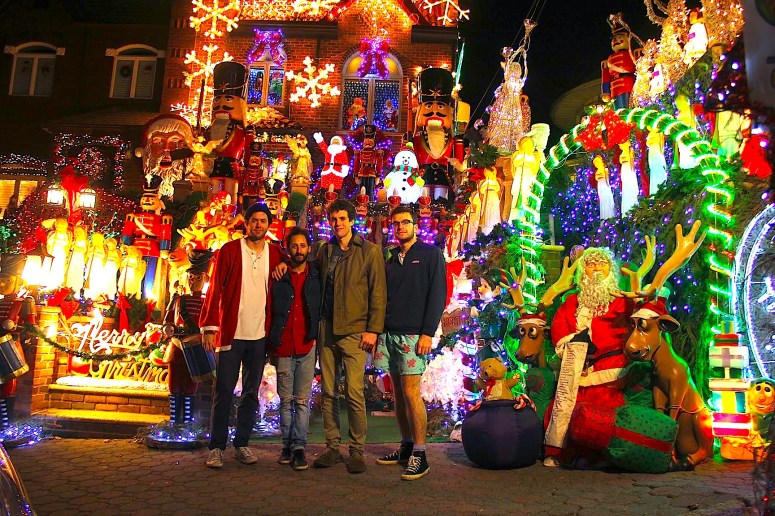
But neighborhoods are the best, by far. Here’s the best band of 2015, Teeth People, out and about enjoying the bling of Dyker Heights, Brooklyn.

Unknown

********

And now for some of my favorite words from A Christmas Carol by Charles Dickens. The book is so good.

“Bah!” said Scrooge. “Humbug!”

“Christmas a humbug, Uncle!” said Scrooge’s nephew.  “You don’t mean that I’m sure.”

“I do,” said Scrooge. “Merry Christmas! What right have you to be merry? What reason have you to be merry? You’re poor enough.”

“Come then,” returned the nephew gaily. “What right have you to be dismal? What reason have you to be morose? You’re rich enough.”

“Bah! Humbug!”

“Don’t be cross, Uncle!” said the nephew.

“What else can I be,” returned the uncle, “when I live in such a world of fools as this? Merry Christmas! Every idiot who goes about with ‘Merry Christmas’ on his lips should be boiled with his own pudding, and buried with a stake of holly through his heart. He should!”

“Uncle!” pleaded the nephew.

“Nephew!” returned the uncle, sternly, “keep Christmas in your own way, and let me keep it in mine.”

“Keep it!” repeated Scrooge’s nephew. “But you don’t keep it.”

“Let me leave it alone, then,” said Scrooge. “Much good may it do you! Much good it has ever done you!”

“There are many things from which I might have derived good, by which I have not profited, I dare say,” returned the nephew. “Christmas among the rest. But I am sure I have always thought of Christmas time, when it has come round—apart from the veneration due to its sacred name and origin, if anything belonging to it can be apart from that—as a good time; a kind, forgiving, charitable, pleasant time; the only time I know of, in the long calendar of the year when men and women seem by one consent to open their shut-up hearts freely, and to think of people below them as if they really were fellow-passengers to the grave, and not another race of creatures bound on other journeys. And therefore, Uncle, though it has never put a scrap of gold or silver in my pocket, I believe that it has done me good, and will do me good; and I say, God Bless it!”

********

I say, God Bless the Keeping of Christmas, too, however it is you choose to do it. Keeping Christmas has always done me good and sustained me, even when I’ve been called upon to bear the worst of years. And if this has been a worst of years for you, I am thinking of you, and hoping the best of Christmas will find you, and see you through.

IMG_2750

From a painting given to me by my daughter one Christmas.

********


Twenty Fun.

Do you remember when you believed reindeer could fly?

Close your eyes.

It’s nighttime.

The night is so big. The cold is so warm. The snow falls and falls and falls.

Every snowflake is smiling.

The reindeer appear in rainbowed arcs from another side of the nighttime, flying forth on a trail of shining stars that look as though they are bursting and popping, yet they are as quiet as the gentle swish of a salamander’s tail.

The reindeer land in your backyard. Their coats of brown fur glisten in moonshine that smells like fresh honey and tastes like bright yellow.

Shiny-belled harnesses ring—winter’s own music—a thousand joyful nightingales singing Christmas carols.

Majestic antlers reach almost as high as your bedroom window where you are watching from the second floor of your home. Everyone else is fast asleep.

The reindeer stamp their hooves deep into the snow, jingle their bells, and—looking up—find you in your bedroom window, believing.

This gives them the courage to keep flying.

********

IMG_1197

(Photo by Aunt Heidi.)

********

Today is my daughter’s 21st birthday. Twenty Fun she says.

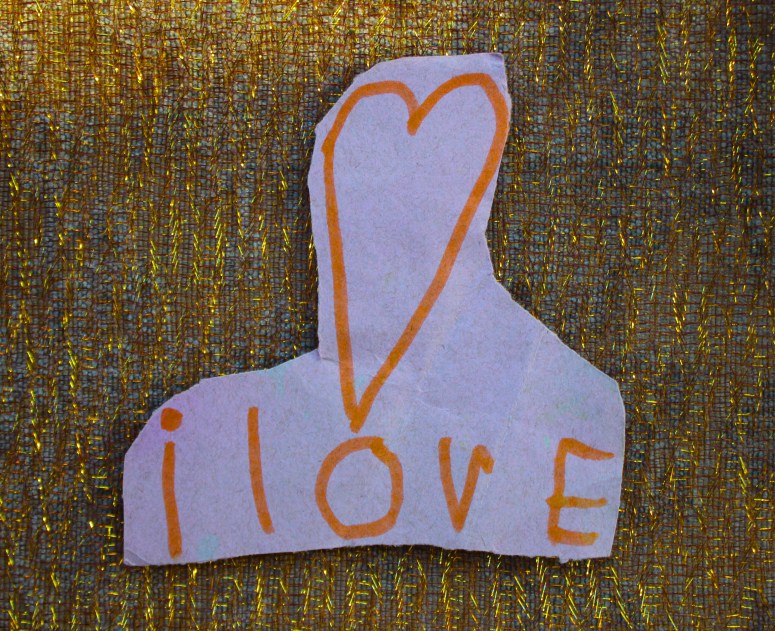
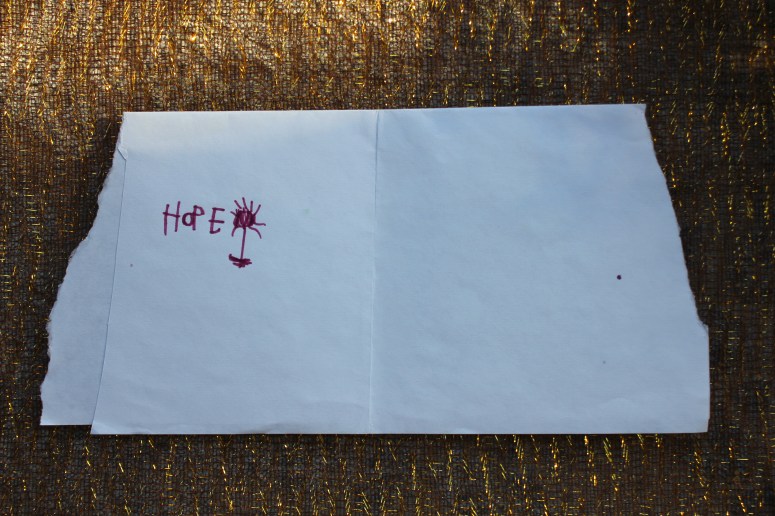
She was born to forever honor and keep special the expansive worlds of childhood play and creativity. She wrote her first manifesto as a toddler and has never doubted her words and all they can accomplish:

IMG_1186

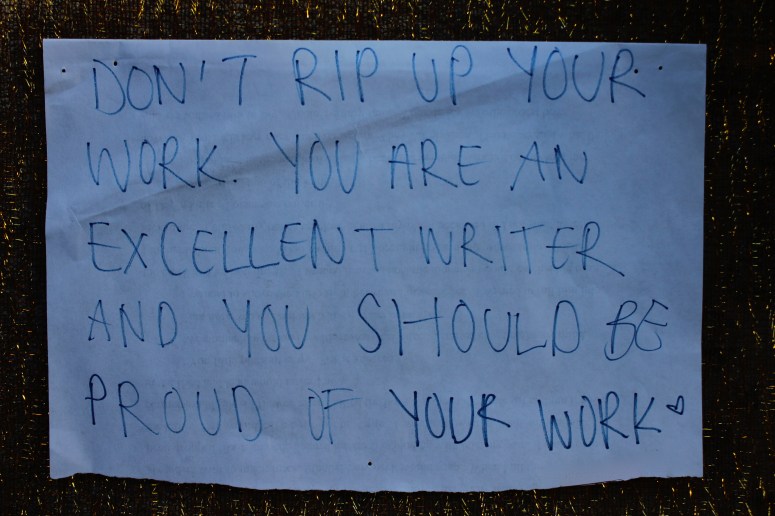
She believes reindeer can fly and she believes in you, too. If you’re having trouble finding your wings, or calming an aching heart, she might cook you an unforgettable meal or leave a note under your pillow or on your desk.

IMG_1187

IMG_1198

She’ll pick a posy of wildflowers and arrange them just so in a paper cup and place them in the middle of a picnic table. She’ll bring you a butterfly.

IMG_1188

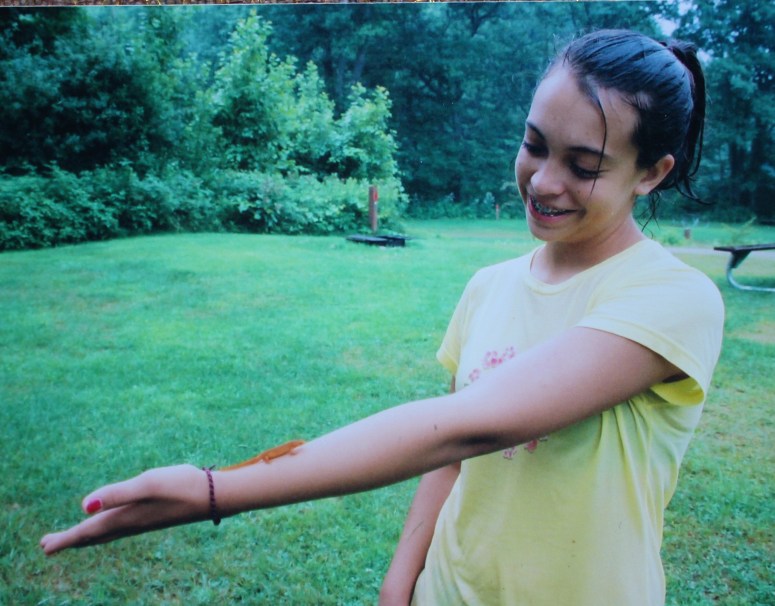
She’ll catch the biggest fish for you. Or the cutest creature colored orange.

IMG_1190

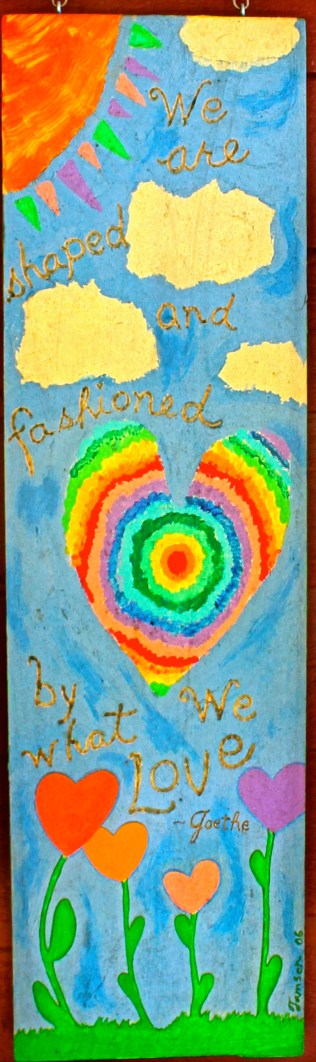
She’ll hike all day in the rain with you. She’ll bake for you. She’ll paint hearts and rainbows.

IMG_1610

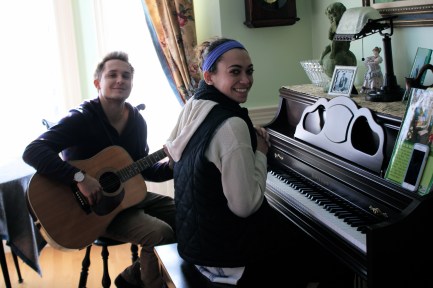
She cheers for the home teams. She plays Christmas carols on the piano. She plays love songs, too, with her boyfriend.

IMG_0925

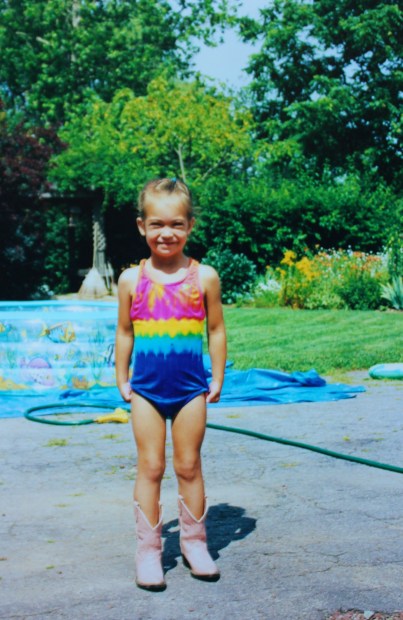
She’ll play board games and watch Disney movies, over and over again until everyone feels like going out for a night on the town, flying around, dressed in princess garb or mermaid skirts or cool boots. Get on your boots. Cowgirl boots. Hunting boots. Ski boots. Big city girl boots.

IMG_1194IMG_1195

IMG_1199IMG_3124

The spirit of party reigns in my daughter’s world. In fact, she has taught me that Party Spirit is the best remedy for the doldrums and the sads. It’s also a necessary component to most every day. When she was a toddler, she would awaken on random days and declare Dress Days. We had to wear dresses all day. You could choose different dresses throughout the day. I was a tomboy mother without dresses in my closet, but I became one fair lady on Dress Days.

The rules for Dress Day were simple. Wear what you want, in whatever combinations you like, all the way down to your shoes, which don’t have to go on a “right” foot.

IMG_1191

********

My daughter taught me to Fling a Little Festive into Everything You Do.

********

Joyce Carol Oates wrote in her essay, “Beginnings,” that the impulse to create is utterly mysterious. “…’art’—originates in play…it remains forever, in its deepest impulse…a celebration of the (child’s?) imagination…”

Oates headlines her essay with a quote from Andre Gide: “I will maintain that the artist needs only this; a special world of which he alone has the key.”

And Charles Baudelaire said: “Genius is no more than childhood captured at will.”

—And one day, recently, when I asked my daughter if she had had a happy childhood, she said:

“I don’t know. It’s not over yet.”

********

Is your childhood over yet? Have you stopped believing reindeer can fly?

Do you love your birthday?

—Or is age something that takes you further and further away from your youth and its attendant genius, instead of delivering you deeper and deeper into those special worlds where only your heart can unlock your own unique perspectives on what’s so wonderful about being alive—and then share them with the rest of us.

My daughter loves her birthday. It’s the one day every year when the party is about the arrival of her world into this world.

Everyone has a birthday. It’s a day better than New Year’s Day for beginnings and celebrations and the sharing of you with all of us.

Do you remember when your lungs drank up that first breath of air before you were plunged into childhood?

Close your eyes. Take a deep breath.

“There is a fountain of youth: It’s your mind, your talents, the creativity you bring to your life and the lives of the people you love. When you learn to tap this source, you will truly have defeated age.” Sophia Loren

Let the breath go. Follow it!

********

Happy Twenty Fun to my daughter! Drink up that first breath again. Keep drinking that energy. Keep playing. Keep sharing the creative genius of your youth.

It never gets old!

IMG_0212

********


Summer Shorts.

A worn paperback discovered

leaning against the dusty window of a used-book store on Vinalhaven Island, Maine.

One of my favorite personal artifacts.

Purchased after a day of hiking and biking on the island, 

and swimming in the island’s abandoned quarries.

The year was 2004.

My children were young. Base camp was Camden Hills State Park.

IMG_5879

********

I am driving. It is late September and it comes to my attention that summer is officially over.

I stare into the rear view mirror and notice the setting sun. Badlands (Springsteen) is playing on an ancient CD in my dash. The CD is partially cracked—sliced clean through—but Badlands still works. A sports car rockets from the edge of the horizon, like a spark leaping off the sun. It is closer than it appears, aimed for my road space. The car is white and after it dusts all 160,000 lumbering miles of my old volvo tank, its hind end sneers back at me—like a mean monster’s face. Red taillights with beady red eyeballs. Frowning mouth with gaping, thin lips. Shiny, loud teeth—inhaling my exhausted sighs and getting me high. It’s an F-Type Jaguar. I want to be the driver of that car. The one living that life. Somewhere in the repertoire of all the lives I dreamed of living, I never thought to envision myself as the owner of a fast, well-engineered, beautifully-designed car.

********

In August, my mother survived the ravages of a stroke. She remains hospitalized, paralyzed on her left side. In fact, anything to the left of her field of vision is a total blank. She has no concept of a world beyond that zone. We are supposed to speak to her and visit with her from the left side, so that she will learn to scan the world “from all the way left.” When I am in her zero zone, I am not of her world.

I remember the early days after Mom’s stroke, when it seemed she could not possibly live another morning, or afternoon, or evening. My husband arrived for a visit. “Hi Mom,” he said, bringing a fresh smile into her somber world, “don’t get up.”

Mom slurred out two words, “I won’t.” And then she tried to smile, too.

Now, Mom can smile a real smile almost all the way through both cheeks and she can laugh. She can sit in a wheelchair. It is so wonderful, one almost feels as greedy as a self-proclaimed king when one continues to pray that she will soon walk into her own kitchen and have the use of her left arm to make an ice cream cake, while checking in on the stock market.

Not long after my mother was struck down, my husband’s mother slipped on the floor where she lives alone near Syracuse, New York. She broke her arm and her hip.

I drive back and forth to Connecticut.

My husband drives back and forth to Syracuse.

We drive back and forth to Connecticut and Syracuse.

We drive back and forth to places where we pretend the world can never find us.

********

There are stories and films and theater productions, and songs and poems, and drunken rants, and perfectly lucid rants,

about hitting the roads of America—summer being the preferred season for taking on the gypsy life.

Maybe the road wanderer is going in search of a worthy cliff over which every parasitic load of grief that has ever chewed venom into the heart can be cast away. (A never-ending quest.)

Or maybe the wanderer wants to find America and the meanings of life. (The meanings are all out there.)

Or maybe the wanderer needs to escape the confines of adulthood. (For a gypsy, life is better on the road.)

Or maybe the wanderer seeks to connect with their one true self. (You meet a lot of true selfs on the road.)

Or maybe the wanderer hates their one true self and wants to frankenstein a new self,

or fabricate a branded self,

or become reborn as some other self they can present to the community for applause and a prize

and for membership in the kinds of contemporary cultural groupings that promise the security of lifelong enrichment

through network friendships. (The road can be so under appreciated if you need to be connected to a network.)

If the road is good to you, and you find yourself freed

—beyond the menacing tentacles of any network—

don’t be a stranger to yourself. (My son said this to me recently when I was feeling bereft and unable to excite the pleasure centers of my brain.)

Learn to believe it when you think life is short.

Summers are even shorter.

********

Summers, indeed, are too short for finding the time to read all the road-trip stories and watch all the movies and play out all the dream excursions, driving fast—or slow—over paths well traveled. I have been finding the time, though, to listen to a lot of the road-trip songs while heading out to visit my mom. I drive parallel patterns running north and south, on roads that are perpetually under construction and increasingly under siege. Trucks, hauling road trains of useless stuff from faraway places to nearby shopping centers, knead road surfaces into landscapes of the moon—cratered and rutted and barren of life.

Plasticity bears in on me.

I know there isn’t one thing, aboard any truck, on any route gouged into American soil, that I need.

But I do need the road.

I am dazed and disarrayed. Glossy-eyed, not sleepy. Annoyed by every little thing. Hurtling my old car 75 mph over paved highways, lane to lane, sun rising, sun setting, stars throbbing.

I am thinking. Over thinking. Using up blank space. Never getting it back. Wishing the leaves would stop changing colors.

My husband and I rendezvous at home and look at each other over the dinner table. We start out sharing a beer. Then we drink wine. Then we sit around pretending we aren’t waiting for the telephone to blow up. Then we rumble the roads again somewhere between Syracuse and Connecticut.

If you set personal-life drama to music—folk songs, rock songs, lullaby songs—you can become your dreamer self again. Especially if you were born during the 60’s and had a pair of headphones and a turntable and a babysitting job and a lawn mowing job, (to fund the purchase of albums), and an established dominion in the corner of an overcrowded bedroom where you could tip your head back, stare up at the ceiling, and listen to the noise.

Louder plays the music, in your memory and in your car. You don’t just love the groove, you love the lyrics. You love the rock stars. You are going to be free forever someday. Still. You will be your own true self and you will never need anyone else except for all the other people who are their own true selves, too.

My mother is her own true self.

********

En route to home after visiting Mom on the day I noticed summer was over, the road delivered me into the parking lot of a New England farm stand near my house. I got out, all grown up, cooing Badlands, using it as a lullaby salve for my shaky little soul, which I prefer to keep protected behind a hard-working heart.

Artfully stacked pyramids of fresh-picked apples and haphazard piles of just-harvested pumpkins stroked longings for the spirit of the Great Pumpkin to carve me up into a happy face. The summer’s long days and nights were being woven into the shorter days of autumn. They hung like a tattered curtain, shredded by the rush of remembering a full summer of road trips that shook me up from Alabama and through the southern states, bound for the north to everywhere in New England to Ohio to Canada to New York State and to still trying to find home. The curtain is lowering over the stage of one set and preparing to rise from the stage of another. Its parts and pieces flap in that in-between space of life like this and the shift. 

When the winds grow calm, I can’t breathe.

Time slows to the length of one, precious, prayed-for heartbeat.

One, precious, flutter of an eyelid.

One, precious, electric particle of the universe, to connect the brain to the body,

And a prayer to a promise.

********

At the farm stand, I want one true apple.

But I choose three—a ginger gold, a macintosh, and a golden delicious.

I slice off a taste of each. The ginger gold tastes best. But the macintosh will part the dark clouds when I slice it into wedges and zap it in the microwave with cinnamon on top. The golden delicious, meh.

I resolve to take a road trip to Scott Farm, Kipling Road in Dummerston, Vermont. There, they display their collection of orchard-grown apples like great wine in a wine shop, like cigars in a cigar shop. Wooden boxes, filled with fruits in varying shapes, sizes, and colors, are arranged together, like shelves in a library. Little descriptive phrasings on labels describe how each apple tastes, what kinds of fragrances they emit, and how they will save your tongue and your inner being from the sadness of plasticity arriving on big trucks from Timbuktu and wifi networks infiltrating the Peace of The Road.

********

It was a short summer. It always is. But there was enough sunshine to grow the apples and the pumpkins for sale along the roadsides of New England. Maybe the fall season will be a glorious one.

Maybe the Great Pumpkin will, at last, rise from the pumpkin patch. Maybe Lucy will let Charlie Brown kick the football. Maybe Charlie Brown will get some candy in his Tricks or Treats bag, instead of rocks.

I never expected any of those things would ever happen.

But I always dream, whenever I become my dreamer self, that they might.

The Slow Art of Finding Peace and True North.

Sebastian Smee is an art critic. He writes for the Boston Globe and he has been awarded a Pulitzer Prize for Criticism.

In the Boston Globe this week, there was an article written by Smee about the Maine Art Museum Trail. I looked forward to reading it, but by the end of the opening paragraph, I found myself terribly concerned for all the people who might read the same first lines and decide to anchor themselves forever to southerly, and most-convenient-to-Boston, regions of New England.

Smee had written: “There are two museums on the Maine Art Museum Trail that have so far eluded me: The University of Maine Museum of Art in Bangor and the Monhegan Museum of Art and History. The first—sorry Bangor—is too far north of Boston. The second is on an island—and that’s just inconvenient.”

********

THROW OFF THE BOWLINES!    SAIL AWAY FROM THE SAFE HARBOR!    (Mark Twain, I think.)

********

Bangor is not too far north. I promise. There is, as mentioned in Smee’s article, The University of Maine Art Museum to see up there. But there’s more. For instance, if you want to visit many of the places that inspired the art all along The Maine Art Museum Trail, keep driving down east to the coastline beyond Bangor.  You’ll find Acadia National Park plus a culturally distinct region of the world.

All you have to do is turn off the GPS and follow your nose. The scent of the sea, or at least the marvelous stink of a dramatically displaced low tide, will lead you to unexpected life-changing experiences such as the pleasures of being a spectator for the Women’s Skillet Toss at the Blue Hill Fair. This rowdy event fills the grandstands and it’s authentic Maine through and through, so even though you risk getting walloped upside the head by an errant iron skillet, you are not required to wear a helmet in order to attend the show. Women competitors are classified as Kittens and Cougars. They fling iron skillets as far, and as straight, as possible. Some of them can send those old iron workhorses sailing further than a soldier’s dream for a home-cooked meal! The Blue Hill Fair pleased E.B. White so much, it inspired many of the story lines and settings for one of the world’s (and my family’s) all-time favorite books, Charlotte’s Web.

As for Smee claiming Monhegan Island is just too inconvenient to visit, allow me to transform the idea of such a journey into something desirable, convenient, and perhaps necessary to your passage through life here on Earth.

IMG_3819

********

Let’s start with a time warp…the year is 2007…Labor Day weekend…I am Mother to a 15-year-old son beginning his junior year in high school and a 12-year-old daughter ready for college instead of middle school…both children are willful, independent rapscallions…we are bound for a campout on the coast of Maine and plan to take a day trip to Monhegan Island…Raffi music in the camper has been taken over by Hendrix…it is painfully inconvenient for my husband and me to travel with our teenagers…it is more painfully inconvenient for said teenagers to travel with us.

Places like Monhegan Island help counterbalance the laws of nature and the laws of technology in our tense and complicated modern world. You might not be suffering through the throes of parenting (or any other situation of nature-determined, unconditional love), but perhaps you are afflicted with the side effects of Blindsided-TechAlien Abduction. In other words, there’s a chance you’ve been abducted by technology aliens and don’t know it. The aliens are so charming and so invisible, you haven’t noticed how conveniently they have settled into your life. They eat with you, sleep with you, make decisions for you, and then they steal your identity, your attention span, your creative impulses, your freedom, and your ability to look UP and OUT.

Monhegan Island is small—only about one mile from end to end and side to side. There are no paved roads and not many cars. You ride a ferry boat to get there. Travel by foot prevails once you are upon the island.

Here’s what happened when our modern family went to Monhegan Island, as recorded–by hand–in my unedited travel journals:

Sunday, September 2, 2007. En route to Monhegan Island. At last. We won’t have a lot of time there. Two porpoises leapt along our port side as we left Boothbay Harbor. Best snack in the pack today was made by the kids: graham crackers with nutella, peanut butter, and 2 squares of Hershey’s. I read Checkhov’s short story, The Lady with the Dog, during the ferry cruise.

We made landfall at 11:05. Our crossing cut through calm seas under outrageous summery-blue skies. Stopped at The Barnacle after getting off the boat to find out what the local shop had to eat. We got two cups of clam chowder (with extra crackers) and one blueberry scone.

We sat under a stand of sunflowers to eat the chowder while bees flew orbital patterns around and around and around.

We set out walking. Burnthead Trail to Cliff Trail and then lost our way a bit to Cathedral Pines. Breathtaking views. You can see all the way out to where the water falls off the edge of the earth. The perches on this little island’s cliffs are not so little. I don’t know how high up we were, but it was high enough–rugged and rocky–and I didn’t like when the kids chose to stand close to the edges. They are hiking barefooted. I read the warning in the Visitor’s Guide out loud to my family. It sounded more like a work of dramatic fiction or an ancient myth, though. Rather than encouraging caution, I think my reading inspired a heroic contest of becoming a sole survivor:

     “Don’t try to swim or wade at Lobster Cove or any area on the back side of the island. Undertows there are unpredictable and dangerous, and high surf can sweep you away if you’re too close to the seas. No one has been saved who has gone overboard on the south or east sides of the island. Always keep a bulwark between you and the sea whenever viewing the surf.”

Picnicked in a stunning setting where the world could not be more scenic, nor life more idyllic. This is true even for a family filled with angst that can barely talk to each other.

I was happy to move away from the cliffs and enter the safe and soundless pretty moss woods at the Cathedral Pines trail. The moss must have felt dreamy to my barefooted hikers. Christmas trees adorn the trail as do the infamous neighborhoods of fairy houses constructed throughout the woodlands. We stopped to admire the imaginative handwork. Some houses had tables set with dinner in acorn bowls.

We walked on and on until we found ourselves busily pressing little sticks into the ground and balancing dried leaves atop them. My daughter built a fairy house next to a stream. My son built a fairy house perched perfectly in the crooks of roots at the base of a big tree. I built a small hut in between the two. My husband traveled from house to house to help with the fun.  We concentrated intently and quietly at our works of art for a long time in the cool and bug-free forest. 

After we were satisfied with our fairylands, we walked back to the wharf, passing the island schoolhouse where there is a peace pole with the words, May Peace Prevail on Earth, written in several languages. A big wish from such a small island.

Before the loud blast from the ferry sounded a warning for departure, we had time for one more stop at The Barnacle. We got root beer, ice cream, and a fruit smoothie.

Returned to camp by 7PM. Both kids were good and dirty from hiking barefoot all day. Everyone cleaned up for the campfire. My husband and my son played guitar. Before bed, another camper stopped by our site to thank us for the music. She said it reminded her of her father and how he used to play guitar during her childhood campouts.

IMG_3820

********

One way to get to Monhegan Island is to take the ferry from Boothbay Harbor, Maine. A great place to stay is Southport Island, which is just beyond Boothbay Harbor, over a swing bridge. If you want to camp, there’s a campground there called Gray Homestead. If you want to rent a cottage, I recommend “An Tigin”, which you can find on VRBO or HomeAway. “Cheerful Southport Island Waterfront Cottage” might come up in an Internet search for “An Tigin.” The cottage is quaint and clean with good vibes of hard-working history and devoted love.

The Coastal Maine Botanical Gardens are nearby for another day trip. The best children’s garden is there–it is designed to encourage fascinating and fabulous fun. It succeeds famously.

Just down the road from the Coastal Maine Botanical Gardens, there is another swing bridge at the Trevett Country Store and Post Office. This swing bridge is operated by hand! According to my husband, the Trevett Country Store has the best lobster rolls. Southport Island has a country store, too, and their lobster rolls are good. So are their cupcakes! They also have a good selection of wine.

The Southport Public Library has a pretty cool butterfly collection. And the Hendrick’s House Museum has a letter written in perfect penmanship by a woman to her husband while he was serving in the Civil War. Not only did he receive the letter, but the letter survived the war. The survival of perfect penmanship has not fared so well.

Nevertheless, the slow art of finding peace does survive in places like Monhegan Island where leaving behind the conveniences of life—the car, the technology, the scheduled activities—isn’t inconvenient at all.

In fact, it’s restorative.

Slow days bring us one step closer to finding, and believing in, our own true norths

********

IMG_3821