Bucket List Blues. Blacks. Double Blacks.

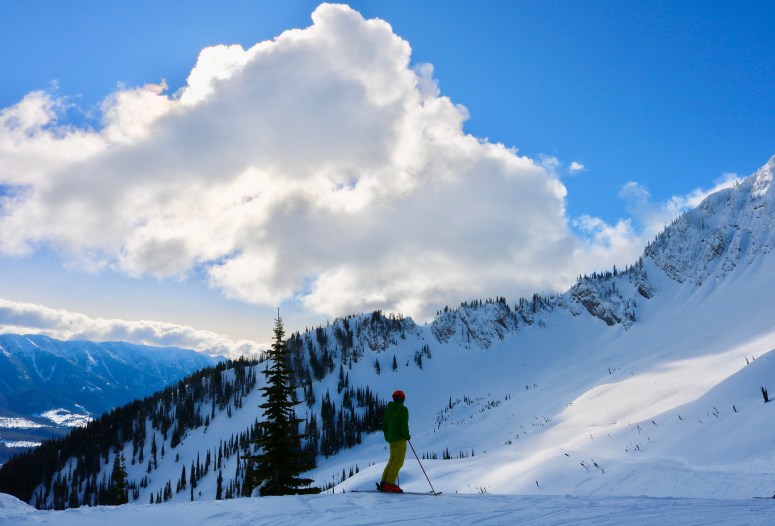
Views from the top of the Polar Peak Chairlift. Fernie Ski Resort.

IMG_9056


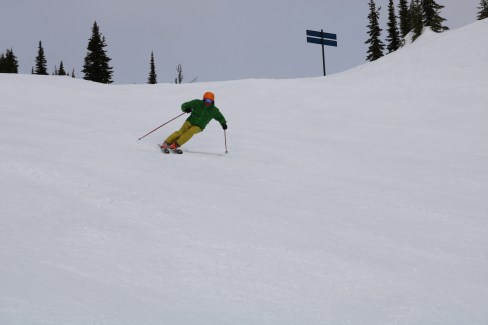
Early morning. First tracks.

IMG_9037

* * * * * * * * * * * *

Beams of pure, late afternoon sunshine are lighting up an expansive supply of fresh air about 7,000 feet above sea level in the Lizard Range of the Canadian Rockies in British Columbia. Heady hits of high altitude sun and oxygen clean out my lungs. My husband and I are gliding through this sparkling airspace aboard the White Pass Chairlift at Fernie Ski Resort. We introduce ourselves to a small man riding the lift with us. He says he’s from Ireland. It’s March 17th, 2018. Who wouldn’t feel a little bit lucky to meet an Irishman on St. Paddy’s Day while riding a chairlift?

Long, wide skis dangle from the ends of our chairlift buddy’s thin legs. He’s older than us, but not so old that we can’t relate when he starts recalling the halcyon days of hardcore skiing.  Back then chairlifts were slow and able to ferry, at most, two skiers per swaying seat to blustery mountain summits where experienced adventurers and foolhardy bandits often preferred to venture beyond the limits of a typical chairlift’s range. We did it by removing and then hoisting onto strong, youthful shoulders our skis, before hiking (in ski boots, always straight uphill) through deep snow or across slick, glare ice (routinely through pea-soup fog) to hidden headwalls, steeps, chutes, and virgin stashes of powder snow.

“And if we could’a! We would’a!” our chairlift companion sniggers, “hiked through the deep snow with our legs tied together! Just for the bragging rights!”

We nod and laugh because those classic days of yore were wicked fun and shockingly idiotic. Especially for me, a woman who didn’t grow up near any ski hills and, as far as I know, doesn’t even have skier’s DNA, with all its gutsy goofiness, schussing through my blood. Fortunately, the thrills of skiing don’t discriminate. Its charms will bestow blissful courage upon any knucklehead who, while skiing for the first time amid spectacular scenery, is willing to ingest (directly, from any passing snow cloud’s supply) the seemingly innocuous drug of one pretty snowflake, and feel the love

I fell (hahaha) in with a group of high-altitude (and attitude) yahoos when I decided, as a lonely, displaced, and curious college coed, that I’d like to learn how to ski. (There is nothing more unsettling to a moody introvert, who has landed in New England from afar, than the thought of spending long winters indoors all alone.) My new ski pals and I were sure we’d never get crushed in an avalanche, suffocated in a tree well, or broken to bits in long, long—so effing long—falls down steep, glacier-carved cirques. We didn’t wear helmets. We didn’t carry cell phones. We didn’t strap transmitters, shovels, whistles, or survival snacks to our bodies. We were members of a ski club based in upstate New York with a link to cheap farmhouse digs in the Mad River Valley of Vermont. I earned money to buy lift tickets for Sugarbush and Mad River Glen by selling my blood to the medical research lab rats at Boston University Medical School every week or so, on Fridays, before work. By the time I was anemic and a really slow bleeder (to this day, I can’t fill a pint pouch with donated blood), I could ski.

We were such a lucky group. Our club promoted ski trips to different mountains throughout the American west every ski season. I needed about six months to save for the trips and to get in shape for them, which meant that every August I became singularly focused on building wealth, building muscle, and building courage. As a wannabe schuss boomer, I had to teach myself to ski. But skiing with so many fearless yahoos (including the hottest skier in the bunch, my future husband) taught me how to get down steeps, chutes, moguls, ice, powder and crud, and in between trees without breaking my neck. If you’ve ever enjoyed the classic ski films of Warren Miller (may the Snow Gods rest his humorous heart and soul!) you know who we were: we were the ones who fell off chairlifts, dropped into chutes, and slammed our stupid asses against mountain boulders without nary a frayed hemline or bent zipper marring the neon-colored ski suits we wore. (It was the 80’s. Maybe our frizzed up and fluffed out, big hair did double duty as de facto helmets.) I remember a deep and glorious powder day in the glades at Northstar, Lake Tahoe. One of our friends, while flying through wisps of snow, snapped one of his brand new Volkl skis into two pieces of useless wood. He continued to sail over the treetops, weave through the tree trunks, and rip the rest of his run on the remaining ski until he zoomed right into the bar at the bottom of the hill.

* * * * * * * * * * * * *

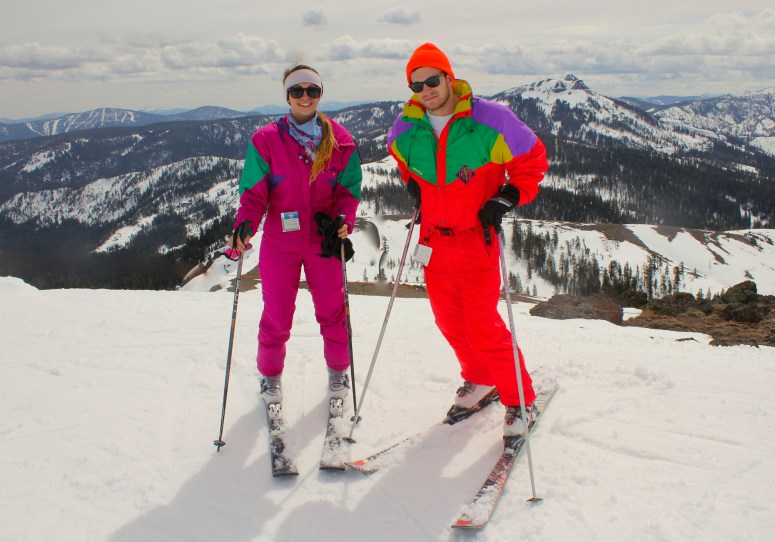
Just for fun (their idea not mine) my daughter and my son wearing my 80’s ski suit and my husband’s 80’s ski suit, respectively. North Lake Tahoe, 2011.
IMG_2047

* * * * * * * * * * * *

Way up in Canadian airspace at Fernie, our new Irish friend makes a chairlift confession: He has skied every single day of every single week of every single month, from the first chair to the last chair up, since Fernie opened for the season. Then he says he’s been behaving this way since coming to Canada from Ireland about seven years ago to retire. I say, “that sounds like a fun obsession.” He says, “You can call it an obsession if you want to.” Because to him, it’s not an obsession. It’s how he breathes. Soon, we realize that the powerful little Irishman is probably responsible for some of the impressive ski tracks down distant mountain peaks we’ve been admiring all week—the ones way, way, way up in the sky and out of bounds beneath curlicued, icy cornices where massive layers of snow bear down on steeps studded with rocky outcroppings and smeared with this season’s epic and oh-so-pristine snowpack.

Our chairlift buddy comes clean. Yes, some of those tracks are his. He tells us how he and his pals take the last chairlift up and hide out during final mountain sweeps conducted by the ski patrols. (All part of the local’s “forgiveness friendship club” we presume.) After the ski patrol has herded the rest of us to the bottom, the locals come out of hiding. They climb to dangerous summits and, if all goes well, are home in time for dinner after leaving gracefully arced, ethereal signatures carved into one of nature’s most beautiful and unstable natural substances—snow.

We’re almost at the end of our chairlift ride when our Irish friend notifies us that the Polar Peak Chairlift—easily accessible via a fast ski lane atop a ridge to our right—is up and running. The chairlift leads to cliffs and chutes above the treeline and is rarely open, our friend tells us, so we should go for it. “It’s worth riding up there if only for the views!” He says.

Just my luck! (But maybe not.) An “almost-as-ancient-as-the-mountains” acute nervous system response to the Irishman’s suggestion starts churning the lunch I recently enjoyed into a knotted clump. I know I will want to take that ski lift up to its spooky perch but, after I’m astounded by the views (while balancing on a slippery plot of mountaintop) (no doubt the size of a postage stamp) I know I will then have to find the least terrifying way down from that highest of summits—on my skis—using trails with the kinds of warning signs that used to excite me: Are you an expert? You better be! and STOP! (skull and crossbones) Fatal fall! and Pay attention to the diamonds! The doubles are the genuine article!

The thing is, I really want to see the views up there—all 360 degrees of infinite, snowy Mother Earth extending to the brink of every horizon. From the top of the Polar Peak Chairlift, I know I’ll be able to see the mountains of Alberta, British Columbia, Montana, Idaho…lakes, rivers, valleys…fluffy cloud formations, maybe distant snowstorms. And without the “heads up” from our Irish lucky charm, I might have missed out on making it to the top of Fernie since it’s our last afternoon in Canada.

But, I also know I don’t have youth on my side anymore. My joints and muscles hurt even when I’m doing nothing. Furthermore, I’m too old to be a knucklehead. Furtherfurthermore, after a few days of skiing at Fernie, I’ve noticed that the blue trails are really black trails, the black trails are really double blacks, and the double blacks are really “expert experts” trails. Or…is my head just messing with me? Because nowadays, when I find myself depending on the skinny metal edges of my skis to find harmony with the wobbly muscles of my body in order to keep me clinging to the side of a slippery slope…there’s some good fear, which serves to protect me from harm (I appreciate this fear) and there’s harmful fear, which deprives me of confidence (I hate this fear and it is getting tougher and tougher to manage).

And then—there’s my blasted Bucket List. I still want to ski as many different mountains as I can from top to bottom. I want to enjoy every view, from every summit. I want to identify mountain ranges, name rivers and other waterways, spy distant landmarks, and survey historical territories. I want to experience close encounters of the best kind with the flora and fauna of extreme alpine zones. I want to get high, for as many years as I am able, inside the heart and soul of winter, outside all day, on mountains that make me feel extraordinarily lucky and unbelievably blessed.

Yet the older I get, the more elusive the mountaintops become. Duh. And instead of my bucket list nearing a stage of completion, it continues to grow. Just last year, we discovered the infamous “Powder Highway” in Canada when we skied Revelstoke (big!) and Kicking Horse which led me to add the mountains of this legendary powder zone to my bucket list. (Fernie this year, now Red Mountain and Whitewater for next year.) My husband (still a wicked fast, beautiful skier) and I discuss this—my bucket list blues—over a well deserved, apres-ski beer after skiing from the summit of Fernie at the Polar Peak Chairlift all the way down 3,550 vertical feet. We compose a list of all the mountains we’ve skied since we started skiing together over 35 years ago. We count 63 mountains skied, in 12 states and two countries. Then we google, “How many ski mountains are there in America?” One answer: 481, give or take a hill. My husband asks me, “How many more do you want to put on your bucket list?”

* * * * * * * * * * * *


* * * * * * * * * * * * *

I have this firm belief that not only should every woman have a room of her own (even if she doesn’t want to write fiction), but she should also have a sporting activity (or activities) of her own.

A sporting activity that takes her into the great outdoors all day where the air is fresh, the views are restorative, and the options for picnicking locations are abundant. A sporting activity that, like a room of one’s own, guarantees long escapes into calm solitude. A sporting activity that rattles the bones, stretches and strengthens the muscles, and encourages useful introspection, refreshing the soul…Every. Time. A sporting activity where the woman athlete makes the rules and where competition falls away. A sporting activity where the woman athlete is challenged and must become fully aware of her own mind and her own body in order to achieve and experience bountiful doses of exhilarating pleasure. (“Abandon learning and there will be no sorrow.” Lao Tzu.) A sporting activity that exhausts the woman athlete, leaving her to marvel at how strong and able her own however-it-is-shaped-and-formed body actually is and how resolute and determined her own however-it-is-wired mind can be. A sporting activity that will rescue the woman athlete in two essential ways: (1) By taking her away, when she needs to get away and, (2) By bringing her back, when she needs to be grounded again. A sporting activity that has faith in the woman athlete, no matter how many set backs, heartbreaks, failures, and distractions she endures, or how many injuries, surgeries, and pregnancies, or how many “losing races against time” hover on her horizon. In other words, a sporting activity without rubrics, awards, rigid expectations, or finish lines. A sporting activity that lands the woman athlete in communities of socially joyful, silly, and heart healthy people who praise Mother Nature (no matter the weather no matter the season) praise love and life, praise good food and drink, praise the merriment of storytelling, praise the spontaneity of making new friends, praise time spent together as a family, and praise, with gratitude, every little moment of exhilarating glee.

I am grateful for three sporting activities of my own:

  1. Alpine skiing/Cross country skiing/Snowshoeing
  2. Hiking/Walking
  3. Road biking/Mountain biking

And, I have found that over a lifetime of devoting myself (and my weekends) to these sporting activities of my own, I continue to find uncommon happiness even as my bucket list grows to include more trails to hike, more routes to ride, and more mountains to ski.

Yes, I am getting older. But after we skied Fernie, we drove back to America and spent a week skiing Whitefish Mountain near Glacier National Park in Montana. What do you think I saw on the beginner’s bunny trail at Whitefish? I saw a woman, older than me, snowplowing down the slope—focused, tense, and determined. When I see something like that, it’s like finding a lucky charm. So encouraging! It’s never too late to find a sporting activity (or activities) of one’s own.

I wonder what’s on that newbie skier’s bucket lists!

* * * * * * * * * * * *

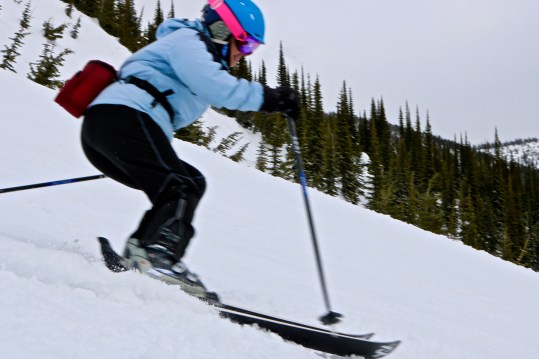
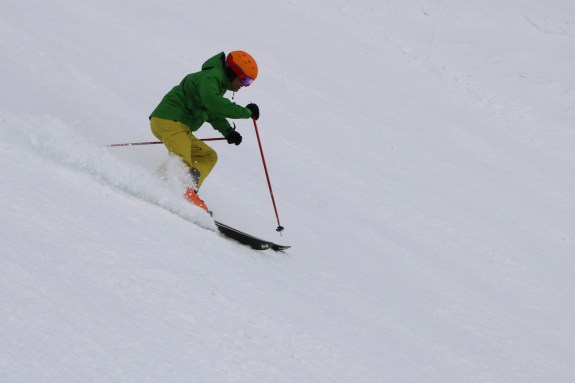
My husband, coach, and best friend on the slopes.
IMG_9158

IMG_9156

IMG_9163

❤ ❤ ❤

Bah Freakin Humbug.

There won’t be any snow for Christmas where I live in America’s northeastern Currier and Ivesville. The grass is green and supple, flowers are blooming, and the birds are taking baths without chattering beaks.

For some of us, 2015 has been the best of years and the worst of years. Worst of all, best didn’t do such a great job of overcoming worst. Sometimes, worst is worst—maybe the worst—and even if you were to fill the cathedrals of the world with every bit of your best from one year, your worst might still hum a mournful wail over the happy-ending high notes we all hope to hit at year end.

And then what!

Well, 2015 was one of the worst years for me. But not the worst. It was, however, the worst year for too many of the people I know and too many of the people I don’t know all around the world.

There is one tried and true practice that, in my humbug opinion, never fails to create notes of grace through times of troubles. It is simply this: Think of others.

Last night, my husband came home from work hauling his collection of briefcases and his guitar. “Why do you have your guitar?” I asked him. Had he auditioned for a rock band? Were we going to sell everything and return to the halcyon days of worry-free living in rent control with bold cockroaches? The days when happiness was stored one block away at the local dive, where we’d go to drink cheap beers and watch Larry Bird show Magic Johnson how Indiana comes to Boston to shoot hoops? Pre-craft-beer glory times! When we used to donate blood to the lab rats at Boston U Med every week or so—on our way to work—for twenty five bucks which was the price of one lift ticket at posh Sugarbush or a couple of lift tickets at wicked uber-rad Mad River Glen, and a whole season of tickets at forlorn Hogback, which is now just a ghost mountain.

No. My husband was not planning to abandon our troubles. We’ve been in this place before. Things have been worse for us. And they have been better. And so it goes. (Vonnegut, with a long face.) And it’s a wonderful thing to be married to a dude who is steady and sensible, because if he had loaded that guitar into our motorhome and stuffed every dollar we’ve ever earned into the overhead cabinets and said to me something like Baby we were born to run I would have clipped a blinking Rudolph nose above my Grinchy frown, harnessed myself to the front of that leviathan rig, and yanked it high into the sky. Far, far away. As far away as far can go.

“I took my guitar to a client meeting today,” my husband said. He told me who the clients were—a lovely couple he enjoys very much—and I remembered that 2015 hasn’t been the best of years for them. One of their daughters has been seriously ill and one grandchild continues to battle heroin addiction.

“What was it like when you brought your guitar in?” I asked.

“I didn’t bring it in right away,” my husband said. “I wanted to see how the meeting went first. But after we got through their financial reviews, I said I wanted to do something different for them and that I’d be right back. Then I went and got the guitar. I said that I was sorry they had had such a heart-breaking year and that I wanted to give them a few minutes to sit, relax, and listen to music.”

“Did you feel awkward?” I said.

“Kind of,” my husband said. “At first. But then, it was just—nice.”

He played: Do You See What I See? Silent Night. And, Angels We Have Heard on High for his clients. A private and intimate performance, unexpected, all in the comfort of their quiet home, on a warm winter’s evening. I know how sweetly beautiful he plays those songs and I am sure his clients were touched.

My husband asked how my day had been. “Well,” I said, “I cried a little bit in the morning. Talked to my sister. Talked to your sister. Went for a walk in the early evening. You know. Did some work. Cleaned up.”

He opened a beer. We split it. He took a hot dog out of the freezer and cooked it on the grill. We split the last scoops of ice cream.

Another night of beer and ice cream for dinner.

********

One day, during the recent fall season, we had a lot of fun tailgating at a UConn football game. My husband’s favorite cousin and his wife joined us for a day of sun, fun, food, and Left, Right & Center—which my husband’s cousin rallied a large group of my daughter’s friends to play. It was a happy day when my husband’s cousin and his wife showed up to care about us during the most stressful days of our 2015, and everyone had a great time.

Only a few weeks later, on the Sunday before Thanksgiving, this favorite cousin died unexpectedly the morning after his birthday—one of the best birthdays he had ever celebrated.

When we went to the funeral, the day after Thanksgiving, I wandered away from the crowd at the funeral home and found a small bookshelf in a private sitting area. The collection of books covered all kinds of grief, all kinds of death, all kinds of life’s challenges. I reached for Viktor Frankl’s Man’s Search For Meaning and settled down to read it. The book is filled with shocking passages about the depths of human cruelty, human suffering, and human triumph. There are pages and pages of wisdom, philosophy, psychology, and suggested life practices.

I don’t imagine it was a book my husband’s cousin ever read, though he was an avid reader. He just didn’t need such books. He was content with his life, including all of its attendant heartaches and joys, and accepted, without too much judgement, the ways of the world. All families need a cousin like him, more than they need books by people they will never know. We will always miss him, and will always be grateful to have his spirit to see us through.

12109969_10206730075881908_4042360677964198636_o

********

For those of us who are, no matter what, in need of books like Frankl’s Man Search for Meaning, and find ourselves often tormented during the holidays by the joys and sorrows of lives as layered as an enormous vat of figgy pudding prepared to feed the hordes of revelers whooshing around on the ice at Rockefeller Center, there are ways to enjoy navigating the emotional minefields of Christmastime.

Of course there are.

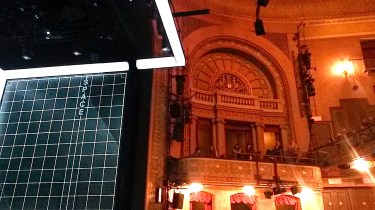
First of all, take your family and friends and Internet bloggers up on some of those out-of-the-ordinary suggestions for holiday-season entertainment. My sister recommended my husband and I go see “The Curious Incident of the Dog in the Nighttime” during a visit to New York City. Neither of us had read the book. We woke up early on a Saturday morning, dressed up, drove a fast three hours to our favorite cheap (but nice enough!) hotel in Long Island City, Queens, (written about in my first blog post when 2015 was just getting underway), took the 7 Train directly to the theater district and settled in for a matinee performance. We thoroughly enjoyed the inventive and exciting play.

20151212_135652

Afterwards, we let a pedicab rip us off for a thrilling ride through the insane crowds and tightly-packed vehicles of Times Square. (It was so warm out! We feared for our lives!)

20151212_165336

We were on the way to the Morgan Library Museum, where we met our son and rushed through exhibits on Matisse and Hemingway. After that, we strolled in the tropical temps to the lounge at The Bowery Hotel for a quiet place to have drinks before dinner at Upstate Beer and Oyster Bar in the East Village—a place recommended by one of our son’s good friends. We ordered oysters, sea urchin, smoked trout, crab cakes, clams and fettucine, all served small-plate style in an intimate, dark space that’s lucious with crazy-loud happy eaters.

Another fun place for drinks with festive decorations: Pete’s Tavern near Gramercy Park. O Henry lived nearby, but did not pen The Gift of the Magi while drinking craft beers at Pete’s.

IMG_2877

Another suggestion: Listen to Patrick Stewart’s A Christmas Carol on the CD player in your car if you have to drive long distances alone. So superb.

20151215_123708(0)-1

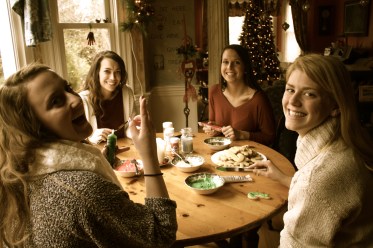
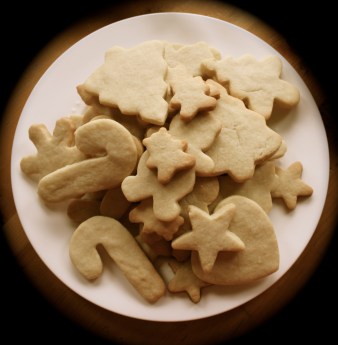
Another suggestion: Bake cookies that require a lot of time and effort. Lose yourself in the long moments required to make a big mess and clean it up. Don’t get all Martha Stewart about how to decorate them. Hand the job over to the kids. Even if they’re big kids.

IMG_2774

IMG_2775

IMG_2778

IMG_2783

IMG_2782

And the old stand-bys: WALK through the woods! Early mornings and late afternoons are lovely. Later, drive around and look at Christmas lights. Professional displays are nice:

IMG_2623

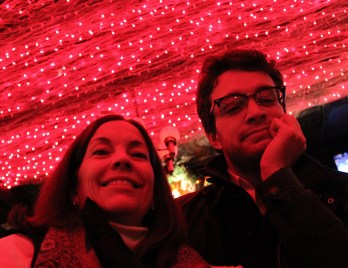
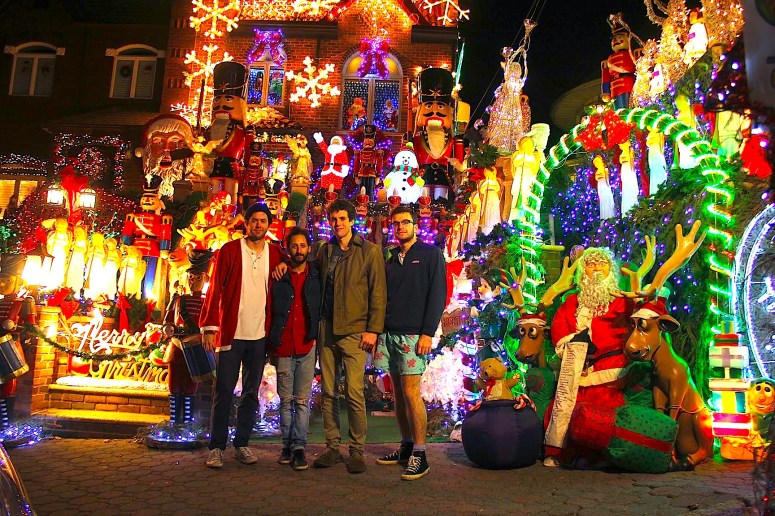
But neighborhoods are the best, by far. Here’s the best band of 2015, Teeth People, out and about enjoying the bling of Dyker Heights, Brooklyn.

Unknown

********

And now for some of my favorite words from A Christmas Carol by Charles Dickens. The book is so good.

“Bah!” said Scrooge. “Humbug!”

“Christmas a humbug, Uncle!” said Scrooge’s nephew.  “You don’t mean that I’m sure.”

“I do,” said Scrooge. “Merry Christmas! What right have you to be merry? What reason have you to be merry? You’re poor enough.”

“Come then,” returned the nephew gaily. “What right have you to be dismal? What reason have you to be morose? You’re rich enough.”

“Bah! Humbug!”

“Don’t be cross, Uncle!” said the nephew.

“What else can I be,” returned the uncle, “when I live in such a world of fools as this? Merry Christmas! Every idiot who goes about with ‘Merry Christmas’ on his lips should be boiled with his own pudding, and buried with a stake of holly through his heart. He should!”

“Uncle!” pleaded the nephew.

“Nephew!” returned the uncle, sternly, “keep Christmas in your own way, and let me keep it in mine.”

“Keep it!” repeated Scrooge’s nephew. “But you don’t keep it.”

“Let me leave it alone, then,” said Scrooge. “Much good may it do you! Much good it has ever done you!”

“There are many things from which I might have derived good, by which I have not profited, I dare say,” returned the nephew. “Christmas among the rest. But I am sure I have always thought of Christmas time, when it has come round—apart from the veneration due to its sacred name and origin, if anything belonging to it can be apart from that—as a good time; a kind, forgiving, charitable, pleasant time; the only time I know of, in the long calendar of the year when men and women seem by one consent to open their shut-up hearts freely, and to think of people below them as if they really were fellow-passengers to the grave, and not another race of creatures bound on other journeys. And therefore, Uncle, though it has never put a scrap of gold or silver in my pocket, I believe that it has done me good, and will do me good; and I say, God Bless it!”

********

I say, God Bless the Keeping of Christmas, too, however it is you choose to do it. Keeping Christmas has always done me good and sustained me, even when I’ve been called upon to bear the worst of years. And if this has been a worst of years for you, I am thinking of you, and hoping the best of Christmas will find you, and see you through.

IMG_2750

From a painting given to me by my daughter one Christmas.

********


Gypsy Picnic. Gypsy Zing Sauce.

I have a new favorite salon and it’s in the drab and under-appreciated city of Worcester, Massachusetts. I’ve never been a spa or salon girl—in fact, if I could cut and color my own hair, as nicely as I cut the lawn and color the garden with flowers, I would do it.

Drab hip is what’s cool about Worcester—there’s a fragmented grunginess about the city that leaves itself alone. Not much legacy or nouveau riche, dreadfully fine* money polishes its urban edges. Go in search of somewhere to hang out, and you’ll feel yourself pulled into a pause. Disoriented, you could be right, you could be wrong about where you’re standing. Something creeps underneath the radar, maybe. There are no crowds to follow and no painted lines to a tourist kiosk. No costumed, smiling docents. The art museum is superb. The array of educational institutions is world class. There are great places to eat and drink. And there are businesses, like Barney’s Bike Shop, with an excellent link on their website about where to hit the road, or the trail, with a bike.

*Dreadfully Fine: I learned this from my son and his friends in college—it means you are depressed due to the fact that everything about your life is so dreadfully fine.

The beauty salon I found in Worcester is Tu Moda Spa and Salon on Pleasant Street. Their decor is American slash European-Hill-Town slash Almost-Chic, and the music piped in, at least during my last several visits, has been tres hip. (Important.)

The European thing lured me to this salon when I went looking for a place to take my daughter for her birthday. She is a spa girl. She is also a lucky charm and I ended up finding a hairstylist at Tu Moda I like a lot. My new hairstylist is tres tres tres tres tres hip. Five-star hip.

First of all, she loves Acadia National Park. So do I. She loves it through and through. She loves how she can go there with a group of friends, and there’s something for everyone. She loves how it’s hidden, but not really, in New England.

She loves to cook. Me too.

She loves to bake, but thinks it’s more challenging than cooking. Same.

She traveled to visit family, as a child, into the summertime countrysides near Amsterdam. The beauty formed within her while spending time with her family, (for she talks of it with joy), has not faded.

Today, when I sat in my hairstylist’s chair, I told her about the recipes I cut out of the Boston Globe and the New York Times. We gushed on and on about radishes fresh from the farm in summertime. There was a recipe in the paper for Butter-Stewed Radishes. I told her I think everyone should get a hard-copy of the newspaper, at least on the days featuring Food. You can tear out the recipes, and keep them. After reading through the newspaper food sections, first thing in the morning, right off the bat you’re ready to saddle up the horse and ride to a farmer’s market.

My hairstylist loves music festivals and following favorite bands.

She loves her dog. I don’t know her dog, but if I did, I am sure I would love her dog, too.

She likes to wander around Worcester and find great bakeries, great places to drink coffee, great bars to share beers with friends.

She tells me about unknown bakeries and funky shops and where to eat the best brunch.

She loves gardens and is helping her friend make a garden at her friend’s new house in Providence. I told her about the Beacon Hill Garden Tour. I said she and her friend should go on the tour together to find ideas for small, delicious, dreamy, urban gardens. She said spending money to go to Boston for a day with a friend to look at gardens, would be worth every penny.

She was an artist in high school, applied to art schools, was accepted, but couldn’t afford to attend any of them. So, she became a hairstylist, because it was something else she thought she would enjoy doing.

She is a cheerful artist who is a hairstylist—perhaps it’s a little bit like being a happy poet who is a therapist. But way more fun.

She lives with, and takes care of, her father. He had a stroke a few years ago.

She told me her father had always admired Bob Dylan, so she took him to a concert several years ago. Elvis Costello was the opening act. Dylan was horrible, she said, and she felt awful for her father. I told her we went to the same show and thought, thank goodness for Elvis Costello, because Dylan was lost in a caricature of his many selves, all of them muddied into one unappealing performance. We both said it can’t be easy to be an artist who is expected to perform, and live up to, great expectations.

I especially like when my hairstylist tells me gentle stories about her father. He used to enjoy cooking. So, she will ask him what he might want for dinners, they will talk about recipes, and then she will assemble the ingredients and orchestrate the process–making sure to allow him to cook as much as he can.

I tell her how much my husband loves to cook and how he will artfully arrange the food just so, taking his time to arrange perfect sprays of fresh herbs, perfect brush strokes of secret sauces, and perfect garnishes of fruit, flowers, or veggies. She says her father wants to do all of that, too. She said he used to work in the garden so she recently bought him small, terrarium gardens to tend, after she found them at an eclectic and strange shop in Worcester called Seed to Stem.

She told me I would probably like Seed to Stem.

I told her my husband’s father loved to cook, too, but he suffered a massive stroke almost three years ago and didn’t survive. He liked to garden, too, and used to grow pleasing varieties of tomatoes for all of his children, from seed, in a unique set-up of lights and growing trays down in his basement. I looked forward to his special deliveries every spring, and his concentrated instructions for transferring the plants into the Earth. After I situated the tomato plants into the garden, my father-in-law never ceased to check in on how they were doing. I made sure to give him frequent updates on the details of our flavorful excursions through the ripe skins of those precious tomatoes.

*****

Today, my appointment was early, so my hairstylist asked if I had any plans for the rest of the day. I said that after reading all the foodie pages in the newspaper, I wanted to design a picnic because my husband and I were going to Vermont to ski and I wanted to pack something new for our lunch.

So far this season, I told her, I’d made homemade chicken salad sandwiches and outrageous homemade meatloaf sandwiches for our ski trip lunch picnics. The meatloaf was an experiment using leftover beef, veal, and pork after my husband made bolognese.

I said I planned to stop at BirchTree Bread, (drab hip warehouse space), over in the Blackstone Canal District to have a cup of soup and check out the breads. The chef there is no hobbyist. He’s focused on food. The morning’s newspaper had included some press about his hideout in Worcester.

Then I hoped to stop at Trader Joe’s.

But now, I said to my hairstylist, I would add her recommended detour to the funky shop—Seed to Stem.

*****

When I got to BirchTree Bread, I tried a killer cup of celery root soup. Great music played on the sound system. (Important.) I slurped the soup surrounded by gray-toned scales of urban decay, blending old warehouse and mill buildings into a sturdy mid-day wash of melting snow, mud, and wet fog. The restaurant space is vast. Computers glowed. One little boy, wearing a bright yellow slicker, laughed. A man conducted business on his phone. People socialized. I was alone, anonymous, content. The pace of my breath slowed to imaginative thoughts. Efforts to preserve history loitered on city streets so deserted, I could make a U-turn on them, in a tandem-tractor trailer, in one fell swooping turn.

God bless BirchTree Bread for bringing some faith to the city. I bought a fresh loaf of their rosemary ciabatta and commenced hunting for the rest of a designer picnic lunch.

Next, I stopped at Seed to Stem. Good music playing! My hairstylist didn’t divulge details about the shop, so when I arrived, surprises were well appreciated. I took some pictures of things that were not for sale.

20150326_124822

20150326_124738

20150326_130033-1

I found something that was for sale, about another city I like a lot:

IMG_0537

At Trader Joe’s, I bought flowers. (Best flowers, best prices, best displays.)

I bought Trader Joe’s thick slices of cooked and salted turkey.

I bought Italian dry salami and pepper jack cheese.

Ideas for sandwich designs began rising and falling in my mind.

For the picnic side dish, I selected a bag of sweet-potato snack chips.

And for dessert, I bought Trader Joe’s dark-chocolate peanut butter cups.

I drove home, unloaded the groceries, and rummaged through the fridge for sandwich start-ups and add-ons.

There was a half can of tomato paste calling out to be rescued.

*****

Final design:

GYPSY SKI PICNIC ZINGWICH

Trader Joe’s cooked, sliced turkey.

Italian dry salami.

Pepper jack cheese.

Lettuce. Tomato.

Fresh cilantro.

Gypsy Zing Sauce.

BirchTree rosemary ciabatta bread.

(Sweet bread and butter pickles—optional.)

Gypsy Zing Sauce: 1/4 c. mayonnaise—3 or so tablespoons of tomato paste—a teaspoon and a dash more of Worcestershire sauce (Worcester!)—half a lemon squeezed out (probably about a tablespoon)—sea salt—coarse ground pepper.

The sandwich contains multitudinous flavors of drab hip, gypsy grit—with zing.

Bon appétit, picnic lovers!

The Ruffed Grouse.

On a sunny, bitterly cold day in Vermont, the snowpack depths grew deeper as springtime approached. It flowed in soft routes around and over tree trunks, boulders, streams, farm fields and well-worn hillsides.

Beautiful as ever, it was, to all of us.

Our daughter had come home from college for spring break and we had decided to spend the time together, retreating into winter’s encore and greeting spring from the tops of Vermont’s ski mountains.

*****

IMG_0462

The daylight flashed sparks of winter’s last light, beckoning us to come walking in the woods, just before sunset on our first day in Vermont. We packed up some appetizers with cold beers and traveled only a couple of miles deep into the forest where we made a campfire and sat, feeling how cold it still was and how glorious a campfire will always be. We had arrived, again, to a second-to-last day of winter. Over the years, the last days of winter had taken us to the world’s most beautiful snowcapped mountaintops. I arrive at those summits, ancient. Yet in all my lifetimes, never have I, nor never shall I, conquer the mountaintop. I am destroyed by the sublime magnificence of being there, every time. My tears barely drop, before the high-alpine air changes them into snowflakes that take flight. I follow them. Some I catch. Some disappear forever.

One of those timeless snowflakes flew from the top of Rendezvous Bowl in Jackson Hole, Wyoming where so many years ago, my daughter and I skied through deep powder snow that buried her strong little body. She had to go potty, now, and the potty was all the way at the bottom of the mountain, 4,000 vertical feel away. “I can wait till I ski down the mountain, Mommy,” she said. I followed her rainbow-shining trail of snowflakes, and have continued to do so, through the stratosphere of times gone by, and into the triumphs, trials, and tribulations of our lives together, today.

A mother slips into such memories, whenever she is spending time with her children.

Our campfire blazed heat, but the sun was setting fast with no moonlight to guide our way out. It was time to break our spare snow camp, and leave the forest. We walked until the trees, blackened, weaved paths to the stars through teal-flavored blues, glowing beyond.

IMG_0431

IMG_0427

Turning from the sunset, there was Jupiter, though we weren’t sure what we saw. It was a dazzling light acting like the most gigantic snowflake that ever hesitated to fall from the sky. We were lucky. Our feet left the ground at the sight of it and we soared, tumbling and gliding through the final hurrahs of the day.

IMG_0435

*****

Every season has its last call. When I sense it’s coming, it makes me anxious. I never get enough and will wave my arms at the heavens, shouting out to, and pleading with, the Great Bartender in the Sky:

One more round!

Winter’s sun moves, the light comes up, and I am at last kicked out of one season and left to go in search of the next.

I nurse the long goodbyes, the indulgent farewells. Like time spent with our dearly beloveds, time within New England’s seasons is a joyful, focused existence for anyone fortunate enough to live a long life traveling through spring to summer to fall to winter.

Nowadays, I awaken to the sun bouncing along the eastern horizon like a white ball pointing out lyrics to a song. Bird song, frog song, flower song. It has been moving from the right to the left, every day, making leaps one-whole-sun-circle width wide. I can’t stop it. Spring is here.

The signs are everywhere.

*****

Of course, one sign of spring is the annoying chirp of grouchy New Englanders. They are sick of snow, ice, cold and dark days. I’m not from New England. But I’ve lived here for a long time, almost forty years. When I first moved to New England, from the sunny southwestern Mexican/American borderlands of Arizona, I noticed that the natives weren’t the friendliest pickles in the barrel. I gave them the benefit of the doubt. Maybe they are just unhappy about the weather.

There was a pond on the campus of my university where I went on winter mornings with a pair of ice skates. I went there to feel happy. As alone as a seed cast by wintry winds to nowhere, I skated around my own private au natural ice rink. Next, I thought it would be fun to learn how to ski.

Winter was a long season—as long as all the rest, but colder and darker. It was too long of a season to give over to feelings of dissatisfaction. Furthermore, I made an acute observation about winter in the modern world—we have the technology to be outside in wintertime all day long. High-tech gear suits us up like bold adventurers traveling into outer space—and protects us while we cavort and gavotte—down mountains, through woodlands, and over icy lakes and ponds.

There is a poem by William Carlos Williams. Danse Russe. After I found the poem, I often thought of it while twirling around New England in search of people who knew how to enjoy wintertime. One year, I won the spring skiing  mogul competition on Outer Limits at Killington. I was a novice skier and a woman, competing against guys. We revisited those old playground ski trails on the first day of spring with my daughter. I asked my husband to tell it to me straight—had I won the mogul competition because I was the best skier or was it because I skied topless like the guys?

*****

Danse Russe

If I when my wife is sleeping
and the baby and Kathleen
are sleeping
and the sun is a flame-white disc
in silken mists
above shining trees,—
if I in my north room
dance naked, grotesquely
before my mirror
waving my shirt round my head
and singing softly to myself:
“I am lonely, lonely.
I was born to be lonely,
I am best so!”
If I admire my arms, my face,
my shoulders, flanks, buttocks
against the yellow drawn shades,—

Who shall say I am not
the happy genius of my household?

*****

Or had I won the competition, as a happy, lonely genius, in my dreams?

I am only kidding about skiing topless. And I’ve never entered any skiing competitions.

But our family does have a tradition for engaging in friendly forms of competition when we are out and about outside. We hand out Rusticator of the Day awards to anyone who earns them. The awards are named after the Rusticators of Acadia National Park, who seized the great outdoors while wearing suits and ties and petticoats.

Our competitions are wide open and there aren’t any rules. You never know if you will earn a Rusticator of the Day Award. It is merely an atta boy or atta girl bestowed upon anyone who carpe diems the rest of us when we least expect it.

My daughter is a great competitor for Rusticator of the Day awards. She is a natural source for magic and creative fun.

*****

As I have gone through the last days of this historic winter season in the Boston area, letting it go, muttering prayers of gratitude for such an epic experience of endless snowstorms, I have considered the scorn such a beautiful season, filled with so many surprises, arouses in people. Another William Carlos Williams poem comes to mind, The Last Words of My English Grandmother. Here follows last lines from the poem, about his grandmother nearing the end of her life, while in an ambulance heading for the hospital:

What are all those
fuzzy looking things out there?
Trees? Well, I’m tired
of them and rolled her head away.

I hope to never lose my reverence for the power of life in all its forms.

*****

On the very last day of winter, we were riding the chairlift together, when my daughter pointed to a fat, feathered beast in a grove of trees. “What is that?” She laughed. Everyone’s eyes grew wide with wonder.

Her father said it must be a grouse.

A what? 

A grouse. A Ruffed Grouse.

We have lived, camped, hiked, and biked in the woodlands of New England for all of her twenty years. And it has taken her this long to spot a grouse, hiding out.

She earned the Rusticator of the Day award. I’d never seen one, either. When you see something you’ve never seen before, it feels magical.

Which makes me think of the words Hokusai, one of my favorite artists, said before he died:

“If only Heaven will give me just another ten years… Just another five more years, then I could become a real painter.”

But back to the Ruffed Grouse we saw. They are shy birds and they hide in the snow. Their lives often end in violence, because they hold a vulnerable and valuable position in the food chain. The males create an interesting drumming sound with their wings. In wintertime, they grow projections from the sides of their feet which might be a form of seasonal snowshoe. And, Aldo Leopold wrote this about them: “The autumn landscape in the north woods is the land, plus a red maple, plus a Ruffed Grouse. In terms of conventional physics, the grouse represents only a millionth of either the mass or the energy of an acre, yet subtract the grouse and the whole thing is dead.”

*****

In terms of conventional time, my life represents the tip of a blip of a snowflake, in the blizzards of one Solar System’s infinite winter storms, melting in the warmth of a spring breeze.

The thought of it makes me hope to never subtract a day from any that belong to all the seasons of my life, because every one of them is a possible harbinger of unexpected magic.

Magic like the rare sighting of a Ruffed Grouse, emerging from a big New England winter, ready for spring.

Work. Skiing. Roses.

IMG_0451

The Aloha Rose. Fragrant. Velvety petals. Blooms all summer, till frost.

*****

Two weeks ago, I wrote about weather in the Mad River Valley of Vermont. This past weekend, we skied through some of the toughest weather in years—a lively combination of snow, wind, pea-soup fog, and dangerously cold temperatures. It’s a lot of work to arrive at the summit of a mountain being battered by weather and to ski back to Earth from that summit. The work is worth it—you get the trails all to yourself, you get to exist as part of a storm, and you get to collapse, later, brand new.

We went to dinner with a nice group of old and new friends. Some are still working, others are retired. The question What do you do for work? blessedly, never made it all the way around the table to where I sat, with my glass of wine and my ideas for an answer. There are so many things I do for work.

I love work.

*****

Oh, work—if thou were a rose, indeed, thou would grow the sharpest, most plentiful thorns along lengthy, overarching, invasive, multi-branched stems. Beneath thy bowers would accumulate the crumpled forms of bloodied, harassed little beings, hissing and cursing and writhing about. Trapped in your web of jammed and twisted traffic routes, ladders to the top, and paths to recognition, the hard workers would brag about how bloody you caused them to become, how unfairly you paid them, and how cruelly you blocked the ways to, and beyond, the summits of joy.

Furthermore, though your rosebuds unfurl, casting heavenly scents to sweeten neglected happiness—your brambles, it seems, remain consistently smeared with the bloodied bodies, plugged up noses and blinded eyes of grumblers.

They were never able to stop and notice the soft touch of your rose petals, falling to the ground, brushing away tears and smoothing out wounds.

******

I grow roses.

I planted them in my gardens without knowing much about them. They stabbed me. Ensnared my hair. Bloodied my days with wounds that throbbed to the pulse of my heart muscle.

I like to collect rose petals and arrange them into luxurious shapes.

IMG_0852

I cook the rose petals until they are transformed into botanical clay and then I roll the clay into beads.

I make tea with rose hips. I dry the rose hips and save them to study or to use in fairy house construction.

I make sure to leave rose hips on the plants for wildlife treats in wintertime.

I make rose water, distilling the fragrance from the petals. It makes my entire house smell rosy.

Roses are a lot of work.

I’m not paid to work with roses. I’ll never become famous because I like roses in my gardens, or because I like to visit them in other gardens of the world, or because I love to read about them and hear songs about them and see artwork that honors them.

Roses can be a bad-boy kind of thing to fall in love with.

*****

I work hard to grow rosebushes near the front porch where I keep a small bistro table with two chairs. You can place onto that table the nicest glasses of wine from the most prestigious vineyards of the world. Next to the wine, you can set out a plate of artisan-baked bread, with cheese—artfully produced in Vermont or France or Italy. The wine maker, the bread baker, and the cheese maker will all be there—in spirit—their hard work appreciated, revered, savored.

I can rely on the promise that a breeze, religiously drifting forth into this romantic setting, will find my roses and rustle them gently. The breeze will rise up, travel some more, and push away the bouquet of the wine, the musk of the bread, and the stink of the cheese. All dressed up in the sensational perfume formed by a once-in-a-lifetime blend of faraway winds, swirled up with sunshine, soil, and my roses—that genteel, sweet breeze will make anyone feel brand new.

One of my roses grew like a heart.

IMG_0969

*****

Graham Rose, who was a gardener and a writer, and a correspondent for the London Sunday Times, wrote that the gardener “contrives to make us ignore the world outside and believe that the impossible is readily attainable. The very best of them can take a miserable yard and, by clever construction and planting, lead us down an enchanting track to the idyllic corner of Arcadia, while blinding us to eyesores beyond and suppressing our awareness of noisy neighbors or the rumbling trucks that throng the road outside its walls.”

Graham Rose also wrote that gardeners are romantics and romancers who enjoy connecting themselves to extravagant fictions—remote from ordinary life.

Skiing inside a raging snowstorm feels, to me, like existing inside an extravagant fiction, remote from ordinary life.

Gardening and growing roses, too, is work I do to find and create fantasy lands where anyone can go to escape what is ordinary and become inspired to believe in what might be impossible.

I’ve worked to grow gardens on a miserable acre of land in Massachusetts for a long time. Trucks rumble by every day.

What do I do for work?

I was glad the question never made it around the apres-ski table to where I was sitting—

with my glass of wine

and a bouquet of roses

in the middle of a raging snowstorm.