Sebastian Smee is an art critic. He writes for the Boston Globe and he has been awarded a Pulitzer Prize for Criticism.
In the Boston Globe this week, there was an article written by Smee about the Maine Art Museum Trail. I looked forward to reading it, but by the end of the opening paragraph, I found myself terribly concerned for all the people who might read the same first lines and decide to anchor themselves forever to southerly, and most-convenient-to-Boston, regions of New England.
Smee had written: “There are two museums on the Maine Art Museum Trail that have so far eluded me: The University of Maine Museum of Art in Bangor and the Monhegan Museum of Art and History. The first—sorry Bangor—is too far north of Boston. The second is on an island—and that’s just inconvenient.”
********
THROW OFF THE BOWLINES! SAIL AWAY FROM THE SAFE HARBOR! (Mark Twain, I think.)
********
Bangor is not too far north. I promise. There is, as mentioned in Smee’s article, The University of Maine Art Museum to see up there. But there’s more. For instance, if you want to visit many of the places that inspired the art all along The Maine Art Museum Trail, keep driving down east to the coastline beyond Bangor. You’ll find Acadia National Park plus a culturally distinct region of the world.
All you have to do is turn off the GPS and follow your nose. The scent of the sea, or at least the marvelous stink of a dramatically displaced low tide, will lead you to unexpected life-changing experiences such as the pleasures of being a spectator for the Women’s Skillet Toss at the Blue Hill Fair. This rowdy event fills the grandstands and it’s authentic Maine through and through, so even though you risk getting walloped upside the head by an errant iron skillet, you are not required to wear a helmet in order to attend the show. Women competitors are classified as Kittens and Cougars. They fling iron skillets as far, and as straight, as possible. Some of them can send those old iron workhorses sailing further than a soldier’s dream for a home-cooked meal! The Blue Hill Fair pleased E.B. White so much, it inspired many of the story lines and settings for one of the world’s (and my family’s) all-time favorite books, Charlotte’s Web.
As for Smee claiming Monhegan Island is just too inconvenient to visit, allow me to transform the idea of such a journey into something desirable, convenient, and perhaps necessary to your passage through life here on Earth.
********
Let’s start with a time warp…the year is 2007…Labor Day weekend…I am Mother to a 15-year-old son beginning his junior year in high school and a 12-year-old daughter ready for college instead of middle school…both children are willful, independent rapscallions…we are bound for a campout on the coast of Maine and plan to take a day trip to Monhegan Island…Raffi music in the camper has been taken over by Hendrix…it is painfully inconvenient for my husband and me to travel with our teenagers…it is more painfully inconvenient for said teenagers to travel with us.
Places like Monhegan Island help counterbalance the laws of nature and the laws of technology in our tense and complicated modern world. You might not be suffering through the throes of parenting (or any other situation of nature-determined, unconditional love), but perhaps you are afflicted with the side effects of Blindsided-TechAlien Abduction. In other words, there’s a chance you’ve been abducted by technology aliens and don’t know it. The aliens are so charming and so invisible, you haven’t noticed how conveniently they have settled into your life. They eat with you, sleep with you, make decisions for you, and then they steal your identity, your attention span, your creative impulses, your freedom, and your ability to look UP and OUT.
Monhegan Island is small—only about one mile from end to end and side to side. There are no paved roads and not many cars. You ride a ferry boat to get there. Travel by foot prevails once you are upon the island.
Here’s what happened when our modern family went to Monhegan Island, as recorded–by hand–in my unedited travel journals:
Sunday, September 2, 2007. En route to Monhegan Island. At last. We won’t have a lot of time there. Two porpoises leapt along our port side as we left Boothbay Harbor. Best snack in the pack today was made by the kids: graham crackers with nutella, peanut butter, and 2 squares of Hershey’s. I read Checkhov’s short story, The Lady with the Dog, during the ferry cruise.
We made landfall at 11:05. Our crossing cut through calm seas under outrageous summery-blue skies. Stopped at The Barnacle after getting off the boat to find out what the local shop had to eat. We got two cups of clam chowder (with extra crackers) and one blueberry scone.
We sat under a stand of sunflowers to eat the chowder while bees flew orbital patterns around and around and around.
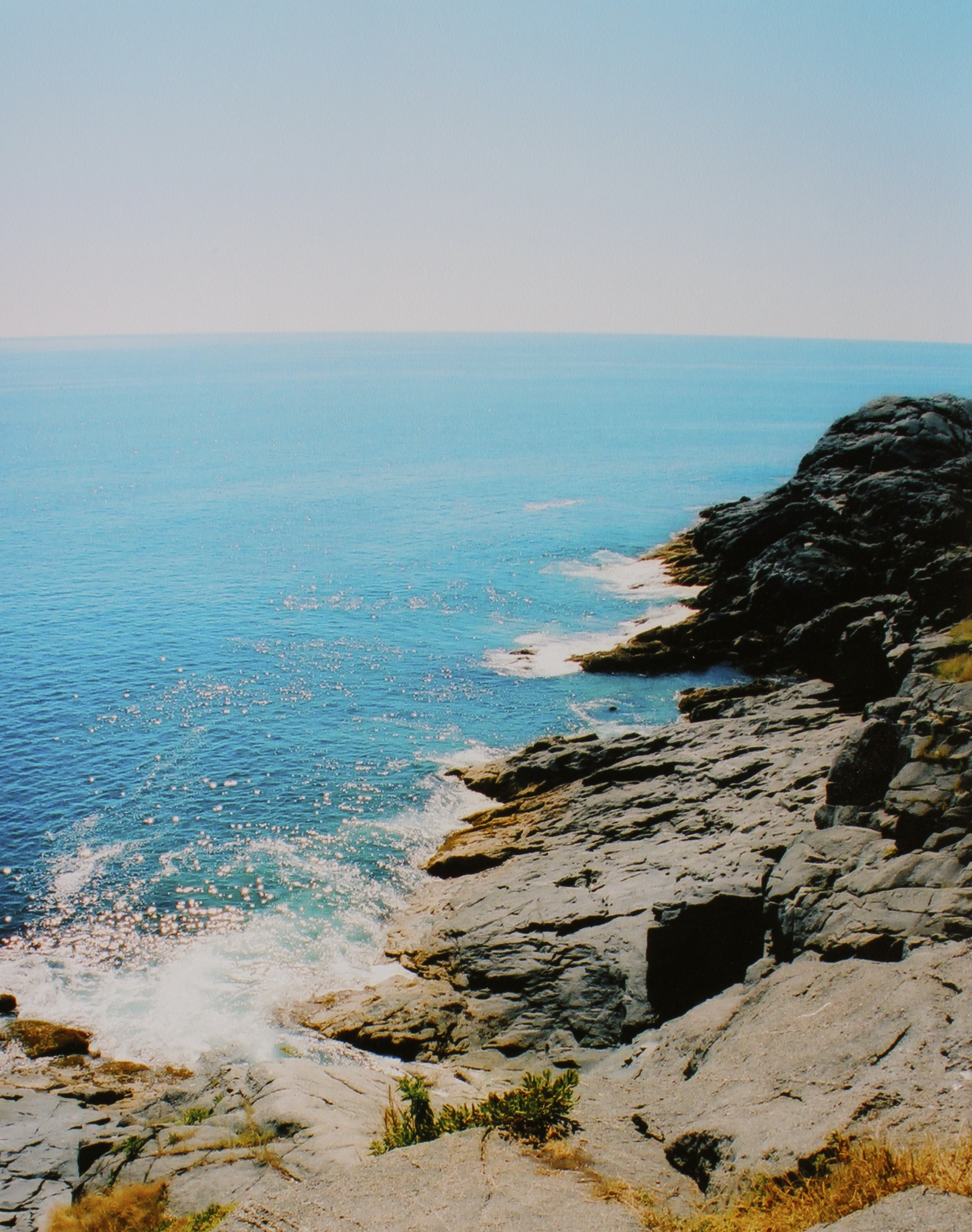
We set out walking. Burnthead Trail to Cliff Trail and then lost our way a bit to Cathedral Pines. Breathtaking views. You can see all the way out to where the water falls off the edge of the earth. The perches on this little island’s cliffs are not so little. I don’t know how high up we were, but it was high enough–rugged and rocky–and I didn’t like when the kids chose to stand close to the edges. They are hiking barefooted. I read the warning in the Visitor’s Guide out loud to my family. It sounded more like a work of dramatic fiction or an ancient myth, though. Rather than encouraging caution, I think my reading inspired a heroic contest of becoming a sole survivor:
“Don’t try to swim or wade at Lobster Cove or any area on the back side of the island. Undertows there are unpredictable and dangerous, and high surf can sweep you away if you’re too close to the seas. No one has been saved who has gone overboard on the south or east sides of the island. Always keep a bulwark between you and the sea whenever viewing the surf.”
Picnicked in a stunning setting where the world could not be more scenic, nor life more idyllic. This is true even for a family filled with angst that can barely talk to each other.
I was happy to move away from the cliffs and enter the safe and soundless pretty moss woods at the Cathedral Pines trail. The moss must have felt dreamy to my barefooted hikers. Christmas trees adorn the trail as do the infamous neighborhoods of fairy houses constructed throughout the woodlands. We stopped to admire the imaginative handwork. Some houses had tables set with dinner in acorn bowls.
We walked on and on until we found ourselves busily pressing little sticks into the ground and balancing dried leaves atop them. My daughter built a fairy house next to a stream. My son built a fairy house perched perfectly in the crooks of roots at the base of a big tree. I built a small hut in between the two. My husband traveled from house to house to help with the fun. We concentrated intently and quietly at our works of art for a long time in the cool and bug-free forest.
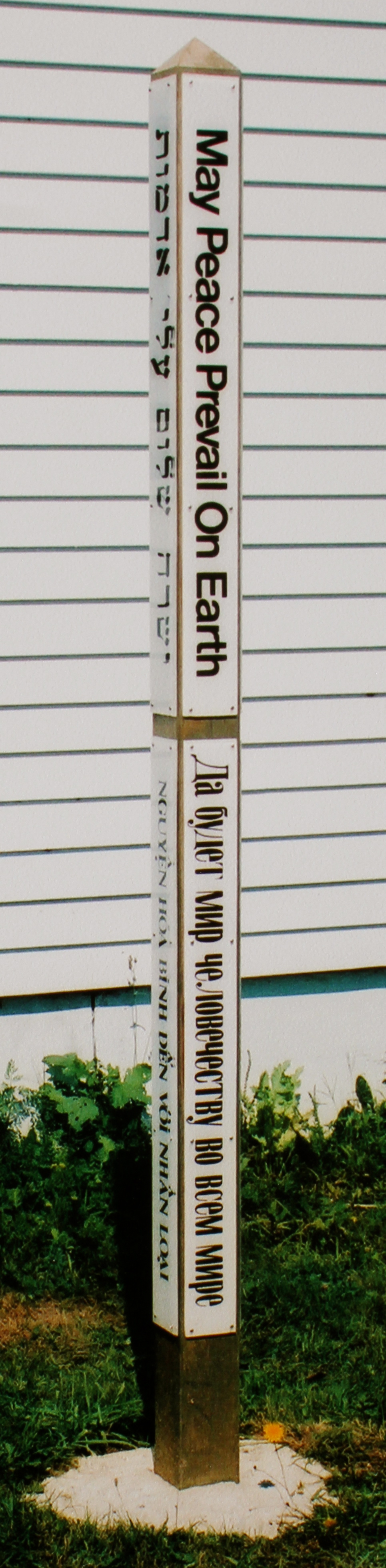
After we were satisfied with our fairylands, we walked back to the wharf, passing the island schoolhouse where there is a peace pole with the words, May Peace Prevail on Earth, written in several languages. A big wish from such a small island.
Before the loud blast from the ferry sounded a warning for departure, we had time for one more stop at The Barnacle. We got root beer, ice cream, and a fruit smoothie.
Returned to camp by 7PM. Both kids were good and dirty from hiking barefoot all day. Everyone cleaned up for the campfire. My husband and my son played guitar. Before bed, another camper stopped by our site to thank us for the music. She said it reminded her of her father and how he used to play guitar during her childhood campouts.

********
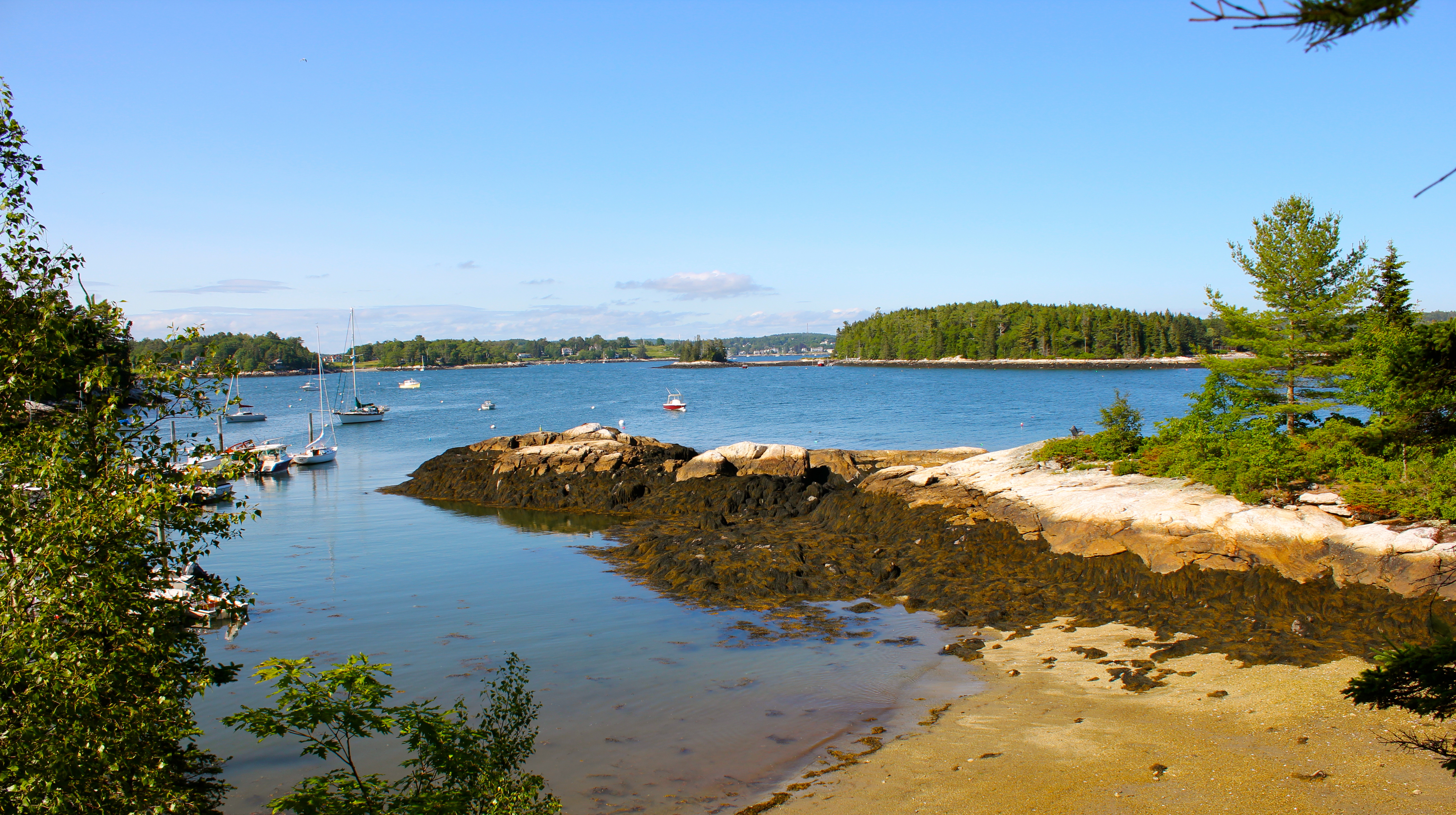
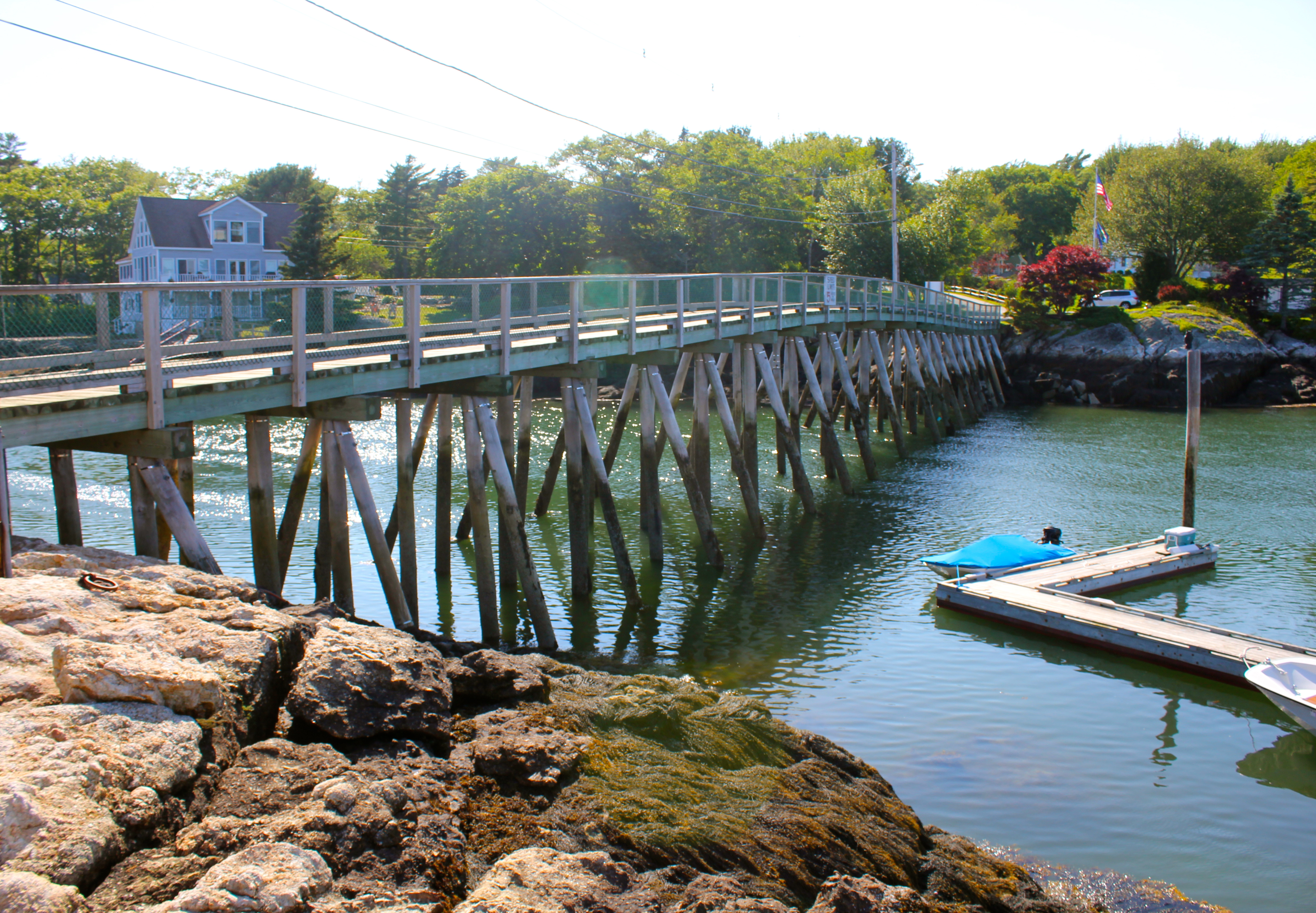
One way to get to Monhegan Island is to take the ferry from Boothbay Harbor, Maine. A great place to stay is Southport Island, which is just beyond Boothbay Harbor, over a swing bridge. If you want to camp, there’s a campground there called Gray Homestead. If you want to rent a cottage, I recommend “An Tigin”, which you can find on VRBO or HomeAway. “Cheerful Southport Island Waterfront Cottage” might come up in an Internet search for “An Tigin.” The cottage is quaint and clean with good vibes of hard-working history and devoted love.
The Coastal Maine Botanical Gardens are nearby for another day trip. The best children’s garden is there–it is designed to encourage fascinating and fabulous fun. It succeeds famously.
Just down the road from the Coastal Maine Botanical Gardens, there is another swing bridge at the Trevett Country Store and Post Office. This swing bridge is operated by hand! According to my husband, the Trevett Country Store has the best lobster rolls. Southport Island has a country store, too, and their lobster rolls are good. So are their cupcakes! They also have a good selection of wine.
The Southport Public Library has a pretty cool butterfly collection. And the Hendrick’s House Museum has a letter written in perfect penmanship by a woman to her husband while he was serving in the Civil War. Not only did he receive the letter, but the letter survived the war. The survival of perfect penmanship has not fared so well.
Nevertheless, the slow art of finding peace does survive in places like Monhegan Island where leaving behind the conveniences of life—the car, the technology, the scheduled activities—isn’t inconvenient at all.
In fact, it’s restorative.
Slow days bring us one step closer to finding, and believing in, our own true norths.
********


 Excursions