A lawn is a lovely thing, but having one is like trying to grow a crop of happiness in Eeyore’s garden. If a lawn is cultivated to be weed-free and lush, it will need a steady supply of water, harmful chemicals, and daily doses of manic obsession in order to thrive, unnaturally and falsely beautiful, in controlled areas.
(Makes me think of marriage and parenthood and human-ness and how perfect we think we can make our worlds.)
Lawns that are allowed to become their own blend of grass, weeds, and other kinds of plants are less of a strain on the environment and the psyche.
But I know a lot of people hate weeds like dandelions. That simple hate causes a lot of harm to the Earth. It doesn’t have to be that way…
*****
Here is the most useful and harmless tool for removing dandelions from a lawn. It is a hand tool:
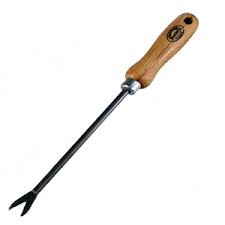
You push it deep into the soil near the center of the dandelion, wiggle it to and fro loosening the tenacious tap root, and then—with an “I’m the boss” kind of tug—you pull the plant out. This is quiet work. (You don’t shout out, “I’m the boss!” You say it softly, to yourself.)
This work involves no loud leaf-and-dirt blowing machines and no harsh chemicals. You take your body for a stroll around the garden. You bend that body over, you stoop it down, you crouch with it—stretching the backbone into curves, keeping the knees oiled—and the mind glides away, like a kite on a string tied to your heart.
What looks likes a mindless exercise in futility (how will I ever remove every dandelion? They will just come back!) is actually a mindful excursion into peace. You will not ever remove every dandelion. They will come back.
So will the sun, and all of its ways to light up the Earth—you’ll work in early morning’s hopeful light, late afternoon’s tea-time light, and early evening’s anxious light—another day is ending. Did I love my life?
The rain will come back, too. As will the quiet walk and the fresh air.
The gentle work you do that brings no harm to the Earth will continue to give you a cycle of calm, meditative motion for the body and the soul.
What do I see when I watch my husband walking around with the dandelion puller upper? I see a modern-day, part-time monk tending his place on Earth. There was a time when he wanted to use chemicals to annihilate the dandelions. But any man who works sinfully long hours most days and spends sinfully long hours commuting to Boston while hating dandelions, can either put his stress into the Earth by way of more harm—chemicals—or he can put it there by way of more peace and groovy love—the dandelion puller upper.
Collected dandelions can be tossed onto the compost pile or into a sauté pan. They go on the compost pile around here because my husband has memories of eating bitter, icky dandelions at his grandmother’s house when he was a boy. I should give them a second chance for him—maybe all his grandmother lacked was the benefit of the Internet to hunt down more memorable recipes.
Dandelions look as breathtaking as fresh sunshine glittering on calm seas when they bloom in upstate New York’s farm country and all over Vermont’s mountainside meadows. The bold yellow flowers make you love them all over again, (if you loved them as a youngster), or they cause you to love them for the first time. (It’s never too late to become a flower-hugger.)
******
So for the past week, I’ve been hand cutting new paths and garden beds from the lawn on my one acre of uneven land in Massachusetts. The way I do this, with spade and body, is nuts. But it is good for the Earth and if I were to calculate my carbon footprint, I’d probably find that I’m tipping the scales on the wrong end because I drive a car, fly on airplanes, ride on trains, and I live in a house that has heat, hot water, and AC.
I know the hand-cut garden won’t save the world.
It is probably more artisan than activist.
More crazy lady than cool mama.
More secret to happiness than maddening masses yearning to keep breathing (and ingesting) chemical sadness.
Nevertheless, whenever I hear that yet more and more landscapers are out there advising folks to make new gardens in their lawns by dousing the grass with Round-up to kill it before planting the garden, I want to douse the landscapers with Round-up and shut them up. Round-up should be used only to douse poison ivy—a true hazard in the home garden.
Grass in a lawn, also known as sod, is a mighty chunk of nutrient-rich greenery and soil. (Of course, if it has been doped up for years, it’s not as good as the clean stuff. But it’s still good.) After I design new garden beds in existing parts of the lawn, I dig deep. I jump onto the spade and let it sink down, down, down. I lift the hunk of Earth out and flip it over.
It’s hard work.
The Earth weighs about 1,000 trillion metric tons. A shovel-full of New England soil weighs more than a glass of wine, more than a spoonful of ice cream, and more than a handful of M&M’s. Heaving it up and out and over is more work than logging onto Facebook or tapping out a text message or chilling out to a TED Talk about how you can save yourself and the world and be all you can be.
The hand-cut garden is a solitary, quiet pursuit. No team. No sponsors. No fan club.
In the realm of that royal solitude, created while at work with the Earth, you get to fill the palace inside your head with anything you want. You can clean the palace out, rearrange it, or decorate it with lofty aspirations. You can study and think. You can feel curious—about how strong you are and how strong you are not. You can notice how filled with stuff—ancient stuff—the soil is. You can realize how noisy the birds are.
If you are fortunate, like me, maybe you live in a town where they still allow church bells to clang out the melodies of hymns from your childhood. The church is more than two miles away, as the crow flies, but when the bells ring and I am outside working, I am able to listen. Because my work is quiet work.
My garden is also downwind from the local coffee roasting business.
Church bells and the aroma of roasting coffee beans blended up with the rising scent of fresh, hand-tilled soil. Soon, the farm down the road will spread fresh manure over the fields. That’s a day when the air smells shockingly ripe.
*****
Hand-cut gardens need the magic rope—a pliable, long strand of woven fibers which becomes like a lasso when waved from the fingertips of a garden design guru. Every dream of Earthly, Eden-like beauty can be caught with the magic rope and drawn out onto the ground. There’s some sketching beforehand and immersion in garden books, but I’m an on-location designer. I have to feel how the land sways, drops, and hovers. Before and in progress:
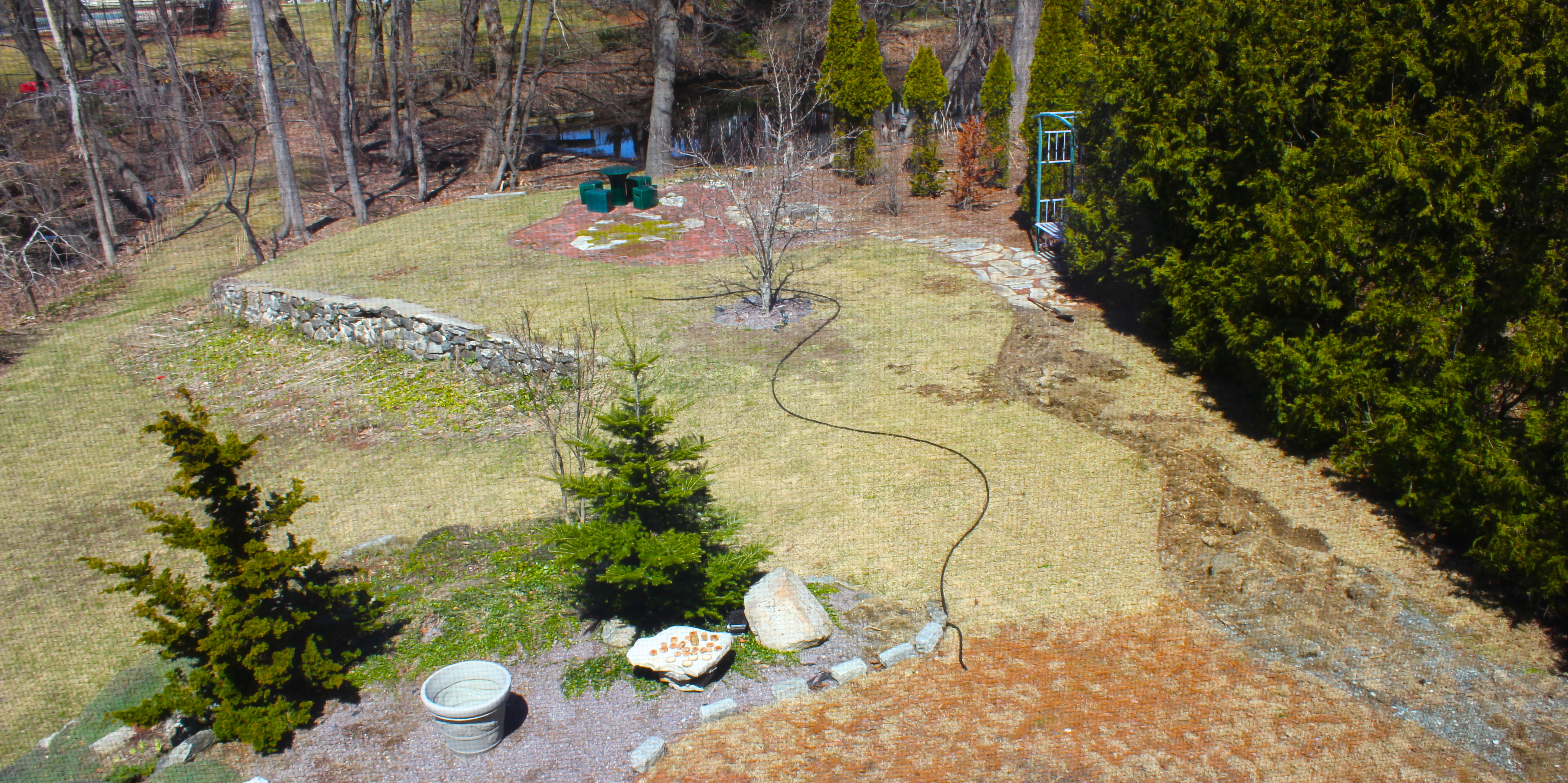
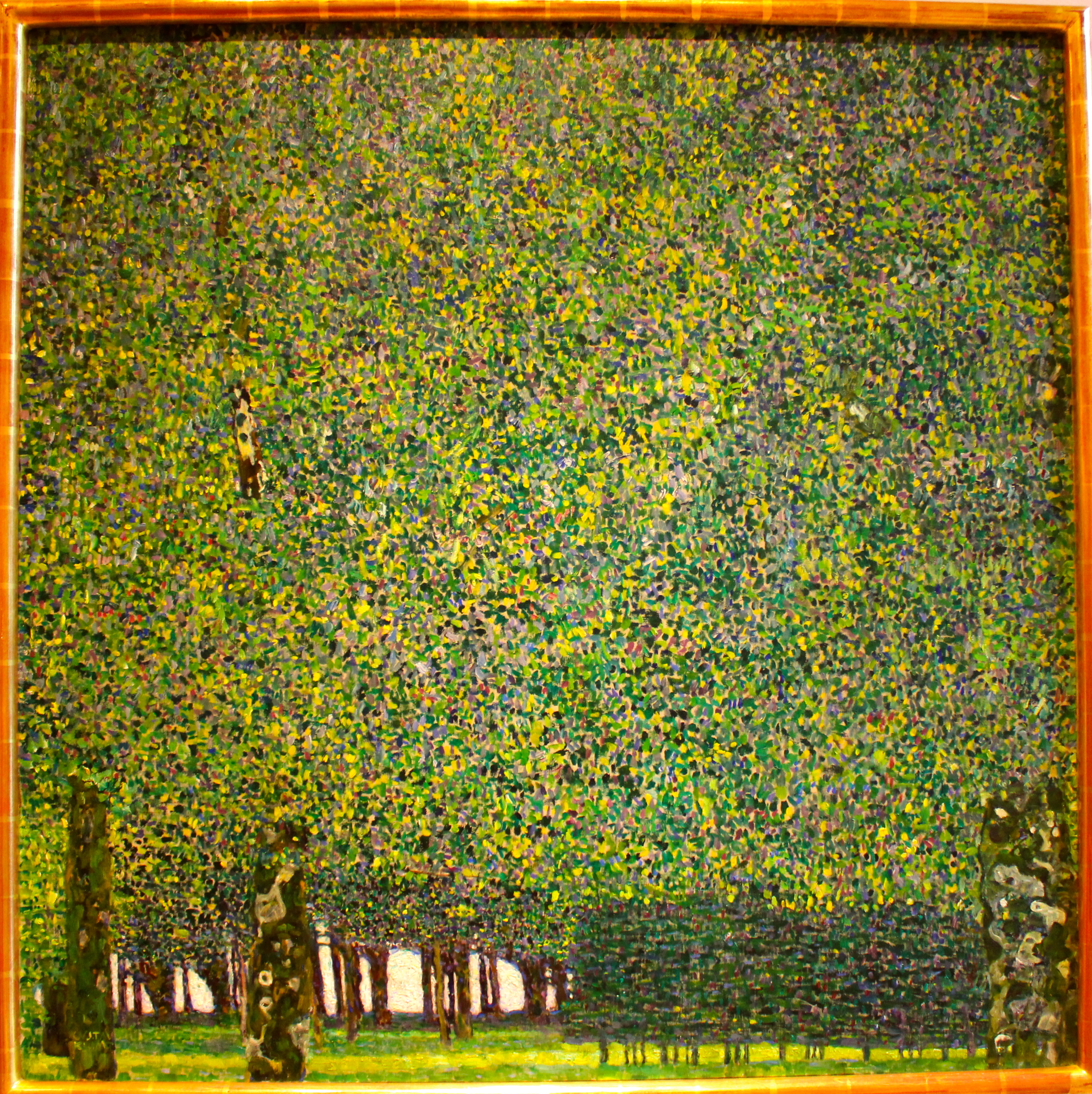
The magic rope abides by important design principles linked in with geometry, but it is also influenced by artistic visions that can’t be suppressed—like memories of Gustav Klimt at the Museum of Modern Art in NYC, during the dead of winter, when I was reminded that I’ve always wanted to figure out how to make the Earth’s trees laugh in flowers:
*****
How I do it (sort of):
I draw the lines of garden beds and paths onto the Earth. Then I cut the edge into the lawn—using the rope as a guide—with a square-tipped spade. I return the good soil to the Earth where it will decompose and build up the soil for garden beds. I make sure to dig deep and flip over the sod, chopping it up here and there. Then, I cover the repurposed lawn with chemical-free, not-artificially-colored mulch to suppress weeds until the bed is fully planted up with trees, shrubs, flowers, ground covers.
I think of my hand-cutting-out-of-gardens as a secret process for sustainable gardening. Though the work is like taking baby steps to help heal the Earth, it’s better than not walking at all. I have hand cut every garden on my one acre, and I have planted every plant in the hand-cut beds.
All the plants survive within the soil, as it is.
And with the rain, as it comes or doesn’t come.
And with the wind, as it blows.
And with the sun, as it shines, or doesn’t shine.
The soil changes every season with decomposing fallen leaves and ever-present wandering worms and weeds.
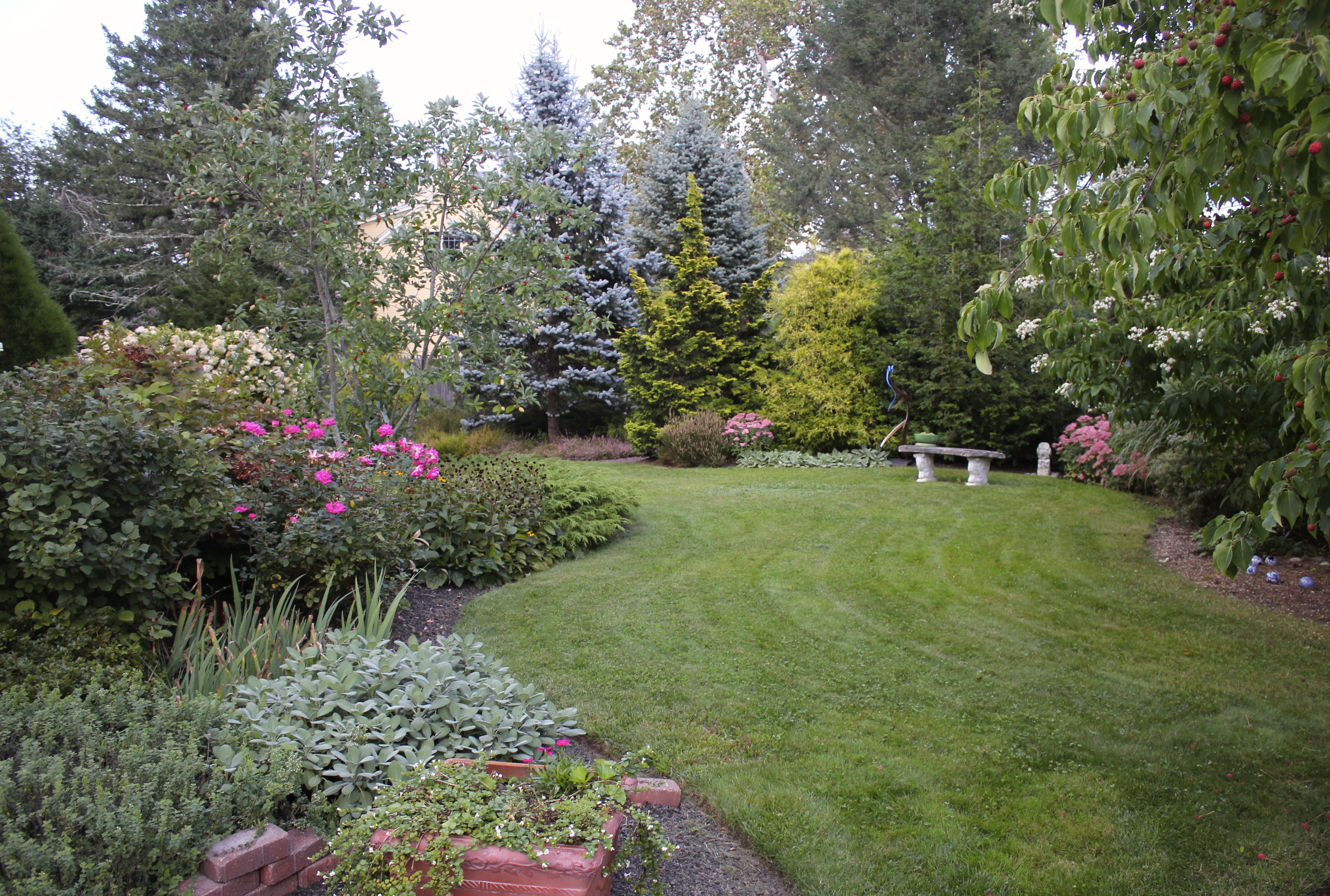
This is a nice picture of my front yard in September. I have never used an automatic watering system nor have chemicals or added fertilizers ever been dumped onto the garden beds. The lawn includes grass, clover, moss, bugleweed, crabgrass, dandelions, violets, and a lot of annoying ants and moles.
*****
Late in the afternoon on last Saturday, after a full day of helping me hand work my gardens, my husband announced that it was quittin’ time for him. There was cold beer in the barn and our son was in there, too—he had come home for an overnight visit. The two of them, my husband and my son, are musicians and they wanted to play music.
But, my husband had dug up about half a trillion metric tons of Earth from a garden bed for me and he had piled it onto two tarps as long as the aisle in the church where we got married. The walk down that aisle was long. The walk out the door, together, as a married couple, happened in the blink of a spring Robin’s eye.
But I am not a spring Robin anymore. I suddenly realized that I had tried to feather too many new nests in one week. My wings were sore. Instead of crying, which is what my exhaustion wanted me to do, I yelled at my husband. I told him he did everything all wrong and now there was no way I could continue my work and finish it by the end of the day.
One of the rakes we were using had broken.
My husband walked away and when he returned, a little while later, he brought a new rake.
And then, together, we moved half a trillion metric tons of Earth, by hand and body before the sun set. Some went to make a nicer garden down by the pond, and some went back into the new garden bed.
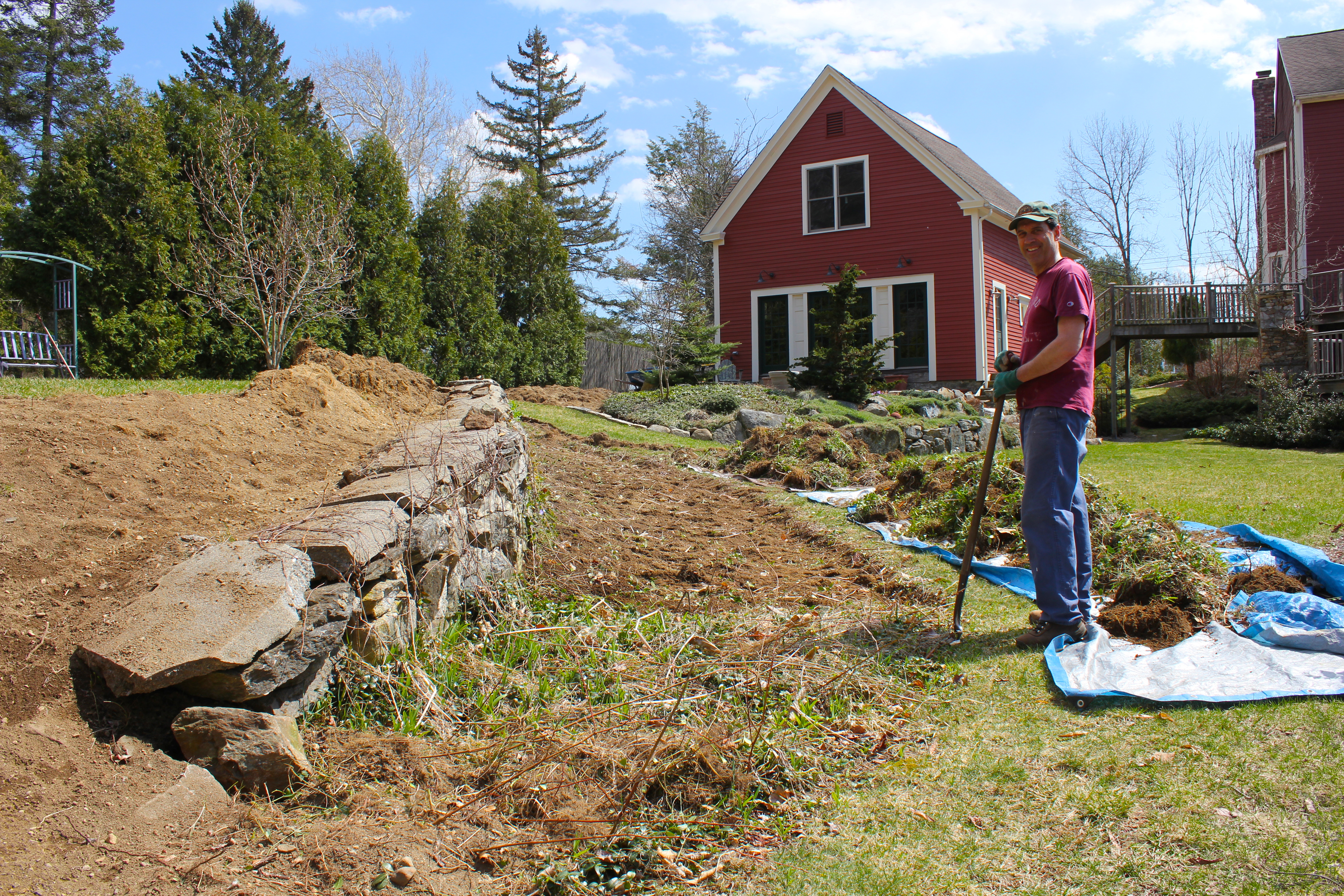
Dirty, sweaty, sunburned—our skin welted up with black-fly bites—we headed for the barn and cold beer and the company of our son, after folding up the tarps and putting the tools away. I made a toast to my husband. I thanked him for noticing that I was in over my chirpy head and was about to fall out of the tree without any wings to save me.
If I have a secret for saving the Earth while keeping a marriage going and trying to raise kids, maybe it’s the dandelion puller upper.
And a hand shovel.
And honored memories of the first time you walked down a long aisle, or road, or unbearable challenge—together—and knew it was a lot easier than doing it alone.
I think about that when I’m at work healing the Earth or helping others learn how to do it.
It’s nice to work alone.
It’s also nice to work together.
That’s when the Earth laughs in flowery bouquets and puts extra spring into our baby steps.
*****
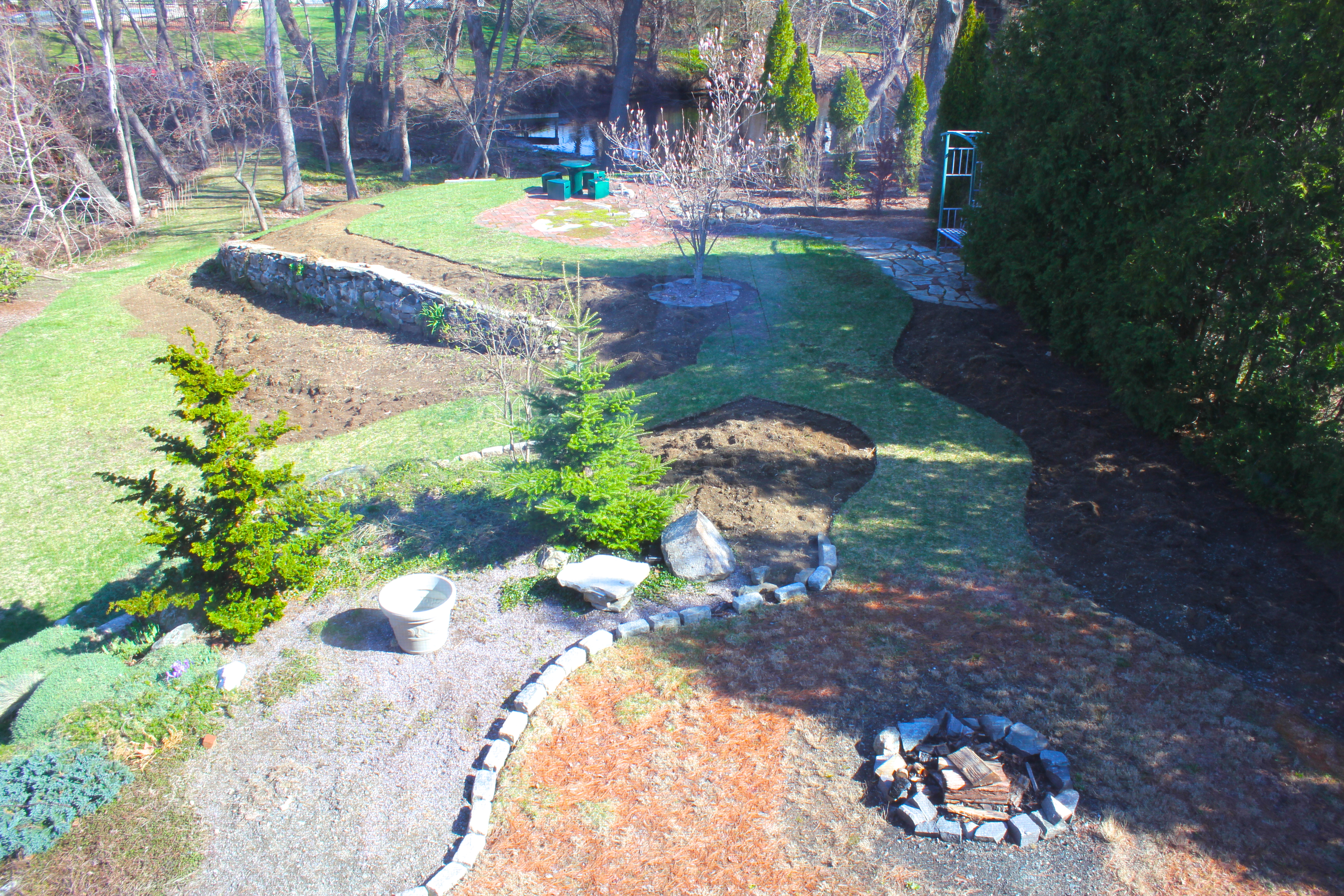
The paths and gardens, beginning to take shape behind the barn:
HAPPY EARTH DAY.
 Excursions