“The Jews are undoubtedly a race, but they are not human.” A.H.
This quote comes before Chapter One of Art Spiegelman’s brilliant graphic novel, MAUS, a story about the Holocaust. I have picked the book up from a position of prominence on a shelf in my daughter’s quiet bedroom. It is one of her all-time favorite books. She read it, perhaps, when she might have been too young to process the intense themes throughout the story and I’m sitting in her room thinking about that because this daughter of mine is about to graduate from college and make her dreams come true.
A mother can never know the exact moments when dreams begin to formulate inside a child’s heart, although we do our best to create supportive and enriched dreamworlds. We set our children free to go leaping through books and movies, to go traveling among the peoples and places of the world, to go wandering in and out of classrooms and onto playing fields. And then, when we aren’t looking, our children escape to discover for themselves sanctuaries for hiding their most cherished dreams—places where no one will trample those dreams nor steal one bit of the sparkle necessary to keep them shining.

I am remembering watching the movie Freedom Writers with my daughter. In the movie, a teacher devotes herself to a large group of the least-promising students in a California high school. The students, through the skills of learning how to become writers, achieve much more than their own personal goals—they also learn the devastating history of the The Holocaust and arrange a remarkable meeting with Miep Gies, the woman who risked her life to protect Ann Frank’s family from the Nazis. I am sure I felt the presence of The Dream Fairy sitting right next to my daughter while we watched that movie. The fairy was quiet, but my daughter was not: I am going to work with the kids no one believes in. She declared. She had not yet finished junior high.
Words from the preface of another book I have found on my daughter’s bookshelves, Black Like Me: “This may not be all of it…but it is what it is like to be a Negro in a land where we keep the Negro down. Some whites will say this is not really it. But we no longer have time to atomize principles and beg the question. The real story is the universal one of men who destroy the souls and bodies of other men (and in the process destroy themselves) for reasons neither really understands. It is the story of the persecuted, the defrauded, the feared and detested. I could have been a Jew in Germany, a Mexican in a number of states, or a member of any “inferior” group. Only the details would have differed. The story would be the same. This began as a scientific research study of the Negro in the South, with careful compilation of data for analysis. But I filed the data, and here publish the journal of my own experience living as a Negro. I offer it in all its crudity and rawness. It traces the changes that occur to heart and body and intelligence when a so-called first-class citizen is cast on the junkheap of second-class citizenship.” John Howard Griffin 1959
I keep time tripping through my daughter’s bedroom because she called me last night to let me know that she’d been offered a position as a counselor working with teens in a residential treatment center where she will deal with the diverse needs of those confronting mental health and behavioral problems, addiction problems, juvenile justice problems, personal trauma problems, and family dysfunction problems. The treatment center is not the kind of place where the rich and famous show up.
My daughter called after spending several hours at the treatment center during a second interview:
“Mom, ” she said, “I’m so excited. But I’m nervous. This job is outside my comfort zone.”
“What makes you uncomfortable?” I asked her.
“How will I know the right things to do?” She said. “Or how to handle difficult situations.”
“Do you feel safe?” I asked her.
“You know,” she said, “risks go along with the kind of work I want to do.”
“Well,” I said, “you’ll be trained and have to learn as you go.”
“I guess this is the real world.” She said.
“Yes,” I said, “so much more of a real world than any of the protected and hidden worlds where we’ve always lived.”
“Some kids just want to go home,” my daughter said. “They want to reach their goals and return home, but home is not safe for them.”
“All kids want home,” I said. “And so many begin their lives without any luck. It’s not fair.”
I told my daughter about the teachings of Mother Teresa:
From her book, In The Heart Of The World, (a gift from one of my sisters): “There is so much suffering in the world. Material suffering is suffering from hunger, suffering from homelessness, from all kinds of disease, but I still think that the greatest suffering is being lonely, feeling unloved, just having no one. I have come to realize that it is being unwanted that is the worst disease that any human being can ever experience. In these times of development, the whole world runs and is hurried. But there are some who fall down on the way and have no strength to go ahead. These are the ones we must care about.”
And from one of Mother Teresa’s letters, reproduced in Joseph Langford’s Mother Teresa’s Secret Fire: “Poverty doesn’t only consist of being hungry for bread, but rather it is a tremendous hunger for human dignity. Not only have we denied the poor a piece of bread, but by thinking that they have no worth and leaving them abandoned in the streets, we have denied them the human dignity that is rightfully theirs as children of God. The world today is hungry not only for bread but hungry for love, hungry to be wanted, to be loved.”
I recall our family’s recent trip to Oaxaca, Mexico. One day, in a bookstore there, my daughter bought the book, Crossing With The Virgin, Stories From The Migrant Trail. The book tells the harrowing stories of Mexicans crossing into the dangerous deserts of Arizona and the people who choose to help them with food and water.
Mother Teresa encouraged people to find the “Calcuttas” in their own countries, their own states, and their own communities where they could work to restore the promises of humanity which include the basic values of human decency and dignity.
My daughter doesn’t believe in or practice religion, so when I tell her about the teachings of Mother Teresa, I remind her that I am sharing the teachings because I believe they have meanings for all of us.
She tells me, “Some people say that I should trust in God and that God will bless me.”
I say, “You know they mean well. I hope if there is a God that He will bless and protect you, too!”
“Well, ummmmm,” she says, “how about if I trust in myself! Duh!”
Which inspires me to return to the lands of literature with a quote from one of my daughter’s favorite dreamworlds, the world of Hermione Granger at Hogwart’s:
“Are you planning to follow a career in Magical Law, Miss Granger,” asked Scrimgeour. “No I’m not,” retorted Hermione. “I’m hoping to do some good in the world!”
********
From Erin Gruwell of Freedom Writers:
“…if you change enough communities you can change the world.”
Here is a video of the challenging community where my daughter believes she will help change the world:
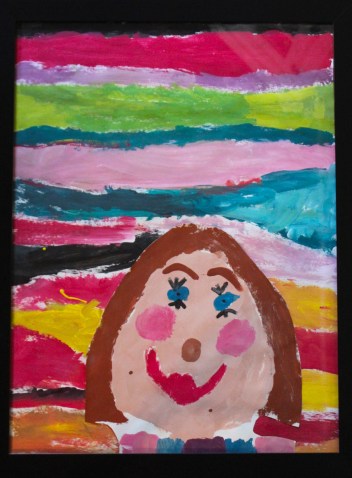
Preschool self-portrait by the little girl, now a woman on the move to heal our world,
who makes me a better person:
 Excursions